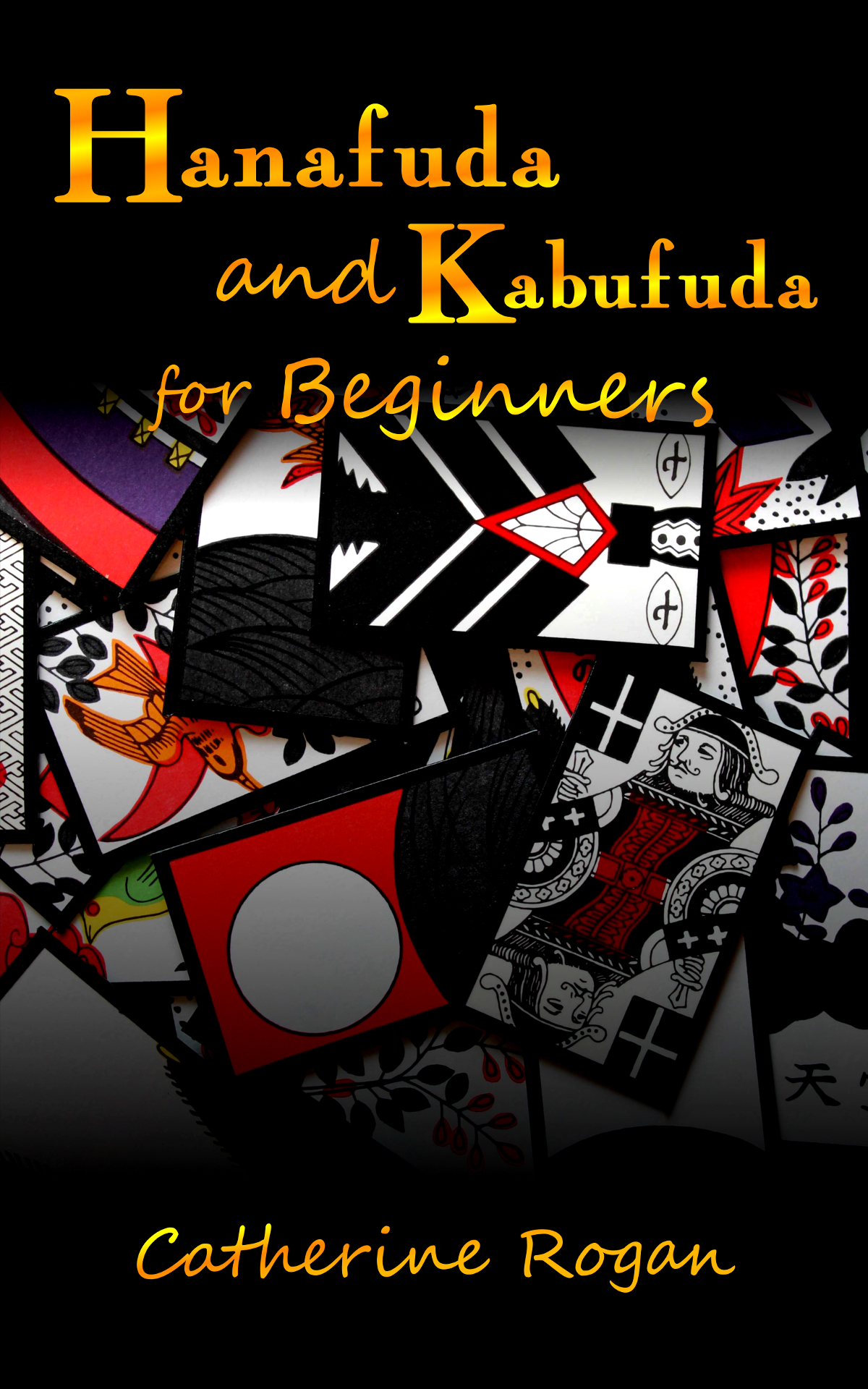
Woking Writers’ Circle member Catherine Rogan has written a non-fiction book about Hanafuda, the Japanese playing cards. She tells us what inspired the book and a bit about the games.
“I first came across Hanafuda (flower) cards in a Nintendo DS game. This had a version of Koi Koi, one of the capture games which can be played with the cards. At first I was bewildered, but after a few rounds of randomly poking at the screen, I began to get into the rhythm of the game and so spot the matching cards.

“In the main, games played with a Hanafuda deck involve matching cards by month (identified by a plant) and collecting combinations of cards that give you a scoring bonus. Rather like learning the Japanese alphabet, a large part of the learning curve is the visual difference between the cards and European cards. However once you have learnt to recognise the different flowers and animals on the strikingly attractive cards, the games are a lot easier to play that they first appear.
“Having bought myself a pack of Hanafuda cards (they are available from Amazon) I set about trying to teach my partner to play. I quickly realised that the game is a lot easier when the computer is highlighting your choice of matches, and keeping track of your sets. Once we had played a few rounds, though, he was beginning to get the hang of it. I found the rules for other games on the internet. I brought the cards on a caravanning holiday but with no mobile signal in rural Wales I had to print off various webpages and lists of hands. I did find a book on the internet, but it concentrated on a game called Hachi-Hachi (88) which is extremely complex and tactical. What I wanted was a guide that could be used to teach the family how to play some simple games.

“While Koi Koi and is one of the most popular Hanafuda games, there are many other games you can play with the deck. I have stuck to the more straightforward games, the ones that beginners can pick up and enjoy. The games are from Japan, Korea and Hawaii and there are several different styles of play. Capture games are about picking up cards and making combinations, Poka games are about getting rid of your hand. There are some Kabufuda games – these can be played with a special deck but equally you could use a Hanafuda deck or a European deck with the face cards removed. Kabufuda cards are numbered 1-10 and are used for blackjack style games. Kabufuda cards are harder to find than Hanafuda, but I got some from eBay.

“As well as some of the more simple traditional games, this book has some Solitaire games for one and I’ve also included a couple of traditional European children’s games at the end. These are good for younger children, and for getting used to the cards.
“The book would be a great Christmas gift for an older child, or anyone who enjoys card or board games and wants to try something new. It is available from Amazon.”


 CARLA SCARANO D’ANTONIO writes: I am an Italian teacher; poet; short story writer; and painter. I moved to England (Lancashire, then Surrey) in 2007 from Rome and started attending creative writing courses. I obtained a degree of Master of Arts in Creative Writing with Merit at Lancaster University in October 2012. I live in Chobham and teach as a tutor in the Surrey area. I won first prize with Keith Lander in the John Dryden Translation Competition 2016 for translation of some poems by Eugenio Montale. I also contribute as an editor at large to The Blue Nib magazine and as a reviewer for London Grip, Write Out Loud, South, The High Window, Woking Writers Circle website and The Temz review. I read my work at poetry events around the country. I attend the Woking Stanza poetry group and Woking Writers Circle as well as being a member of the Poetry Society and of Second Light Network for women poets. I have published work in a number of magazines and anthologies, and self-published my poetry pamphlet A Winding Road. I also write the blog carlascarano.blogspot.co.uk/ where I publish recipes, my art work, travel journals and opinions. I am currently working on a PhD on Margaret Atwood’s work at the University of Reading. Website:



 hort stories won the April 2014 Freelance Market News competition and was published in a subsequent issue. Having seen a request for freelance writers, in Freelance Market News, from the editor of the En Vie fashion ezine, I was commissioned to write several flash fiction pieces. These were published alongside the fashion shots around which I was asked to plot each tale. Another new experience was seeing each one translated into several languages. My website is under construction.

 SHAUN ATTWOOD is a former stock-market millionaire and Ecstasy supplier turned public speaker, author and activist, who is banned from America for life. His story was featured on National Geographic Channel as an episode of Banged Up/Locked Up Abroad broadcast to tens of millions of viewers in over 40 countries. Shaun’s writing – smuggled out of the jail with the highest death rate in America run by the notorious Sheriff Joe Arpaio – attracted international media attention to the human rights violations: murders by guards and gang members, dead rats in the food, cockroaches crawling in his ears at nights.While incarcerated, Shaun was forced to reappraise his life. He read over 1,000 books in just under six years. By studying original texts in psychology and philosophy, he sought to better understand himself and his past behaviour. He credits books as being the lifeblood of his rehabilitation. Shaun now tells his story to schools to put young people off drugs and crime. He campaigns against injustice via his books and blog, Jon’s Jail Journal. He has appeared on the BBC, SKY, CNN and TV worldwide talking about issues affecting human rights. Website:

 Pyrford TV Arts, the online TV station that staunchly supports local creativity, has turned its attention to another member of Woking Writers Circle. After interviews with Amanda Briggs and Alan Dale, this year it featured Greg Freeman’s poetry collection Trainspotters in a seven-minute


 often away, talking to student audiences across the UK and Europe about his jail experience and the consequences he faced after getting involved in drugs and crime. He has appeared on TV worldwide, speaking about issues affecting prisoners’ rights. His writing, smuggled out of a jail in Arizona with the highest death rate in America, turned the spotlight on conditions there: dead rats in the food, cockroaches in his ears at night, murders by guards and gang members. Shaun recently co-hosted Prison Night on Channel 4, a countdown of the top 10 prison movies as voted by UK prisoners – his fellow hosts were other ex-inmates. His story,