Category: Liz lennie

  • Member Spotlight: Liz Lennie

    Member Spotlight: Liz Lennie

    We caught up with Liz, one of our longest standing members, and discussed most things that keep her coming back to the Writers Circle.

    Liz joined the Woking Writers circle in 1998 after reading for a local writing group in our local library which she describes as ‘the most excellent, the best in Surrey’ while reminiscing on how there was no online information in those days. She recalls the format of a meeting being much as it is today, with news about writing (including any personal successes) followed by reading out new work for feedback. Sometimes a creative writing exercise was imposed but little time is available now for that in order to spend more minutes on reading the work. A homework topic is always suggested (the prerogative of the volunteer Chairperson of the evening) but no one has to do it.

    Over the years the number of members has fluctuated as now. Occasionally so many people turned up that feedback had to be restricted. On other days only one person turned up, such as a wife of a member bringing homework from a husband who was seriously ill in hospital. Motivation is one of our strong points.

    One thing she appreciated about the Circle is that members can volunteer for ‘jobs’ for each monthly meeting, including bringing refreshments and taking minutes (which are then emailed to everyone swiftly afterwards). Liz used to have to write them by hand (as she does all her creative words) but now prefers to bring milk and biscuits while others bring wine and spontaneous treats for the break in readings.

    Liz is currently working on two novels: Cereal Killer and Letters from the Wall (Hadrian’s Wall, Northumberland, 130 AD). After articles, short stories about holidays abroad and the odd poem that gripped her (from dancing to dementia), she now loves penning mostly short poems to fit in with her busy life. She has just self-published her first book, ‘Images: Water Gardens’ which she describes as a ‘beautiful pocket-sized collection of 10 haiku about nature and emotion’ based on a walk around the lovely Gertrude Jekyll gardens and idyllic grounds of Tylney Hall in Hampshire. Liz always has a few copies in her capacious handbag and can post 1 or 2 copies on request. Her book can also be found on the poetry shelves at Woking independent Lionsheart Bookshop.

    What keeps Liz coming to the WWC meetings, which she has seldom ever missed is the togetherness and support, great work and socialising over refreshments. She says, ‘the monthly reading meetings on the 3rd Thursday is always a highlight of my months and you can always contact a fellow member for further discussion’.  

  • Ciao, Carla: remembering an evening of poetry, warmth and friendship

    Ciao, Carla: remembering an evening of poetry, warmth and friendship

    LIZ LENNIE recruited Carla Scarano D’Antonio to join Woking Writers Circle. Here she recalls a memorable evening – Carla’s online launch of her ‘Workwear’ collection – a month before she died

    On Friday 10 February, 2023 I was one of many poets invited to the Zoom launch of ‘Workwear’; Carla’s latest collection. Below my iPad screen was my notebook and herewith are some of the words I scribbled as I listened.

                It was a very full and high quality programme in two parts, each consisting of an introduction, a reading of original poems by Carla and then by her guests. Greg Freeman introduced Carla, covering her wide-ranging talents as a poet, reviewer, painter and producer of crafts and cards, her impressive academic record and her participation in groups, workshops, courses and competitions – and her publications, many and varied. He then focused on her new collection and her capture, in her second language of English, of life and landscapes at home and abroad – from close-ups on family and food to memories and “muffled arguments from other rooms.” He concluded with a comment on her “superlative energy and real craft”.

                After thanking Greg, Carla proudly acknowledged her daughter Irene as the painter of the colourful front cover. She then read a few poems, which I particularly enjoyed for their directness and visual imagery – including colour (especially blues)!

                One piece struck me as unusual for Carla. It was a prose poem written in response to a workshop prompt, ‘Who do you think you are?’ After pyjamas, teeth and dieting (guilty pleasures such as a tiny slice of cake) she mentioned various aspects of ageing and health ranging from the menopause to the moon. She added that she needed to check stress levels at the end of the week. I must add something here. If you want an answer to the question asked by Rodney later (in part 2 of the launch) as to what it was like to be Carla, reread the last line of this revealing poem.

                Despite my imperfect memory, the simplicity of her lines often sticks in it, for example: “I was pregnant. I was full.” And something about a traumatic, intimate examination by a gynaecologist prof and students? Carla could be powerfully visceral as well as powerfully tender. She still felt the baby “float”.

                Greg thanked her for her poetry in the first half, calling it “a sheer delight”. After the first open mic and a break, Rodney Wood took over as compere for the second half. He’d witnessed Carla’s work ethic for years and reminded us of the arduous nature of putting a book together and how she had also recently volunteered to organise Woking Stanza and the live sessions of Write Out Loud Woking at the Lightbox. Carla then seized the opportunity to say that what motivated her more than publication was contact with people. She added: “It’s not ambition. It’s creativity.”

                Her first poem was dedicated to her son, Francesco. On his moving away from a loving family to teach maths to underprivileged children in Newcastle-upon-Tyne, she’d simply told him: “It will make you rich.” Having served seven years in my first job at a tough school in that city, I know what she meant. An elderly colleague still needed to cheer us as every week ended with TGIF (Thank God it’s Friday)! And isn’t “rich” a good word for Carla’s life and poetry?

                To my report I must add two other things. The first is her stating that reading Margaret Atwood changed her life. An accolade typical of the generosity of Carla Scarano D’Antonio. The second is more personal. When Carla read aloud for us, as always, I enjoyed her charming Italian pronunciation of a few English words. My favourite of the evening was “looshius” for “luscious”. And what a way to describe her poetry and her home-made cakes!

                After all this came another open mic and Carla thanking everyone for their support with her usual courtesy, saying how much she had learned from us.

                As people left the Zoom, always unsure of whether I was muted or not, I heard myself saying “Ciao!”

                Ciao, Carla.

  • Cats with fewer than nine lives … or how Liz Lennie got a disappointing reply from Enid Blyton

    Cats with fewer than nine lives … or how Liz Lennie got a disappointing reply from Enid Blyton

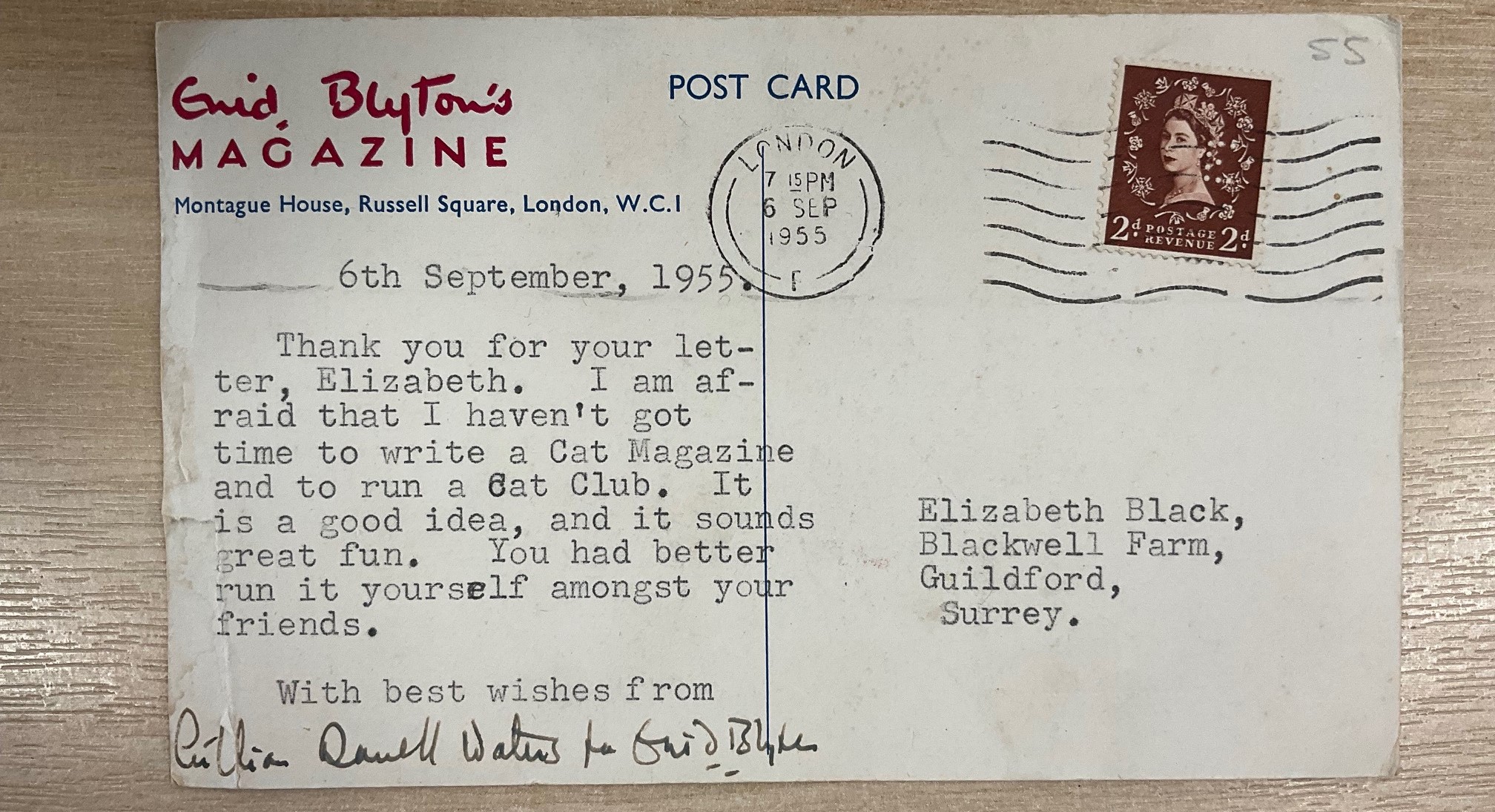
    Woking Writers Circle member Liz Lennie’s current creative interest is in ‘life writing’. She recently discovered a rather dismissive postcard reply from Enid Blyton’s assistant, who also gets Liz’s surname wrong, after she had written to the popular children’s author from boarding school in the 1950s. Here she re-imagines her original letter, which also contains insights into her childhood living on a Surrey farm. She asks – in vain – that Enid Blyton start a cat club for cat lovers. In her letter she also tells how cats are not so loved down on the farm …     

    A LETTER TO ENID BLYTON,  SEPTEMBER 1955.

    (Reimagined on rediscovering, in June 2022, the somewhat formal postcard reply from her assistant).

    Dear Mrs. Blyton,

                I hope you are well. I am writing to you from school. I have just become a termly boarder and on Sunday after church we are allowed to write letters until lunchtime. I have done my letter to Mummy and Daddy at home at Blackwell Farm and Matron says it is so good that she is going to show it to The Head Mistress and that she likes my idea of writing to you.

                At home I have no one to play with because my three sisters are all young. We are three years apart; Mummy says that is the right gap. So, in the holidays I read a lot of books. One week I read eight!

                I like yours very much because the girls as well as the boys have adventures and a pet dog as well as their own ponies. My pony is from Dartmoor and is called Tiptoes, Tippy for short. Sometimes she bites or kicks, but not often.

                Our cows are lovely and brown and white and they give lots of lovely warm, creamy milk. Every year there is a different letter of the alphabet to begin their names, which we girls get to choose. The cow with my name is a kicker so Tom has to be careful when he puts on the teat cups.

                Also my sisters and I each get a kitten of their own and can give it a name. My cat, Peter, was black and white. Mummy just wrote to tell me he died. I was crying a bit in prayers but I don’t think anyone noticed.

                I cannot even count the outside cats. They live somewhere in the buildings. They are all tabby and very skinny, and they hiss and spit at you if you try to stroke them. Worse than that, there is always a great big pot of fish bones simmering away on the kitchen stove that the village fish man gives Mummy for nothing. It smells disgusting but Mummy says we have to feed them a bit as they are so good at killing the rats. But they do have too many kittens which we have to find as soon as possible so that Len can take them away and drown them.

                We have seven men. Walt is the oldest and he can’t even write his own name. He just puts an X. Once he told me he was going to string the cats up by their necks on the washing line. I think he just wanted to make me cry. One day, when I’m a famous writer I can put that idea in a story. I did begin it under the desk one day in English when the lesson was boring.

                I should tell you why I am writing to you for help. I wonder if you could start a cat club for cat-lovers, with a magazine and competitions for stories, poems and pictures. I am sure that children like me would really like that.

                                                    Love from

                                                                Elizabeth Brock

    Liz Lennie at a recent poetry reading at the Lightbox art gallery cafe in Woking
  • Liz Lennie makes waves in Woking News & Mail with article and haiku

    Liz Lennie makes waves in Woking News & Mail with article and haiku

    Liz Lennie water lilies

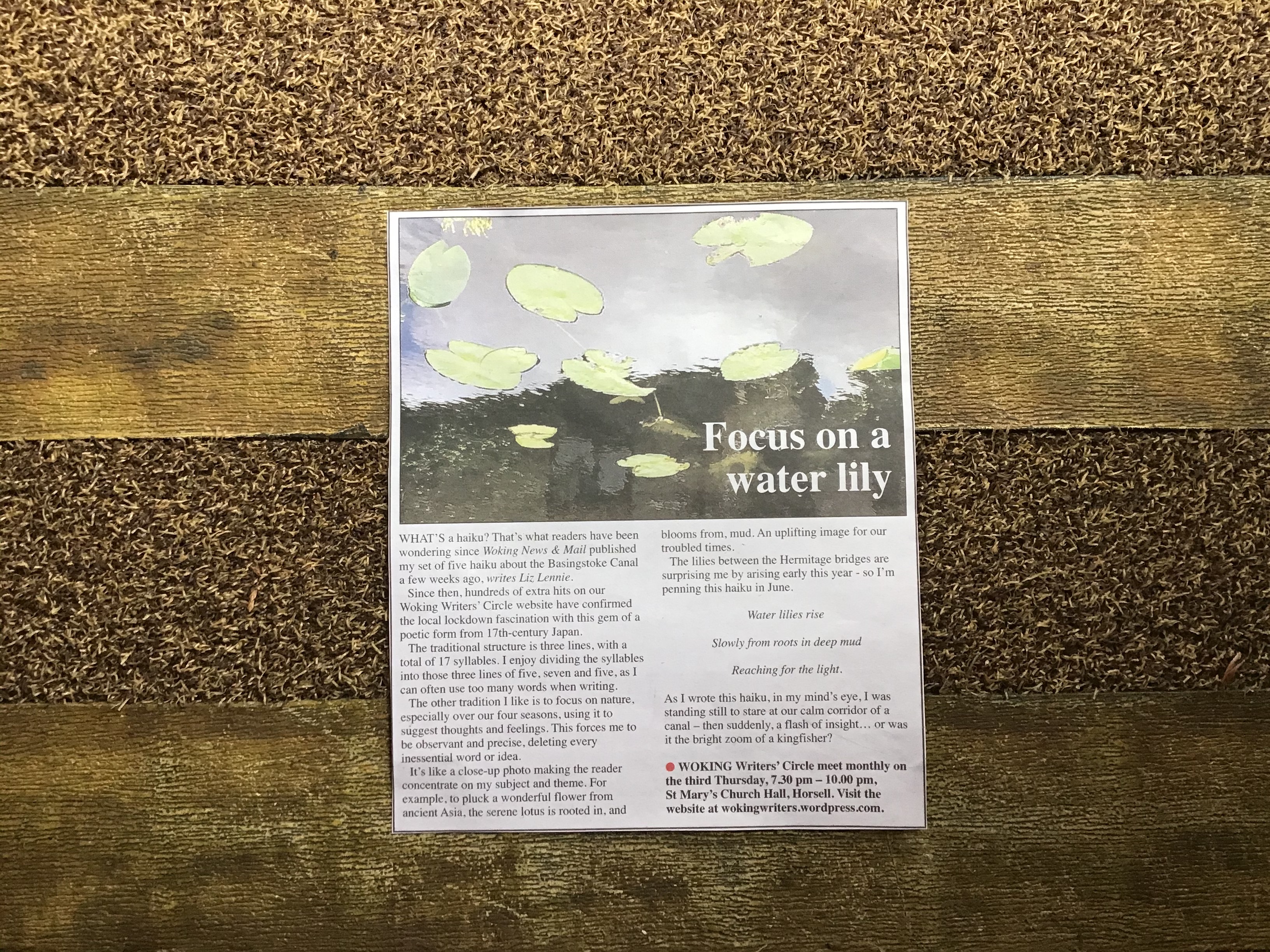
    Woking Writers Circle’s longest-serving member Liz Lennie has been making waves in our local newspaper, the Woking News and Mail, with her haiku inspired by our local waterway. Following the publication of Liz’s five haiku about her lockdown walks along the Basingstoke canal near her home in St John’s, the newspaper republished them on its Letters page. It has now gone further and published an article by Liz about haiku in its 29 June edition, also on its Letter page. This is Liz’s article, headed ‘Focus on a water lily’:

    “What’s a haiku? That’s what readers have been wondering since Woking News and Mail published my set of five haiku about the Basingstoke Canal a few weeks ago, writes Liz Lennie. Since then, hundreds of extra hits on our Woking Writers Circle website have confirmed the local lockdown fascination with this gem of a poetic form from 17th-century Japan.

    The traditional structure is three lines, with a total of 17 syllables. I enjoy dividing the syllables into those three lines, of five, seven and five, as I can often use too many words when writing.

    The other tradition I like to focus on is Nature, especially over our four seasons, using it to suggest thoughts and feelings. This forces me to be observant and precise, deleting every inessential word or idea.

    It’s like a close-up photo making the reader concentrate on my subject and theme. For example, to pluck a wonderful flower from ancient Asia, the serene lotus is rooted in, and blooms from, mud. An uplifting image for our troubled times.

    The lilies between the Hermitage bridges are surprising me by arising early this year – so I’m penning this haiku in June.


    Water lilies rise

    Slowly from roots in deep mud

    Reaching for the light.


    As I wrote this haiku, in my mind’s eye, I was standing still to stare at our calm corridor of a canal – then suddenly, a flash of insight … or was it the bright zoom of a kingfisher?”


    Liz Lennie haiku article 2


  • A Set of Five Haiku: On The Basingstoke Canal

    A Set of Five Haiku: On The Basingstoke Canal

    by Liz Lennie 


    At our second Zoom meeting on Thursday 30 April Liz Lennie read these haiku, which were inspired by walking along the Basingstoke Canal with her husband Robin for exercise during lockdown. Here they are, with pictures from Liz as well. 


    Waking to birdsong,

    Walkers talk, a distant train.

    I listen, alone.


    Liz Lennie haiku no 1


    Along the canal

    My walking meditation –

    From movement to mind.


    Liz Lennie haiku no 3


    Borage blooms, blue stars,

    Leaves point like soft spears

    As spring warms the soil.


    Liz Ldennie haiku wild garlic


    Wild garlic revives

    The smell and taste of childhood

    Wanderings alone.


    Liz Lennie haiku no 5


    The garden, evening.

    Old backs bend to rake dead leaves,

    Clear space for spring growth.


  • Cherry blossom time: how WWC members bloomed in response to a homework theme

    Cherry blossom time: how WWC members bloomed in response to a homework theme

    cherry blossom carla

    Each month members of Woking Writers Circle respond to a “homework” subject set the previous month by producing a piece of work with the subject as the theme. Some more than others, it has to be said. It’s not compulsory, of course! But in April Carla Scarano D’Antonio’s offerings on haiku and the Japanese haiku master Basho inspired the homework theme of “cherry blossom”, one of Japan’s national symbols. And that in turn resulted in a remarkable amount of work read out at our May meeting. So much so, that we thought we’d like to share the results on our website.


    The first poem is by Carla herself. Although she did not read it out at May’s meeting, it does mention cherry blossom. Carla says: “It is a sequence I was working on for a while and completed at a workshop with Jean Sprackland at the Poetry School a few weeks ago. She gave us a map (mine was from north Devon) and told us to choose some landmarks and write about it in a sort of journey.”


    MENTAL MAPPING, LANDMARKS

    by Carla Scarano D’Antonio


    Locked crocuses, blade petals

    Lower Slade stretching

    in the frost.


    Daffodil bulbs

    in Homebase plastic nets

    crave for the moon.


    Purple and white hyacinths

    in flower pots

    along the rage of the pool.


    Holiday Village hosts

    scarlet camellia bush,

    unreliable desire.


    Fanciful magnolia tree

    rooted at the Industrial Estate

    like a scarecrow.


    Wisteria grips

    at the Green Park Farm walls,

    starving love.


    Antique hawthorn

    snow flakes freezing in the sun

    frogs chanting in the Moor.


    Lee Hills melting in rain

    cherry blossoms

    fading in glory.


    The violated rose bush

    grew wider at Ilfracombe College,

    its perfume thicker.


    Higher Slade paved with

    chemical blue hydrangea

    rainbow colours.


    Tricia Mcnamee’s ‘Cherry Blossom/Broken Hearts’ comes in two versions. Both comprise four haiku plus a final couplet. The phrase ‘mono no aware’ – a sensitivity to ephemera – features in both.


    CHERRY BLOSSOMS/BROKEN HEARTS (1)

    by Tricia Mcnamee


    Song of young Japan

    Winter Sakura, flowering

    Painted on war planes


    Drunk, toxicity

    Blooms like life ephemeral

    Kamikaze flights


    Nepal to Iran

    Exquisite beauty rises

    As warriors fall


    Karmic cherry blossom clouds

    Abundant petals tinged pink

    Mono no aware


    As the seasons set apart

    Tree that stole a nation’s heart


    ‘Mono no aware’ is a Japanese term for a sensitivity to ephemera, and the awareness of impermanence


    CHERRY BLOSSOMS/BROKEN HEARTS (2)

    by Tricia Mcnamee


    Karmic cherry blossom clouds

    Abundant petals tinged pink

    Painted on war planes


    Drink, eat like green tea

    Blooms ephemeral as life

    Kamikaze flights


    Nepal to Iran

    Exquisite beauty rises

    As warriors fall


    Song of young Japan

    Winter Sakura, weeping

    Mono no aware


    As the seasons cycle starts

    Women folk with broken hearts


    Greg Freeman’s poem also mentions kamikaze pilots. There are also references to Cherry Blossom shoe polish in the shining boots of first world war soldiers and the rough leather of the GIs’ boots, to which the Americans attributed their lack of success at impressing Japanese girls.


    cherry blossom 3CHERRY BLOSSOM

    by Greg Freeman


    Unknown soldier abandoned in the mud

    and blood; his boots, miraculously,

    still gleaming. Leather guarded

    against weather. Demand

    blossomed on the western front.


    Boots on the ground. GIs found

    that Tokyo girls they took a shine

    to weren’t swept off their feet.

    Blamed their lack of polish,

    their rough, scuffed look.


    But it was much, much more than that,

    not just what it said on the tin, its

    fish-plate opener, the superficial sheen.

    Occupying Japanese soldiers

    often planted cherry trees.


    Temperate zone of the northern

    hemisphere. Drinking sake under

    the branches. Militaristic plotters

    assumed the name. Suicidal pilots

    painted them on the sides of planes.


    The blossoms symbolised clouds

    in a nation’s culture. O, what

    a cloud. And such brightness.

    Just shadows left on walls.

    The ephemerality of lives.


    Heather Cook has two poems relating to the cherry blossom theme. The first, ‘Cherry Blossom’, seeks to capture a fleeting memory of her mother sitting under cherry trees. The second poem, ‘The Virgin of El Panecillo’, tells of tourists visiting a huge aluminium statue above Quito and being disenchanted. The statue was upstaged by a man polishing shoes – you’ve guessed – with Cherry Blossom polish!


    CHERRY BLOSSOM

     by Heather Cook


    I leave her sitting on the bench,

    small and fragile in her floral dress.

    Above her head the blossom froths,

    releasing petals in confetti drifts.

    She’d wanted me to go,

    but as I climb the hill

    I sense her worrying,

    her thin hands fluttering.

    I wave. For moments all I see

    Is blossom, pale and shifting,

    but then a doll’s hand lifts;

    I cannot see her face,

    but know she’s smiling.

    A sense of endings overwhelms

    and I return, to gather memories

    while there’s time.


    THE VIRGIN OF EL PANECILLO –

    A WOMAN CLOTHED WITH THE SUN

    by Heather Cook


    cherry blossom 5Coaches click, tick and cool by dusty trees.

    We have been disgorged to seek the Virgin

    and be back by twelve.

    Up close, the woman clothed with the sun

    cannot be seen, cannot be understood.

    Our guide is fraught: we must not stray;

    we must stay in our groups.

    She flares at rivals, waves them off:

    ‘Only blue stickers! You are stickered red!’

    We are blue stickered. There is comfort in belonging.

    Unable to see more than the snake the Virgin treads on,

    attention wanders; splinter groups rebel

    and shuffle off in search of plastic Virgins.

    Below, in leafy shade, an old man polishes shoes,

    watched by a boy and a sandy dog.

    The man’s hand moves in slow circles,

    massaging the leather; he spits, buffs, smiles.

    He has no teeth.

    ‘Best Cherry Blossom!’ he calls, ‘best in the world!’

    Sun strikes the dancing Virgin

    and the sky flashes. It’s five to twelve.


    Liz Lennie used an intriguing approach at our WWC meeting, writing individual lines of a poem, ‘Sakura for Carla’, on separate strips of paper. These were handed out and put together in different configurations by those present. Each line contained a complete thought, so each poem ‘worked’. This is Liz’s own version:


    SAKURA

    by Liz Lennie

    for Carla


    Cherry blossom time!

    Bare twigs burst with bright bloom

    My heart lifts – and flies


    Petals fall, my thoughts rise

    And I write in gratitude

    For life and for love


    These words, me to you

    Ripple over a deep pool

    To reach every shore


    Alan Dale’s short story ‘Signed Off’ features cherry trees and a couple under threat from bailiffs. There is humour  but also sadness in this story.


    SIGNED OFF

    by Alan Dale


    “They look lovely at this time of year, don’t they?” Stifling a sob, Jill glanced at Matt.

    “I know, love.”

    They contemplated the rows of cherry trees, their trunks beckoning, like ballerinas’ legs, under a wind-teased billowing of pink.

    Matt sighed, placing a hirsute, brawny arm around her shoulders. “We did our best, love. We can’t sell cherries at Stoughton’s new price and they’re the only important customer now, ‘cos of the volume they take.”

    “Matt, I feel those trees are calling to us. It’s as if they know what’s going to happen to them, once we’ve gone.”

    “Folk’ve got to live somewhere. I’d do anything to stop all this, but…”

    Gravel scrunched, tyres squealed, a car door clumped. Rapid footfalls pounded. The kitchen door exploded open.

    “Liam – we weren’t expecting you ‘till Thursday,” said Matt. Everything OK?” Liam opened his mouth to reply, saw his mother’s devastated expression and swallowed. Matt felt the silence smothering them all.

    “I’m OK,” said Liam quietly,  “and once you’ve heard this, both of you will be – trust me.”

    “Go, on,” said Matt.

    “I’ve found a company who’ll give you a loan, keep you afloat and sort the debts.”

    Matt and Jill gaped at each other.

    “Guy I work with, on the equities desk – turns out his uncle’s a director of Fructigro.”

    “Isn’t that one of the big agribusiness outfits?” said Matt. His wife grimaced.

    “No, Dad, you’re thinking of Futurecitrus. They’re massive, but Fructigro’s a relatively small company – they’re growers, like you. Anyway, we talked and I explained, without going into too much detail, if you get my drift, where you were, financially. Now, what they need is a reliable source of really class, established rootstock, for grafting. Bottom line – you let them have grafting stock, you get the loan. I mentioned the sum you’ve both been after – no problem.”

    “Thanks, son. I really appreciate that.” Matt gulped. “I know we haven’t always seen eye to eye, since you chose the city rather than following me, here.”

    “Forget it.” Liam shrugged.

    “When can I meet their boss, to discuss details, so we could sign up to this?”

    “He’s in Hawaii for three weeks. I could fix something after that.”

    “Yeah, the only thing is, I really ought to…”

    “Matt, the bailiffs’ll be here at eight o’clock tomorrow.” Jill’s face was becoming crimson. “For God’s sake, think. Someone must be able to deal with this, if he’s away.”

    “Give me five with Rupert, Dad.” Liam was already jabbing at his phone. “Rupes – Liam – how goes it? Did she – told you, didn’t I? They always go for that. About this Fructigro thing – it’s now balls out, mega urgent, yeah?”

    Gill winced. Matt gave a spluttering snigger.

    “Right, email me the contract and declaration, he’ll sign and give bank details. I’ll scan and patch it straight back. No they haven’t. Don’t go there, mate, OK? And could you then get Tobes to transfer the cash, so’s they can stall these bastards off? Top man. Go.” He hung up, grinning at his parents.

    “All sorted – Dad, you sign and include your bank details, you’ll have the cash in the morning. You can tell the bailiffs its coming and stall them.”

    “Matt, do you think we should give these people our bank details like that – email’s not secure, is it?” Jill had calmed to a cherry red, but her brows were drawn right down, a sign Matt recognised from years of marriage.

    “You said think – I think we’ve no choice.” He turned to Liam. “Thank you, son. What was that declaration I heard you mention?”

    “Oh, all that says is ‘we only supply traceable British products, cultivated for Fructgro’.” Liam shrugged.

    “You know what these lawyers are like – still, it looks good and covers you, I guess.”

    “Oh, I see – that’s OK, isn’t it?” said Jill, looking up at Matt.

    “Yes, that’s fine. It’ll be true, so no harm done, far as I can see.”

    *

    A week passed, in which the bailiffs were dealt with, while creditors were mollified. The following Monday, a van and lorry arrived, as arranged. Several men got out and unloaded hacksaws, gloves and various other tools. Matt greeted the florid, portly foreman, and led them all into the orchard, to take their first grafting cuttings. Matt noticed that they all wore jackets with a cherry tree logo, but no wording. He went back indoors, glad of a chance to sit down. Several hours later, their laden lorry had departed.

    *

    That weekend, he and Gill went away for a weekend break. “Let’s have a walk over that field – look, there’s a public footpath,” said Matt. Woods to their right led to a chain link fence.

    Matt stopped in his tracks. A path led off the main track, to a set of high, barbed wire-topped gates. A huge cherry tree logo, identical to those on the visiting Fructigro staff’s jackets crowned one of the extensive, white concrete buildings that stretched away into the distance.

    “What the hell?” muttered Matt.

    “Oh, my God,” whispered Jill.

    “What?”

    “That logo…”

    “Yes, I noticed that – the men wore it, the other day, didn’t they?”

    “Yes, but Matt, look, this place is huge – Liam said it was only a small company – small growers, he said, that’s right – you remember.”

    “Probably their offices and stores.”

    “I don’t think so. Look at all those glass cabinets and all that stainless steel piping in there.” Jill was breathing heavily now. “Hang on, what’s that, over there?”

    She walked over to the gate and picked up what looked to Matt like the remains of an estate agent’s ‘For Sale’ sign.

    “What’ve you got there?” he called.

    Silently, Jill turned the tattered, splintered sign board to face him.

    Fructigro Out – NO GM Cherries! he read.


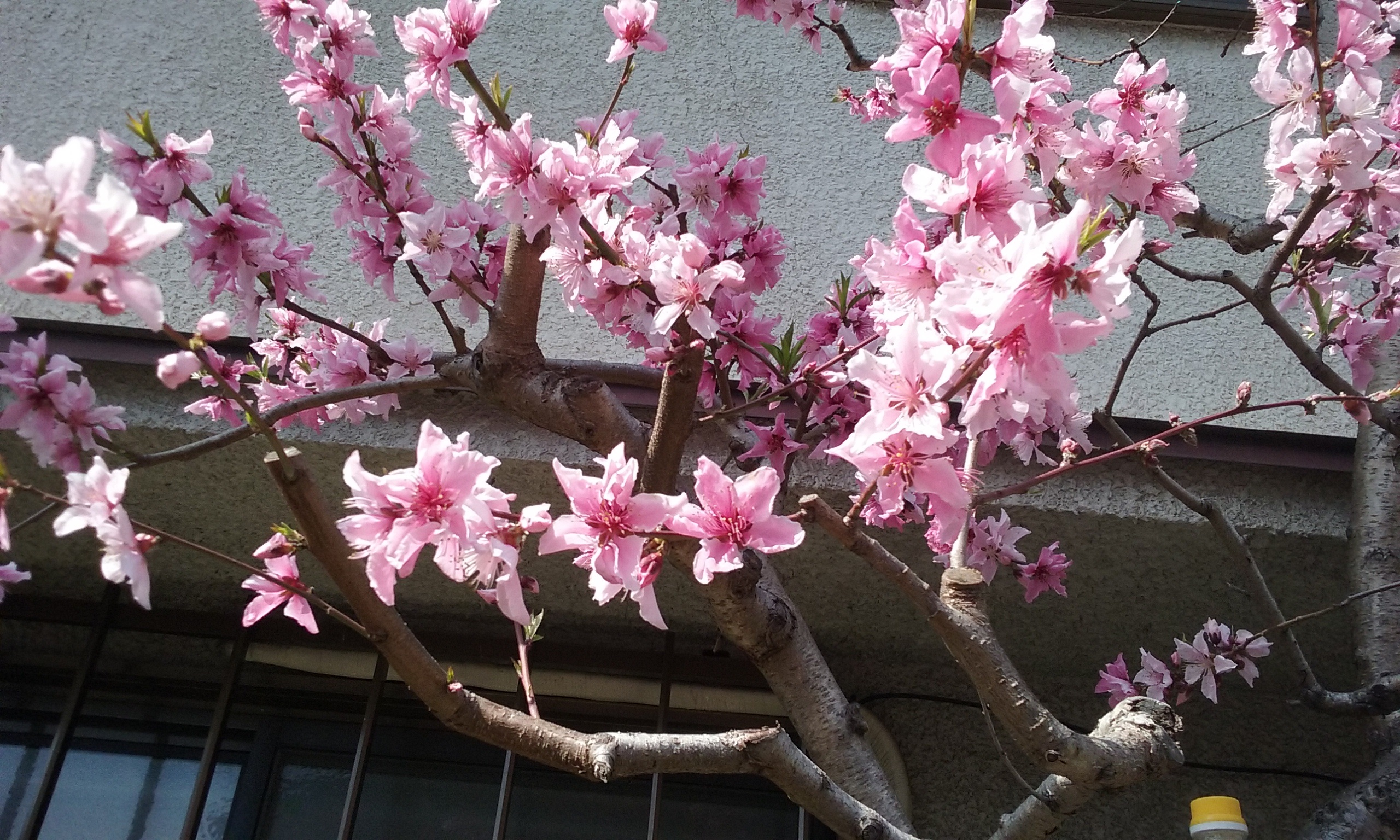
    PICTURES OF CHERRY BLOSSOM TREES BY CARLA SCARANO D’ANTONIO


    Copyright remains with the authors


  • Liz Lennie returns to Camberley festival with new play script reading

    WWC member Liz Lennie is appearing at Camberley International festival for the second year running with another play script reading. On Saturday 23 June at Camberley theatre’s upstairs studio in Knoll Road, from 7:30 – 9:30pm, Liz’s play Tinkler! will be scriptread in small groups and then staged as a radio performance. The play is about a spirited elderly mother faced with leaving home for ‘a home’. Disparate daughters disagree and a grandchild gets an unusual inheritance … The play lasts around 20 minutes and this script reading event will last about an hour. Please email jo.bartlett@surreyheath.gov.uk if you are interested in taking part.