Category: Negotiating Caponata

  • Renewal, and satisfying complexity: Heather Cook reviews ‘Negotiating Caponata’

    Renewal, and satisfying complexity: Heather Cook reviews ‘Negotiating Caponata’

    Carla cover 2

    Negotiating Caponata by Carla Scarano D’Antonio, Dempsey & Windle, £8 

    I didn’t so much read these poems as experience them, the precision and richness of the imagery making them a feast for the senses.

    The steadying effect of the processes involved in the preparation of food – the chopping and peeling followed by the magical connecting and melting of ingredients as the meal cooks – never settles into cosiness. There is always something more – a sometimes disturbing reference to a relationship or to the power and mysteries of the seasons and the natural world. In ‘Cooking betrayal’, the food tells a compelling story: “I was the idiot, / my pointless cake making and biscuit making / crumbling along the path, signposting my coming back home”.

    The bonds of family and the language that binds people together are themes that run through this collection. But these are not straightforward, predictable poems; in ‘Your illness’, where the poet describes the sudden onset of her father’s final illness, the last line refers to her mother “forgetting all the past beatings and the shame”, revealing that this had not been an easy marriage. ‘Flying’ conveys in just a few words the challenging nature of the relationship Carla had with her father, recognising the extent of his love for her “in spite of all the fights,/ your blows and my defiance”.

    ‘Cyclamens for my mother’ presents a vivid picture of the poet’s mother tending to the flowers on her balcony in Rome, but here again the last lines contain warning of imminent sadness: “The dead are calling you, / I’ll hold your hand walking the last steps of the journey. / The cyclamens shrink within the bulb/under soil till the new season comes.”

    Several very moving poems refer to long journeys and the need to adjust and settle in an alien environment. I particularly enjoyed ‘Grandad Ciccio and Grandma Orsola’ with its restrained but powerful description of the couple “Sitting serene like ancient Roman statues … with their first baby daughter on their lap”. They have travelled “From the south straight to the northern border”, where “their smooth dialect clashed against guttural sounds”. The closeness of the couple is conveyed with deft understatement as in “His arm touches lightly her shoulders”.

    In this poem, as in others, there is a reassuring sense of renewal and of life continuing beyond upheaval; Grandma Orsola has their baby on her lap. Even in the presence of death, the poet finds comfort in nature; in ‘Your last words’ she opens “the window to let in the mild April air” and recognises that her memory of her father lives on. There is sadness in the poem ‘Ants’ where everything is tried to avoid killing the invading ants, but in the end they have to die, “their insignificant bodies dissolving under our feet”. In this poem the circle of life is incomplete and I shared the poet’s sense of failure and regret.

    I read these poems convinced that Carla Scarano D’Antonio not only loves the human race with all its quirks, weaknesses and occasional glories; she faces up to difficult issues without inflicting glib judgments on the reader. She recognises “the importance of imperfection”, a message beautifully conveyed in ‘In touch with my daughter in Tokyo’: “The impersonal networking / warms me up, though infertile / reminds me of the importance of imperfection / in our infernal autonomy.”

    This is a wonderful collection. I thoroughly enjoyed the satisfying complexity of poems such as ‘Negotiating Caponata’, which is so much more than a recipe, and am haunted by the lingering beauty of words that most of us can only chase in dreams.

    Heather Cook
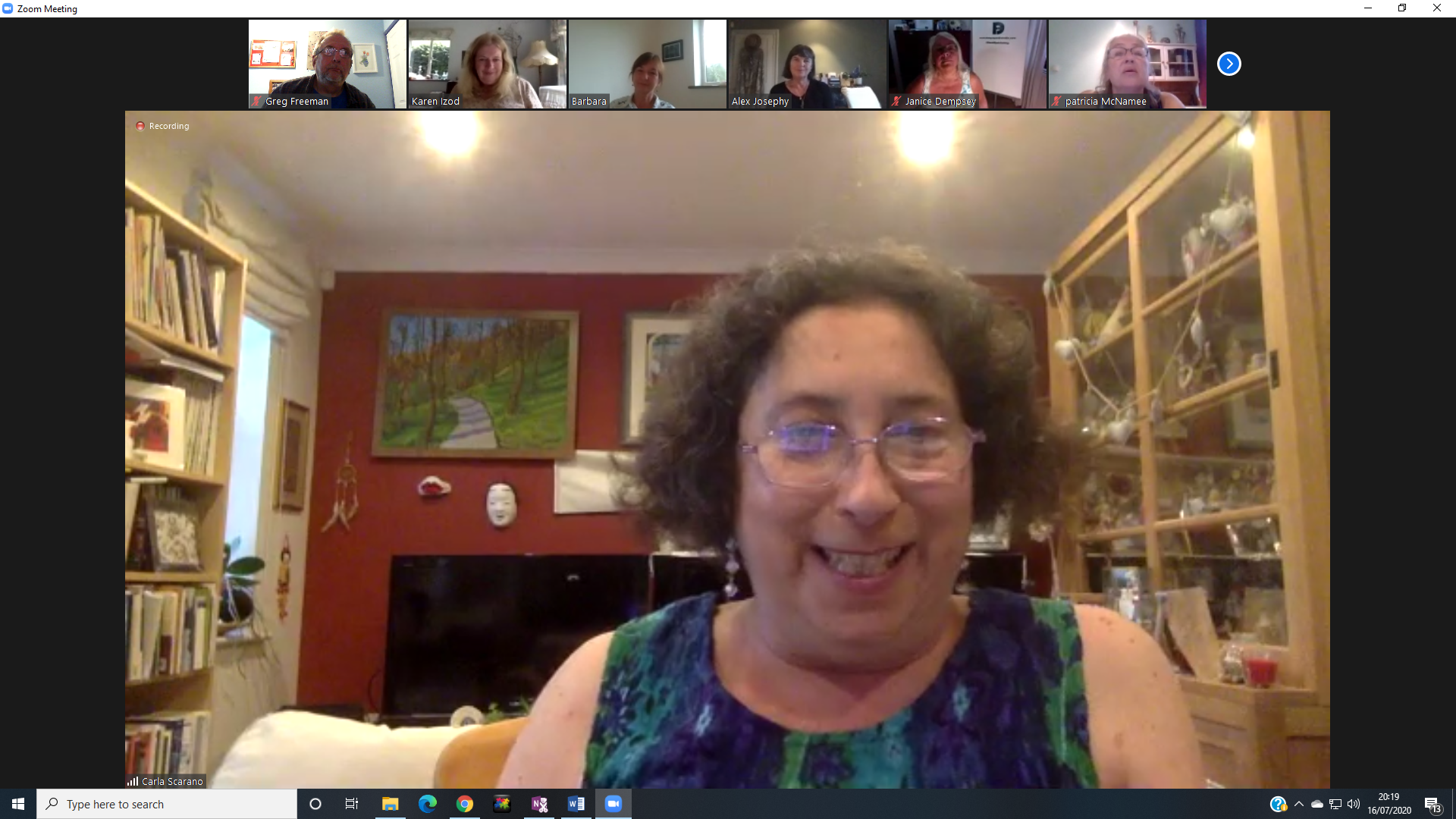
  • Carla Scarano D’Antonio launches ‘Negotiating Caponata’ poetry collection

    Carla Scarano D’Antonio launches ‘Negotiating Caponata’ poetry collection

    Carla Scarano cover

    “Food is so important in Italy for our identity. It shapes our relationships. And it is also a way to renew them.” With these words Woking Writers Circle member Carla Scarano D’Antonio introduced the launch of her short poetry collection, Negotiating Caponata, on Zoom – an occasion attended by dozens of friends, family and poets, from Italy, Canada, and even Australia.

    The event was warmly and ably hosted by Janice Dempsey, of Carla’s Guildford-based publishers Dempsey & Windle.  Carla’s collection is indeed about food, and abounds with lip-smacking recipes; but it is also about family history, a father’s final days, a mother and her cyclamens, and an acute assessment of the seasons. She had generously invited 19 poets to take part in an open-mic accompanying her reading. They included fellow WWC members Heather Cook, Liz Lennie and Greg Freeman, and a number of regulars who read at Write Out Loud Woking poetry nights. But there were also poets from the north-west of England, where Carla used to live and read her poetry before moving to the Woking area, and from Canada, which Carla has visited while pursuing her PHD research into the work of novelist and poet Margaret Atwood.

    Those Canadian poets included Josephine LoRe, whose parents are from Italy; and Pam Medland, who met Carla when she visited Calgary, and read a poem titled ‘Buffalo Jump at Calgary Olympic park’.

    North-west of England poet Keith Lander, who with Carla jointly won a poetry translation prize a few years ago, read a poem about a beach in northern Italy. Another poet Alex Josephy, who usually spends a lot of her time in Italy, has been stranded in England during lockdown. Her poem was ‘Leaving Italy’. Fellow WWC members Heather Cook and Greg Freeman contributed poems about Verona and  Bagni di Lucca respectively, while Liz Lennie gave us a series of haiku, including one sequence that she titled ‘Five-course Italian meal’, a response to Carla’s collection.

    But what of Carla’s own poems?  She gave two readings, at the beginning and end of the evening, commencing with the title poem ‘Negotiating Caponata’, a poem that appears to be about a recipe, but contains more enigmatic lines such as “The aloofness at times” and “The body has no protection / when the light dims”. Suppressed feelings are bubbling under the lid in ‘Cooking betrayal’, while ‘Farina Manitoba’ – “the land of flour” – anticipates Carla’s first trip to Canada.

    ‘Only a cake’ takes its title from a Margaret Atwood quotation, ‘Special carbonara’ has liquor as the “secret ingredient”, and ‘When I was leaving’ is a sequence of poems about the seasons. Carla said her favourite season was autumn: “I was born in November.” During Carla’s second reading we glimpsed old family pictures to assist us with poems such ‘Grandad Ciccio and Grandma Orsola’ and Mum during the war’, and heard poignant poems about her father’s final days in hospital.

    She grew up in Rome, gained two degrees at La Sapienza, the University of Rome, and moved to England about 14 years ago – first to the north-west, where she obtained an MA in creative writing at Lancaster University, and read poetry at venues such as the Spotlight in Lancaster. She moved to Surrey around six years ago, and quickly became a regular at local poetry venues. She has published her creative work and reviews in number of print and online magazines.

    She is also an artist, and you can find motifs by Carla within her collection. The attractive cover illustration, Cappuccino in Positano, is by her publisher, Janice Dempsey.

    You can order a copy of Negotiating Caponata here  

    or from Carla herself here

    You can watch Carla reading poems from Negotiating Caponata at Write Out Loud Woking’s open mic poetry night when she was the guest poet in July