Category: New Victoria theatre

  • The Nutcracker, Northern Ballet

    The Nutcracker, Northern Ballet

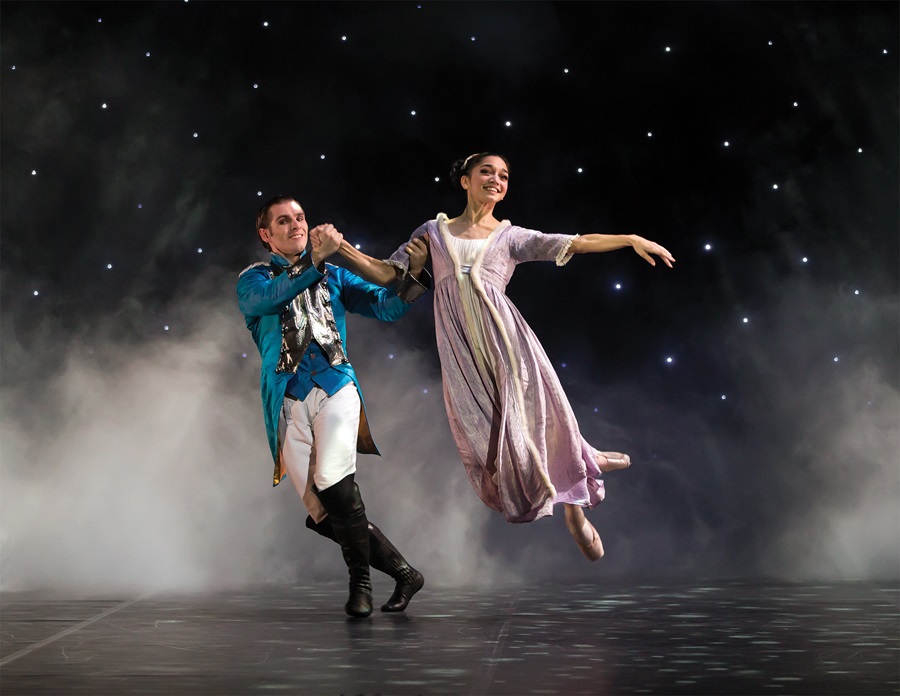
    Nutcracker 5 Ashley Dixon as the Nutcracker in The Nutcracker. Photo Emma Kauldhar (2)
    Ashley Dixon as the Nutcracker PHOTOGRAPHS: EMMA KAULDHAR

    What heralds Christmas and excites our senses more than the turning on of the town’s Christmas lights or promotions of the fun-filled pantomime season? If you’re lucky enough to catch it, it has to be Tchaikovsky’s most popular and evocative ballet, The Nutcracker. It is, without doubt, the essence of Christmas, and an experience you must have, at least once in your lifetime. It has been a staple of the Christmas tradition in the US since the 1960s, and, unlike Black Friday, is a cultural import that we can appreciate. This season, Woking is privileged to host a five-day run of the performance, performed by one of the most exciting and brilliant touring ballet companies in the country currently, the Northern Ballet. Ballet fans may remember their original production of The Great Gatsby that came to Woking a few years ago, one of the most stunning contemporary ballet performances I have seen.

    I was therefore intrigued to discover how they would interpret this extremely traditional ballet and meet the audience’s expectations, who were, on the first night, of a largely traditional age. The company’s artistic director David Nixon has said that he “wanted to create a Nutcracker that was simultaneously traditional and yet bespoke to the Northern Ballet”. In the opening scene, we see this vision. Nixon chose to set the piece and, of course, the divine costumes in the Regency period. The elegant Regency-style dances and floating costumes were definitely of the Northern Ballet’s characteristic style – informal, fluid and vibrant.

    The plot is quite phantasmagorical, making Alice in Wonderland seem pedestrian; however, that is of little consequence. The delight, excitement and awe comes from Tchaikovsky’s music, the incredible dance choreography and, yes, I’m going to mention it again, the costumes. The set is subtly rich and elegant and doesn’t dominate – centre stage is always taken up by the dancers. Although feeling a bit crowded at times, the stage was a smorgasbord of activity with multiple groups of dancers weaving and interacting.

    The first act starts with Clara and her family preparing for Christmas, when Uncle Drosselmeyer arrives with a box of exotic toys. The heroine falls in love with a gift toy, The Nutcracker, that later that evening magically comes to life and turns into a handsome prince, dragging the bemused Clara into a battle with a Mouse King and his army of mice. Again, we see Nixon’s characteristic style here. Rather than going with the conventional, slightly scary mice, he turns them into rather amusing characters, that frequently twerk their behinds to the audience. The end of the first act sees Clara and the Prince, after triumphantly defeating the Mouse King, running off through an enchanted forest, and encountering the exquisite snowflakes, dressed in stunning, glittering tutus.

    The second act finds Clara and the Prince in the land of sweets ruled by the Sugarplum Fairy, and the style reverts to the conventions of the traditional ballet. After meeting the Sugarplum Fairy and her Cavalier, superbly danced by Minju Kang and Javier Torres, the two watch a series of divertissements and the audience gets to appreciate the most well-known musical pieces of the ballet, including the fabulous pas de deux finale of the dance of the sugar plum fairy. This act differed quite clearly from the first act, reverting more to the traditional form and style of the original. We were more aware of the technical competency, strong poses and holds, and grand jetes, although some of the music seemed underused at times and synchronised moves perhaps more constrained than they could have been. Still, the show was completely enchanting, and the audience left the theatre merrily, ready now to do their Christmas shopping and get the mulled wine on the go. Bring on Christmas!

    [Amanda Briggs November 2018]

    The Northern Ballet’s The Nutcracker runs from November 27 – December 1, at the New Victoria Theatre, Woking 

    Nutcracker 3 Minju Kang as the Sugarplum Fairy in The Nutcracker. Photo Emma Kauldhar (2)
    Minju Kang as the Sugarplum Fairy in the Nutcracker
  • Jane Eyre

    Jane Eyre


    The National Theatre’s tour of Jane Eyre came to Woking last night in dazzling fashion. Directed by Sally Cookson, this imaginative staging of Charlotte Brontë’s classic 1847 novel quickly grabs you by the soul and sucks you in.

    We begin with Jane’s birth. “It’s a girl!” the cast call as actress Nadia Clifford voices the screams of her character’s infant self; the folded dress that young Jane will soon be dressed in stands in as the newborn. It’s one of the many clever uses of costume in this production.

    We follow Jane through her unhappy childhood. The set, a stark maze of ladders and walkways, becomes first Gateshead Hall, where Jane endures the cruelties of her cousins and her Aunt Reed, then Lowood school, run by the tyrannical Mr Brocklehurst (terrifyingly played by Paul Mundell). With just wooden walkways and a white backdrop, a sense of place is provided by clever lighting in the case of the Red Room, where Aunt Reed confines a terrified young Jane as a punishment, and the work of the ensemble cast who don schoolgirls’ uniforms to act as Jane’s classmates (even the magnificently-bearded Tim Delap, who later plays Rochester.) After Jane’s best friend Helen Burns (played perfectly, among four other roles, by understudy Francesca Tomlinson) dies, Jane is encumbered by the trappings of womanhood; on stage she is dressed in her corset, petticoat and sensible grey dress. She becomes a teacher at Lowood but yearns for “liberty or at least a change”. She advertises for a governess’s position and is offered a job at Thornfield Hall.

    After a carriage ride, soundtracked by the on-stage band and the chanting of the town names to give an idea of distance, Jane sees a rider thrown from his horse, accompanied by his dog. We know it’s Rochester, but she doesn’t. There is no horse, of course, Delap uses the ladders of the set to “ride”, and Pilot the dog is played by Paul Mundell. It’s a testament to his skills that not only can he switch from the despotic headmaster to the adorable dog, but that his woofing and panting get warm, not incredulous laughter. A grown man pretending to be a dog, or a schoolgirl; a man on a ladder straddling thin air – these all have the potential to be excruciating, or silly. In this production they work, because they are integral parts of the play. Pilot’s reaction to Jane in the final scene of the play make that scene. The cast voicing Jane’s inner thoughts allow her to have a dialogue with herself (in particular in my favourite scene of the book, where she tells herself to draw a harsh self-portrait in chalk, then one of Blanche Ingram in the “freshest, finest, clearest tints”.)

    Rochester leads Jane to believe he will propose to Blanche (played by Evelyn Millar), but of course it is Jane he loves. He finally proposes after a dramatic scene, where Jane gives her famous “I am no bird …” speech. Another on-stage costume change has her wedding dress and her governess dress floating before her. Of course, she chooses the wedding dress. At the wedding Rochester’s secret is revealed – he is already married to Bertha Mason. It is Bertha who set fire to Rochester’s bed, Bertha who laughs in the night, Bertha who ripped Jane’s veil in two. Bertha has been a presence from the very start of the production, singing a soundtrack in a rich mezzo-soprano. She is played by Melanie Marshall, who is magnificent. Her singing subtly narrates the action – the mad woman in the attic is the one who sees the truth.

    All of the cast other than Clifford and Marshall play multiple parts – all are brilliant. As well as Mundell’s switch from headteacher to hound, Evelyn Millar is equally at home as society beauty Blanche and handsome but repressed St John Rivers. Clifford, as Jane, and Delap, as Rochester are perfect. The production has special effects of real fire, but the flames fade in comparison to their chemistry on stage. The cast, the production, the music, the costuming, even the accents are flawless.

    In the final scene, Jane returns to the now-blind Rochester. He knows it’s someone familiar from Pilot’s reaction, but only when Jane touches his hand does he realise his love is returned to him. His sightless eyes rest on Jane as he folds a coat into the shame of a newborn baby – it’s a moment as tender and intimate as what it represents. In a mirroring of the start of the play, Rochester holds the newborn baby and declares “It’s a girl!” In the book it was a son, but it seems right and fitting here that Jane should have a daughter.

    This is a reimagining of Brontë’s masterwork which puts the book’s proto-feminist themes of freedom, self-determination and equality of women front and centre. I am a card-carrying member of the Brontë Society and have read Jane Eyre dozens of times. This production is not just the best adaptation of the book that I’ve seen, it makes me love the book even more. This is a modern Jane Eyre which takes the heart of the novel and makes it shine even more brightly.

    [Catherine Rogan 31 May 2017]

    Jane Eyre is at the New Victoria theatre, Woking  from Wednesday 31 May to Saturday 3 May at 7.15pm, with matinees on Wednesday and Saturday at 2pm.

  • Funny Girl

    Funny Girl

    PHOTOGRAPH: MANUEL HARLAN

    Funny Girl is a musical loosely based on the life of real star Fanny Brice.  Some liberties are taken with the facts but it is entertainment with a capital E and essentially remains the story of a vaudeville chorus girl who rose to become a Ziegfeld Follies star.  Along the way she met and fell head over heels in love with Nick Arnstein, a suave gambler, whom she married and with whom she had two children.

    Those are the basics of the show. But despite her total infatuation, her love was sorely tested when he was constantly away on the racetrack or playing cards when she wanted his support.  He, on the other hand, was desperate to make sufficient money so that he could stand as her equal and not have to be bankrolled by Fanny whenever he needed cash. Alas, his “no fail” plan to open a money-making casino was dashed when a hurricane destroyed the building and so he turned to crime and a dodgy Wall Street bond scam to make the fortune he longed for. He was caught out and sent to prison.  On his release, he admitted to Fanny that he had come to realise that they are not compatible and they divorce with the show ending with Fanny, left on her own, singing ‘The music that makes me dance’ – almost a soliloquy. Along with the plot come a host of exuberant musical numbers and several dance routines, most of which involve Fanny but demonstrating the talent of the chorus. Comedy is provided by Fanny’s mother and her poker-playing lady friends.

    Funny GirlNatasha J Barnes, apparently the second string for the part of Fanny, who is playing selected venues on the UK tour deputising for Sheridan Smith, nevertheless gives us a flawless performance as does Darius Campbell as Nick, pictured right.  Both of whom are well served by Joshua Lay as Eddie, her long-time mentor, and Rachel Izen as Fanny’s mother, Mrs Brice, and the rest of the cast. Michael Pavelka has produced a fitting set and Michael Mayer is to be congratulated on his direction so the show well deserved the stand-up ovation it received at the end of the performance.
    [Dermot Hoare 25 April 2017]

    Funny Girl is at the New Victoria theatre, Woking from Tuesday 25 April to Saturday 29 April at 7.30pm, with 2.30pm matinees on Thursday and Saturday

  • Million Dollar Quartet

    Million Dollar Quartet

    MDQ archive shotI am a bit of a theatre geek, but even more so I’m a music geek. If you are trying to listen to the radio and hear me say “Did you know …” you know you are about to get a lecture on what I consider to be an interesting sidenote in music history.

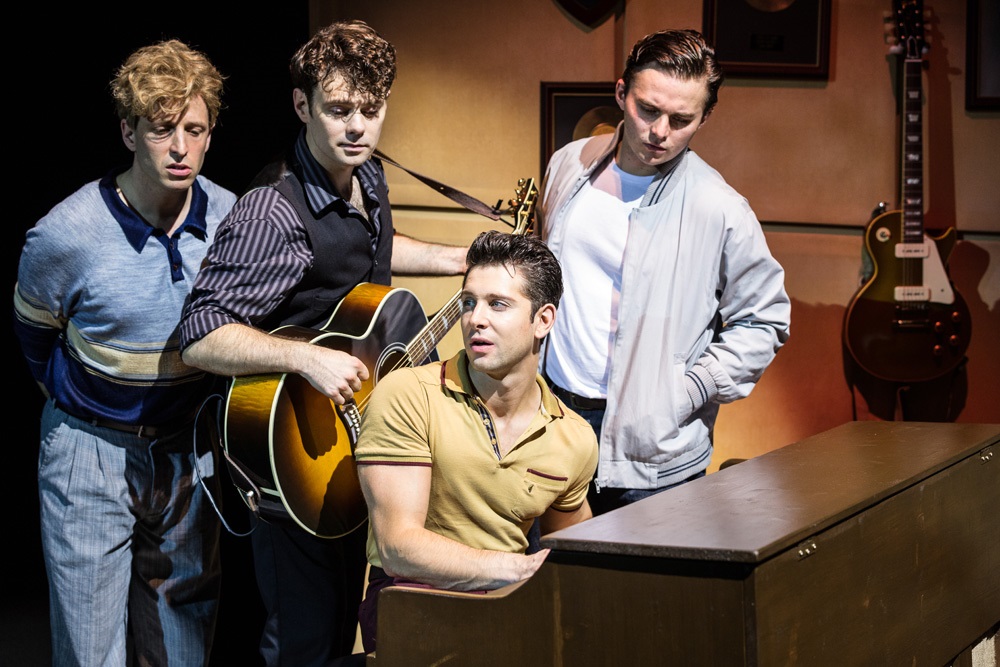
    Million Dollar Quartet tells the story of one of those interesting sidenotes in music history – in December 1956 Elvis Presley (Ross William Wild), Jerry Lee Lewis (Ashley Carruthers), Carl Perkins (Matthew Wycliffe) and Johnny Cash (Robbie Durham) all ended up in the studio at Sun Records together and spent the day messing around and jamming (see archive picture, above) . It’s not much of a story, so Floyd Mutrux and Colin Escott, who co-wrote the book, have beefed it up a bit by adding the backstories of the singers’ relationships with Sun and some drama about contracts. The trouble is it’s still not much of a story.

    The first half introduces the musicians by having them play a bit of one of their hits (Elvis’s That’s Alright Mama, Cash’s Folsom Prison Blues), then pausing for flashback to their fateful first recording, narrated by studio owner Sam Phillips (Peter Duncan) before continuing with the song. The information in the flashbacks is nothing that someone with a passing knowledge of rock ‘n’ roll, or a copy of the programme, wouldn’t know and while it’s well staged I did have to swallow the urge to shout “Get on with it!”

    The second half is more about the music, with less interruption of the songs. The conflict, such as it is, is that Sam Phillips wants Johnny Cash to sigh a new three-year contract. Unbeknownst to Phillips, Cash had already signed to Columbia. In reality, Cash didn’t sign to Columbia until 1958 and would release an album, Johnny Cash Sings the Songs That Made Him Famous with Sun, the recording of which continued long after the Quartet. The truth is (rather prosaically) he’d gone to the studio to pick up some money.  This isn’t the only fudging of facts – the real recording was mostly gospel songs, but let’s face it, we want hits.  Elvis’s girlfriend at the time was a dancer named Marilyn Evans, not a singer called Dyanne (Katie Ray), but we need someone for the high notes.  Cash is barely audible on the real recording, but it would be a crime to waste Robbie Durham’s voice.

    The music is well played and well sung, with good impersonations of Presley and Cash’s distinctive voices. At the start we are told the actors are playing their own instruments, and they clearly are. This is impressive, but does it matter? At a music gig we care that no one is hidden behind a curtain playing the tricky solos, but does it make a better theatrical experience that the guitar playing is for real? This is one of the play’s problems; it can’t decide if it’s a tribute act or a piece of theatre.

    It does conform to the Aristotelian unities of time, place and action, which is unusual in modern musical theatre. There is one set – the studio. Occasionally characters go outside, denoted by a blue spotlight and their taking their coat from a messy pile on the right of the stage and putting it on. All action takes place within a day. There are no costume changes, no dancing horses. The cast are dressed appropriately casually. It is committed to being a story about that one day, which is refreshing.

    There are some issues with the staging. People wander in and out of the studio for no apparent reason, some guy (I think he is the musical director) is sat in the studio writing notes but never referred to, and there is the messy pile of coats which (maybe it’s my inner mum) I found distracting.

    I feel like it sounds like I didn’t enjoy myself, which isn’t the case. Million Dollar Quartet is fun. There are laughs, chiefly from Carruthers’ self-aggrandising yokel Jerry Lee Lewis and his bickering with the other singers. There is acknowledgement that rock ‘n’ roll is black music, which the likes of Phillips and Presley repackaged to be palatable to white folks. On leaving many of the audience commented how much they’d enjoyed it, particularly “the last bit” – the (now obligatory) sing-a-long section. Certainly the cast can’t be faulted – they are all excellent musicians and it’s no surprise several of them are recording artists in their own right. They did the best they could with an imperfect play.

    If you like rock ‘n’ roll music you’ll like it. It you like deep storytelling then you won’t. For me it was neither fish nor fowl – not enough story for theatre, too much story to be a gig. The music geek in me likes the idea, but the theatre geek can’t love the execution.

    CAST PHOTOGRAPH: DARREN BELL

    [Catherine Rogan 29 March 2017]

    Million Dollar Quartet is at the New Victoria theatre, Woking  from Wednesday 29 March to Saturday 1 April at 7.30pm, with matinees at 2.30pm on Wednesday and Saturday

  • Shirley Valentine

    Shirley Valentine

    Shirley Valentine 1

    PHOTOGRAPHS: MANUEL HARLAN

    Expectations were varied at the New Victoria last night as the audience filed in to see the latest touring production of Willy Russell’s Shirley Valentine. Some expected a musical, recalling that the star had cut her teeth winning the singing and dancing role of Nancy for a London production of Oliver. Others assumed it would follow the lines of the film starring Pauline Collins and Tom Conti. But what we were in for was Russell’s original play and that proved to be the setting for a masterclass of a one-woman show – and what a delight in the process.

    Jodie Prenger gave us a truly believable and entertaining Shirley Valentine throughout the evening. This is one of two Russell plays in which women successfully fight against their lot in life, the other being Educating Rita, and in listening in to Shirley’s talks with her “walls” and her “rock”, her private way of release, you sense her frustration as well as her underlying determination to find something better.

    But as Shirley reviews her life we get the highs and the lows and we get a lot of comedy. Two gems that I appreciated were her son’s nativity play and her Greek boyfriend coming to collect her for a day’s fishing – but there are many more similar moments. Cleverly directed by Glen Welford and a set designed by Amy Yardley, a visit should go into your diary.

    [Dermot Hoare 14 March 2017]

    Shirley Valentine is running at Woking’s New Victoria theatre from Tuesday 14 March to Saturday 18 March, with matinees on Wednesday and Saturday

  • Rent

    Rent

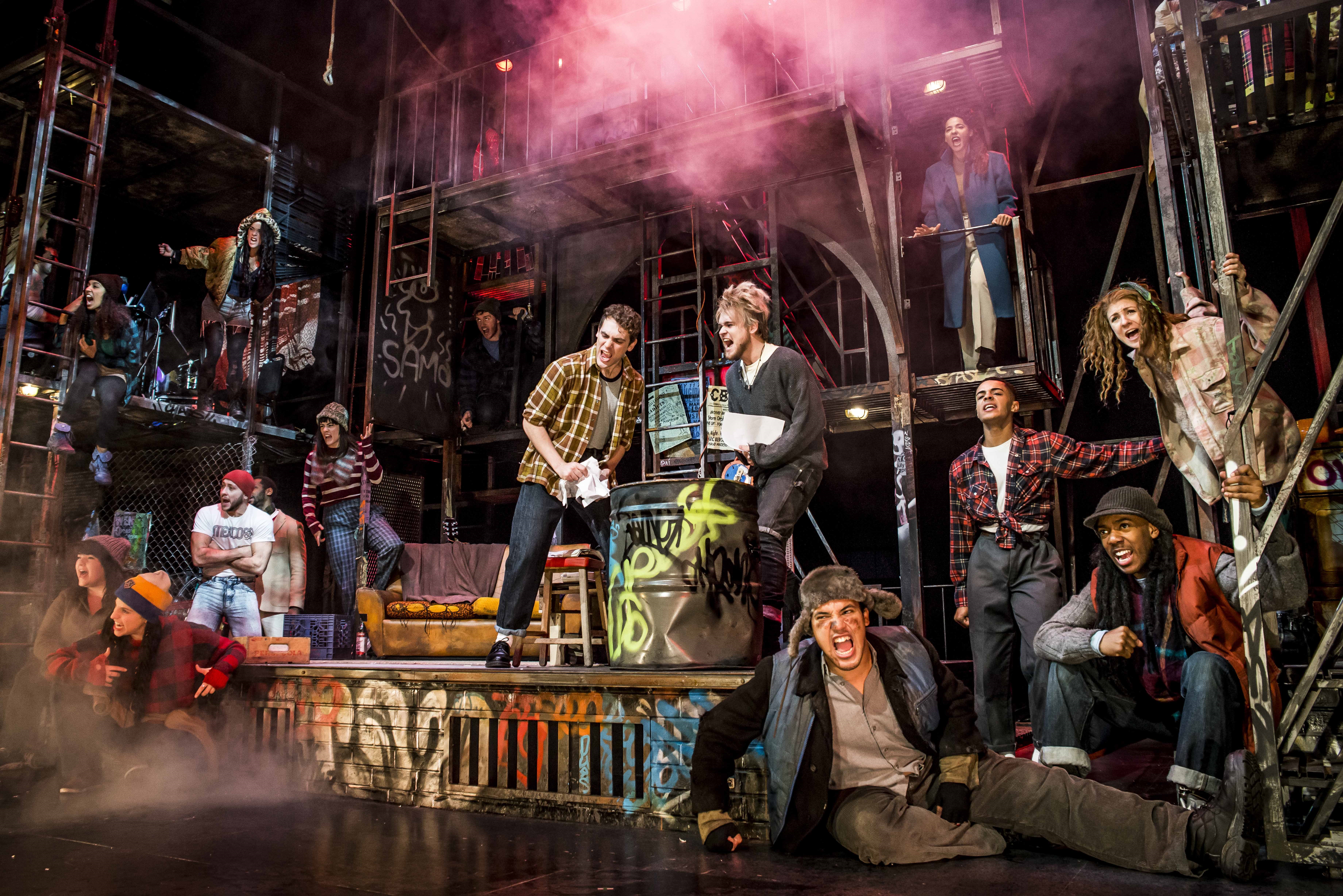
    PHOTOGRAPH: MATT CROCKETT

    I missed the original performance of Rent back in the late 90s and the subsequent film, although was aware of its impact and acclaim, so was pleased to hear that a brand new production celebrating its 20th anniversary was coming to Woking. The multi-award winning rock musical, inspired by Puccini’s opera La Boheme, was written by Jonathon Larson and ran on Broadway for 12 years, from 1996-2008, and for 18 months in the London West End. Sadly, Larson didn’t experience the success of his play, nor see the film adaptation, as he died unexpectedly the night before the show’s first off-Broadway performance in New York. And after seeing this performance, all I can think is, what a shame, as the play is a triumph of originality and dynamism, that lives on to this day.

    Rent tells the story of a group of struggling artists in New York’s East Village, fighting for individuality and love amongst the threat of gentrification and conformist lifestyles. The passion and tragedy of La Boheme serves as the structure, but Larson brought in modern themes and a score that appeals to current values and perspectives. The audience loved it.

    Set, costumes and a live band on stage sets the scene perfectly, absorbing the audience into the time and the place. Unlike some performances I’ve seen, the all-British cast delivers the American accent well, without going too nasally. The first couple of numbers were a little low in energy levels, but once we were familiarised, the dynamism on stage took over and the audience was completely engaged. Layton Williams as Angel stole the show with his performance of Today 4 U, and after that, the performances were galvanised. Well, doing a flawless, handless backflip in four-inch heels while singing and dancing sets the bar very high indeed! Strong performances also came from the women performers, who sang with a passion. Lucie Jones, our current Eurovision hopeful, as Maureen, memorably delivers a hilarious performance that works the mike in unimaginable ways, and Jenny O’Leary as Joanne, dancing an unexpected tango, delighted the audience.

    Funny, sexy, and moving, Rent is playing at the New Victoria theatre from Wednesday 8 March – Saturday 11 March, with additional matinees on Wednesday and Saturday.

    [Amanda Briggs March 2017]