Category: Opera

  • Carmen

    Carmen

    Bravo to Woking’s New Victoria theatre for adding two operatic performances to this season’s listings. Madame Butterfly played on Friday 11 and Carmen on Saturday 12 March. These one-night-only events, billed as some of Ellen Kent’s ‘dazzling’ productions are currently on a 34-venue tour of the UK, bringing the most classical and enjoyable operas to culture-starved audiences around the country. Despite limited billing, Carmen attracted a large audience to Woking on Saturday night. There was a nice buzz going on in the restaurant where we ate pre-show, and the waiter struggled politely to find our 6pm reservation, as the restaurant was already full of well-dressed, wine-drinking folks enjoying the start of the evening.

    Ellen Kent is renowned as one of the top opera and ballet producers in the UK, drawing on talent from eastern Europe, often using stunning outdoor locations and adding spectacle and passion to the performances. The glossy programme is fronted with a smouldering image of a gypsy Carmen, with hints of bosom-heaving sexual allure, befitting the role of the title character. Carmen’s popularity as an opera comes not just from the memorable score and classic operatic songs but its simple and tragic story of a woman driven by love, lust and desire. You often hear it said jokingly that Carmen is a slut, and it’s certainly true that the story line runs on her passion for Don Jose that runs from hot to cold when another lover comes on the scene, but it’s her desire for ‘freedom to love who she wants, or die’ that drives the narrative and is carried by the music.

    As the orchestra warmed up I felt a tingle of excitement, preparing to get carried away by the musical performances, dazzling set and costumes. When the lights went down and the conductor (Vasyl Vasylenko) launched the orchestra into its first thrilling musical prelude, I was mesmerised by his superbly controlled direction, flamboyant hand gestures and swift baton commands, leading to high anticipation as the curtains rose for the first act … which sadly, left me rather underwhelmed. From the opening scene I found myself distracted by the gaps in the set and a wobbly colonnade, the certainly-not dazzling costumes and ill-fitting wigs on the lead characters. The choreography of the chorus seemed a little too fluid for the anticipated sharpness, pride and passion of Spanish dance, and I found myself watching an extra who didn’t seem to quite fit, nor quite know what she was doing or why she was there. That said, Carmen herself (Maria Davydova), was excellent; it was easy to believe why men adored her and the poor Don Jose fell under her spell, and her voice and body language was commanding enough to distract you from the surtitles.

    The finale received a good response from the audience, who remained in their seats for the curtain calls, until the mostly Ukrainian cast lifted a Ukrainian flag and vibrantly sang the Ukrainian national anthem, bringing the entire audience to their feet to loudly clap and shout their support and solidarity for these brave performers. Not only was it incredibly moving, but it proved yet again that art and music crosses political divides and unites us all.

    [Amanda Briggs, March 2022]
  • La Traviata – Behind the Curtain: Glyndebourne 50th Tour

    La Traviata – Behind the Curtain: Glyndebourne 50th Tour

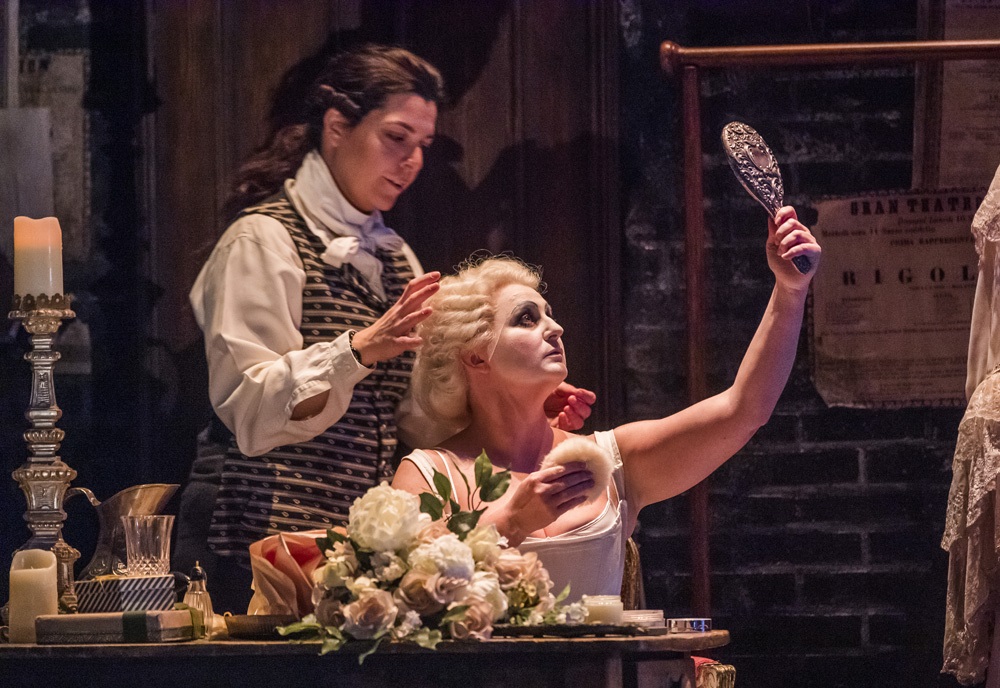
    Anna-Marie Sullivan spins the wheel to find out what the next quick costume change will be

    In this tweeting, twittering age of soundbites, music videos, endless, pointless newsfeeds, political rants and inane banter, our daily lives are filled with such a cacophony of voices that we are often left feeling exhausted and numb. The human voice has become so devalued, that it’s hard to appreciate its power, so, take a step back, deep breath, pause and think Opera, where the voice can be appreciated in its purest and most awesome sense. La Traviata – Behind the Curtain gives us more than that. Not only do we hear breathtaking vocal ranges set to the heartrending musical scores, but we also get a popular comedian breaking it down and taking us backstage, to show us how the magic works. Is it then, as the publicity claims, demystifying opera, or is it simply opera lite, for those of us who might have a Classic Opera Arias CD gathering dust on a shelf somewhere?

    Let’s start with what it’s all about. La Traviata – the story is simple and, of course, tragic. A beautiful Parisian courtesan, Violetta, falls in love with Alfredo, an honest young man. They move to the country where they live blissfully, until Alfredo’s father Germont visits and pleads with Violetta to leave his lovestruck son, for the sake of his family’s honour and respectability. Violetta acquiesces, and sacrifices her love for Alfredo for the honour of his family and returns to Paris. Alfredo, unknowing, angry and heartbroken, follows her there, only to discover the truth as Violetta succumbs to consumption and dies, after a brief but happy reunion.

    Old, historical hat perhaps? Not at all! Chris Addison, probably better known as a TV comic and satirist rather than an opera buff, enlightens the audience on the historical and social context of the piece, revealing its subversive and shocking nature and how Verdi’s masterpiece, first performed in 1853 in Venice, is as relevant now as it was then. Addison uses contemporary references to clearly demonstrate its impact on both old and new audiences.

    The structure of this production is masterfully put together and astutely targeted at the audience. Whether an opera fan or a novice, it appeals to all. The talk in the ladies loos during the interval was as excited and engaged as a 75% off sale queue in Debenhams. The first act had drawn everyone in, with a combination of music and humorous documentary-style interviews with members of the cast and production team. Most enlightening was the revealing relationship between the conductor and the singer, and the explanation of ‘What does a conductor actually do?’. A sing-off between a tenor and a baritone to demonstrate the difference between an aria and recitative delighted the audience, as did the appearance of  Woking Choral Society, who admirably performed the Hebrew Slave Chorus as the last song of the first act.

    The start of the second act had the audience on the edge of their seats, now empowered with operatic insight and appreciation, craving for more. We were not disappointed. The best was saved for last. Now endowed with an understanding of the complexities of the performance, the audience was given a short but powerful version of the opera’s most poignant arias, culminating in Violetta’s dramatic death scene. Although prepared for the outcome by Addison’s jokey style, we were still caught by the finale, and the audience could be seen stifling sobs and wiping away tears at its beautifully exquisite conclusion.

    Glyndebourne is celebrating 50 years on tour, of bringing opera to the provinces, or in current language – outreaching – and so it should. La Traviata, Behind the Curtain: Demystifying opera or opera lite? Both. If Glynebourne’s aim was to capture new audiences then this production hits the spot, as it leaves you wanting more. It excites the passions and allows us a moment to disconnect from the mundanity of the real world and truly appreciate the power of voice and music in the purest form.

    Amanda Briggs November 2018

    Glyndebourne 50th Tour 2018 performances at the New Victoria theatre, Woking are: La Traviata Tuesday 20 & Sat 24 November; La Traviata – Behind the Curtain Wednesday 21 November; Cendrillon Friday 23 November

    Tenor Nico Darmanin helps to demonstrate the difference between arias and recitative