Category: The Lightbox Woking

  • Cyril Mann: Painter of Light and Shadow

    Cyril Mann: Painter of Light and Shadow

    Finsbury Square, c. 1948 Oil on canvas © The Artist’s Estate courtesy of Piano Nobile


    ‘The sun, my dear, is God’ : JMW Turner

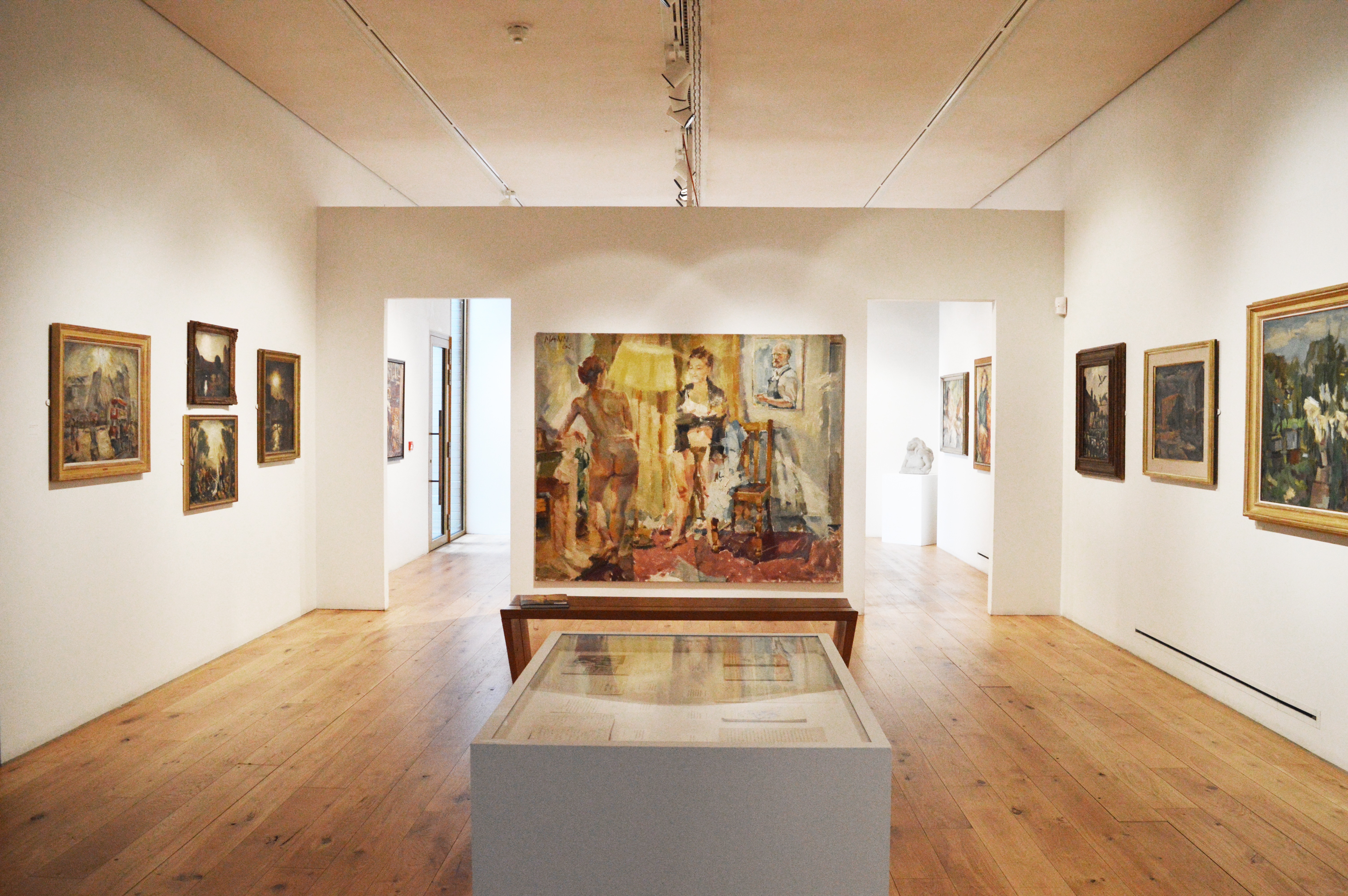
    Painting into the sun was Cyril Mann’s main consideration in order to achieve an effective study of light, which is present in all his paintings. The exhibition at the Lightbox, loaned by the London-based art gallery Piano Nobile, spans from Mann’s first paintings, when he was only 14, to the 1960s. It shows the different phases of the painter’s career, highlighting the contrast between light and shadow in his work, which is almost monochromatic in some of the pictures.

    Mann was a gifted painter who studied at Nottingham School of Art then moved to British Columbia in Canada when he was only 16. He was part of the Group of Seven, based in Toronto, – landscape painters who expressed their feelings for nature in bright colours rather than using a realistic approach. Mann applied this emphasis on expression to all his work, conveying his emotional experience of the subject rather than its reality.

    When he returned to England in 1933, he attended the Royal Academy but he was not in line with their teaching. He was an outcast in the art world as he was not interested in trends and fashion – he rather despised them – and his art was figurative while most painters turned abstract at the time. He was in part self-taught and fiercely independent in his pictorial choices, living a hand-to-mouth existence to remain faithful to his principles.

    Renske, 1963, oil on canvas, © The Artist’s Estate courtesy of Piano Nobile


    His first marriage failed and a period of depression followed. He remarried in 1968. His second wife, Renske van Slooten, a Dutch-Indonesian young woman, was his model, muse and breadwinner until his death in 1980.

    He lived in times of liberation which were also characterised by big changes, such as  universal suffrage, better housing conditions, decolonisation and immigration. It was also the epoch of the two world wars (Mann served in the Royal Artillery in the second world war), a period of hardship and suffering. Modernity and Modernism emphasised the life in the city which had already been the subject of the Impressionists, as Manet claimed: ‘Il faut être de son temps’ (we need to move with the times), meaning that  a work of art needed to be modern to be considered art.

    Modernism is a multi-faceted concept. Certainly Mann adhered to some of its principles in his interest in modern life and city scenes, in his study of forms and colours using an emotional representational approach and in his innovative way of painting influenced by artists such as Cézanne, Frans Hals, Van Gogh and especially Turner.

    In his early paintings on display at the exhibition, such as ‘Dark Satanic Mills’ (1925), he is inspired by the thought of Blake and DH Lawrence. His profound study of light is already present in ‘Pont Neuf’ (1938) and ‘Panning for Gold’ (1929), a painting that goes back to his Canadian years. Light becomes paramount in ‘Study for Light and Shadow’ (1950) and in the street scenes, such as ‘Finsbury Square’ (1948) and ‘Wilson Street, EC2’ (1948). Between Impressionism, which accentuated the movement of light, and Expressionism, which expressed the personal emotional experience, Mann painted into the light, glorifying the sun. He communicated what he felt in a dynamic tension with the effects of sunlight. In this phase his work might seem sombre, focusing on the city during and after the second world war, but his palette is definitely original in its monochrome quality, with a rich texture of thick impasto, reminiscent of Turner’s last period.

    After his divorce from his first wife Mary in 1950, he moved into a council flat which had scarce daylight. He kept painting in electric light in forms of ‘solid shadow’. The pictures at the exhibition, such as ‘The White Rose’ (1955), ‘Still Life with Pot Plants and oranges’ (1951), or ‘Still life with Cabbage’ (1953), testify to his secluded life, the strong marks of the contours and flat pictorial surfaces recalling Pop Art. It is a private interior world where the objects seem frozen in their artificiality.

    Sunlit Roses in a Brass Jug, 1963 © The Artist’s Estate courtesy of Piano Nobile


    After his second marriage, Mann’s art seems to explode in a brighter vision that integrates all the lessons he had learned in his career. The study of the movement of light is still important, but the passion he puts in the expressionist interpretation becomes paramount. Nudes, interiors, landscapes and self-portraits become his subjects, conveying an encompassing sense of liberation. The brushstrokes give form and volume in an almost abstract approach, as in ‘Self-portrait (with double nude)’ (1965), ‘Brushes and palette knives’ (1966), or ‘Studio corner’ (1961). He studies form and colour, how they shape the object in the light using thick impasto and dramatic brushstrokes. The contrast between light and shadow has a kinetic quality reminiscent of Cézanne’s and Turner’s lessons.

    His nudes are emotional and geometrical at the same time in a rigorous interpretation of forms through colour, which is intense and dynamic. He does not explore the body in the way Lucian Freud and Francis Bacon did, destabilising traditional rules and against academic tradition. Mann treats the body as a form flooded with light and vitality.

    There are also two interesting stone sculptures at the exhibition, ‘Budgerigar’ (1955) and ‘Venus’ (1957). He ended his life in a pyschiatric hospital, frustrated and embittered by the lack of recognition he endured throughout his career. His fierce individuality, which rejected all the ‘isms’, is probably best shown by his last self-portrait, ‘Ecce Homo’, which is not on display. He painted his figure naked, holding a cigarette, elderly and exposed between two of his previous self-portraits. His vulnerability and the triple self-portrait reveal his isolation and, simultaneously, his originality.

    The exhibition of Cyril Mann’s oeuvre at the Lightbox explains and displays effectively the painter’s work and career in different, engaging paintings that reveal his unique approach and engrossing research in the study of light and shadow.

    [Carla Scarano D’Antonio, February 2019]

    Cyril Mann: Painter of Light and Shadow, The Lightbox, Woking, 12 January – 31 March 2019

    Dark Satanic Mills, 1925 © The Artist’s Estate courtesy of Piano Nobile


  • Exploration and invention. Picasso: Paper & Clay at the Lightbox in Woking

    Exploration and invention. Picasso: Paper & Clay at the Lightbox in Woking

    Picasso 2 Face (1960), Pablo Picasso - Image courtesy of Leicester Arts and Museums © Succession PicassoDACS, London 2018
    Face (1960), Pablo Picasso – Image courtesy of Leicester Arts
    and Museums © Succession Picasso/DACS, London 2018


    by Carla Scarano 

    The prolific and versatile traits of Picasso’s talent are manifest in the current riveting exhibition at the Lightbox in Woking. It gives a clear-cut vision of Picasso’s artistic development, focusing on his printing and ceramic works and highlighting his experimental technical approach, innovative both in forms and subjects, and amply contextualising the different works of the artist’s multi-faceted career.

    Though the works are not in a chronological order, the captions summarise effectively the different stages of Picasso’s artistic development, explaining the main characteristics of, for example, Cubism or the Blue period, contextualising each picture within the artistic movement of the time and highlighting Picasso’s innovative contribution.

    Moreover, there have been two photographic exhibitions as well; photos of Picasso taken by the professional photographer Lee Miller, and by an amateur, Stanley Stanley. This is an opportunity to see a different aspect of the great artist.

    An overview of the main stages of Picasso’s development are present in the timeline introducing the main exhibition. Good examples of his work are in the etching of ‘The frugal meal’ (1904) exemplifying the sombre Blue period, possibly influenced by the death of his friend Carlos Casagemas and of Picasso’s life as an art student in Paris, with angular elongated figures and sad expressions; or in the ‘Woman’s face’ where the figure is both seen in profile and frontal view, giving a surrealist, 3D impression.

    Weeping Woman
    Pablo Picasso, Weeping Woman, 1937, graphite and crayon on paper, unique, © Tate, London 2017 © Succession Picasso/DACS, London 2018

    The essential quality of his drawing technique, where the line is reduced to the basic and yet expresses a total vision of the subject, is clearly shown in the etching of the ‘Woman with a book’ (1918-19), which recalls the works of the Renaissance masters, with simple lines suggesting the folds of the dress and the stress on the hands holding the book. These characteristics emphasise Picasso’s innovative interpretation as well as his legacy from previous masters; they also underline his tendency to simplify his figures, not in the sense of making his work easier, but in the sense of making it more essential and effective. The exhibition highlights very well this quality of the artist’s work both in the pieces exhibited and in the explanations.

    The other important feature emphasised in the exposition is Picasso’s incredible ability to experiment and mix different media, evident both in the printing and ceramic works on display. He began his apprenticeship in printing at Fernand Mourlot’s studio in 1945 where he used to spend whole days and late into the night experimenting with different techniques – engraving, linocut, drypoint, etching, lithograph and aquatint, mixing the different methods or inventing new ones.

    His pioneering attitude, a constant feature of his artistic career, enabled him to create a new figurative language. Especially in the posters he produced at Vallauris, a village in the Côte d’Azur where he lived from 1948 until 1955, the colours and the figures communicate a message that was intended to attract the interest of the viewer and was easy to remember.

    Head of a Young Boy
    Pablo Picasso, Head of a Young Boy, Lithograph on paper © Tate, London 2018 © Succession Picasso/DACS, London 2018

    For him, printing was not simply a way of reproducing images but an exploration of his never -ending creative process; he did not totally rely on ready-made traditional approaches but reworked the printing blocks. ‘Le banderillero’ (1959) shows in four stages how he reprinted the paper with different colours.

    Another important example of this innovative creative approach is in the ‘Portrait of Jacqueline Roque’ (1958) where the lithograph is produced from an inked stone in which he scratched the white contours against the black, reversing the traditional technique of drawing in black on a white background. The effect is surprising in the shadowing of the face’s features giving a sensation of depth and rich texture. In other works he combined etching and aquatint or etching and drypoint.

    His eclectic, fruitful approach not only allowed him to experiment with different materials and techniques but also produced original mixed works both in subject and in form. For him art work was a way to penetrate and understand mankind and the world, in his search for a new conception of art. Picasso saw himself as a revolutionary and art was his tool to make men and women freer. At the same time he thought that art was not an imitation of nature but a lie; a necessary, aesthetic lie. Thus, art is not simple decoration  but an exploration of an idea of the world which is essential to understand and influence society. The writer Gertrude Stein, who supported and funded him in the early years of his artistic life, said that through his art work Picasso communicated “the truth which only he can see”.

    In addition to the etching and the engraving examples of the Vollard Suite, a series commissioned by Ambroise Vollard revealing a neo-classical taste with Greek and Roman themes in part autobiographical, the exhibition also shows his commitment to the theme of peace with one of the famous doves he made to support the French Communist Party.

    When he moved to the Côte d’Azur after the second world war, he was a famous and rich artist. He started to work in the Madoura ceramic studio owned by Suzanne and Georges Ramié at Vallauris, an area where they had been producing ceramics since the time of the Romans.  Picasso both learned from the traditional craft and experimented with new forms and subjects inspired by primitive African and Iberian art, as had already happened in his paintings since ‘Les Demoiselles d’Avignon’ (1907). In the first year he produced about 2,000 pieces, triggering a new flourishing of the ceramic trade in Vallauris.

    The exhibition shows standard plates he marked and modified before they were dry and then decorated and glazed with different coloured slips. Similar subjects, like a bullfight, a picador or a goat, are presented with different experimental techniques. In the vases he used to combine different pieces in a sort of collage, merging the decoration with the shape. This is evident in the animal-shaped vases, like the ‘Owl with feathers’ or the ‘Dove’. Eventually he hoped to produce a plaster mould to make more affordable ceramics. Some of the works exhibited were on sale, ranging from £2,000 to £30,000.

    At the Lightbox there is the opportunity for both children and adults to create your own drawing with paper and pencils, imitating Picasso’s work, together with two lightboxes with coloured plastic shapes with which to play and explore the master’s work.

    On the second floor of the gallery is the exhibition of Picasso’s photos taken by Lee Miller (open until 17 June). Lee Miller and Picasso met in 1937, and then again after the war. She took more than a 1,000 shots for her husband Richard Penrose’s biography of Picasso; they show the artist in his villa and at work, his powerful personality and inexhaustible creativity apparent from the pictures.

    At the Art Fund Prize Gallery on the ground floor until 29 April there were some photos that Stanley Stanley took of Picasso, his daughter Paloma and the art dealer Ernst Ascher in Golfe-Juan where Stanley met the artist by chance on the beach. The photos showed the artist relaxing at the seaside and having fun with his friends. Stanley never met Picasso again but the artist gave him a ceramic plate that Stanley cherished until his death.

     The main Picasso exhibition is at the Lightbox until 24 June

    Picasso 3 Pablo Picasso (1881-1973) Head of a Woman, 1926. UEA 10. Robert and Lisa Sainsbury Collection © Succession PicassoDACS, London 2018

    Pablo Picasso (1881-1973) Head of a Woman, 1926. UEA 10. Robert and Lisa Sainsbury Collection © Sainsbury Centre for Visual Arts, University of East Anglia © Succession Picasso/DACS, London 2018


  • The Story of British Comics So Far: Cor! By Gum! Zarjaz!

    The Story of British Comics So Far: Cor! By Gum! Zarjaz!


    If you’re of a certain age and enjoyed what some might describe as the golden age of British comics, you should get yourself down to the Lightbox and savour their latest exhibition. It don’t ‘alf take you back.

    Never mind the fact that the title of the exhibition – ‘The Story of British Comics So Far: Cor! By Gum! Zarjaz!’ – seems to have been drawn up by a committee to ensure that no one felt excluded, this show may well appeal most to that baby boomer generation reared on the Beano and the Dandy, Dan Dare in the Eagle, Roy of the Rovers,  Princess, School Friend, Jackie and Bunty.

    One frame in a Desperate Dan strip from the Dandy  – sadly, the Dandy ceased its print edition in 2012 – had me laughing out loud in the Lightbox. Desperate Dan has a problem with hiccups, which, as always with him, is a huge problem. The force of one hiccup sends his aunt Aggie flying out of the window; another brings the house down.  What made me chuckle audibly was that long-suffering aunt Aggie disappears through the open window without a yell of surprise, or word of complaint. Oh well, maybe you have to see it for yourself, to see what I mean. There is a bust of that other Dan, the daredevil space captain who often found himself stranded on Mercury, or some other inhospitable place. The smile of supreme confidence on his face made me think of Buzz Lightyear. Buzz’s confidence always turns out to be misplaced – but maybe Dan Dare’s air of superiority in the 1950s was of stronger stuff. Pre-Suez, at any ate.

    In Dundee, home of DC Thomson and the Beano and the Dandy, there are statues of Desperate Dan, Minnie the Minx and Oor Wullie. Beano and Dandy were both launched just before the second world war. The Dandy closed in 2012 but the Beano, which I always preferred as more anarchic, is still going. If only former education secretary Michael Gove had visited Bash Street school – what would they have made of him, eh, chums? Viz, launched in the late 1970s and aimed at adults, or more accurately, at halted-development adolescents, represented a loving parody of the DC Thomson format.  My wife accompanied me to the exhibition, and spoke of her sense of anticipation, waiting for her girls’ comic to be delivered through the door each week. She felt that the girls did not get enough of a show at the Lightbox, a little lost amid the Lions, Busters, Swifts, and War Picture Libraries, perhaps.

    The exhibition is intended as a journey through the past, present and future of “sequential art”. The ‘Cor!’ part is a potted history, including examples of 3,000-year-old hieroglyphics, 18th century satirical prints by Hogarth, and a contemporary “playful yet political” ceramic by Grayson Perry. ‘By Gum’ is the down-memory-lane section, plus DIY comic-making interactives. ‘Zarjaz!’ includes modern manga, graphic novels and digital comics. The exhibition has been curated by museum professional and comics enthusiast Hamish MacGillivray and Paul Gravett,  a journalist and curator who has worked in comics publishing. Hamish has said: “Both older people and school kids have helped to evolve the layout and interactives. My ideas were brought to life thanks to some theatre magic by set builders Bowerwood and the enthusiasm of Paul Gravett and the Lightbox team.”

    When I was a kid – before school drummed such things out of me – I drew up my own comics and strip cartoons. My mum kept them, and I came across them recently when clearing out her flat. One message to readers was signed off, “From the happy editor”, which made me smile. Happy days indeed, it seems, looking back  – when life always appeared hilarious.

    Greg Freeman

    ‘The Story of British Comics So Far: Cor! By Gum! Zarjaz!’ is on show at The Lightbox until 31 December 2016

    ILLUSTRATION: ASIA ALFASI AND HAMISH MACGILLVRAY, THE STORY OF BRITISH COMICS SO FAR © THE ARTIST AND THE LIGHTBOX

  • Wells’ War of the Worlds: A Visual Celebration

    Wells’ War of the Worlds: A Visual Celebration

    HG Wells 1

    If HG Wells had stumbled up on a magical elixir of youth – of the kind he might have written about in one of his sci-fi novels – he would have been 150 years old this year. Sadly he did not – but in the absence of the great man, Woking is celebrating the birth of a writer who by commencing his world-famous novel The War of the Worlds on Horsell common, associated this Surrey commuter town forever after with destruction and Martian death rays. To get in the mood for the planned HG Wells events over the course of the next few months, you should visit the new exhibition at The Lightbox,  ‘Wells’ War of the Worlds: A Visual Celebration’  (26 March – 1 May 2016). It features prize-winning works and a selection of the best designs submitted from a public competition, and includes a smaller version of a statue of Wells that will be unveiled in Woking later this year.

    As well as the sculpture by Wesley Harland, who is based in Woking, key features of the exhibition are the two prizewinning artworks – Look Up! by Neville Godwin, and The Visionary by David Dragon. Godwin actually lives in Horsell, and has said he wanted “to include elements from different ages to reflect the longevity of The War of the Worlds”. Thus his work, which has the Martian fighting machine as its central image, has a pulp fiction/comic book feel, as well as that of a B-movie film poster. He has also smuggled two building from modern-day Woking into the background. David Dragon’s The Visionary combines a bold portrait of HG Wells in a style that calls to mind propaganda posters from the Soviet era, with images of the Martian and of guns that would have been trained upon the alien. Other artworks on display at the Lightbox that demand a mention include Adam Green’s Man flu strikes again, depicting the lowly virus that finally saw off the Martians; Candida Woolley’s depiction of the battle at Shepperton lock; Penny Green’s vision of the invaders marching through the Surrey countryside while cows graze beneath them; and Julia Hawkins’s vision of two chaps – one smoking a pipe – putting the world to rights in a peaceful study on The Eve of the War.

    And then there is Wesley Harland’s original maquette version of his sculpture, a glimpse of his figure of Wells that will eventually be 17% larger than life size, and installed in Woking town centre, on Christchurch Way by the subway, which sounds a rather disappointingly obscure location.  You can read more about the development of the work here. He has said that the piece, Novelist and Thinker, “reflects HG Wells in a thoughtful, contemplative  seated pose … I wanted to reflect his importance as a political thinker in the design”.

    The exhibition may be housed in a comparatively small room at the Lightbox, but there is much to see. The artwork on the walls represents an explosion of images associated with this most remarkable of novels – a novel that helped to establish a worldwide literary reputation, and put a hitherto obscure Surrey community on the global map.

    [Greg Freeman 1 April 2016]