Category: Members

  • What happened at our May meetings – news and readings

    Minutes of meeting of Woking Writers Circle on Thursday 19 May 2022

    Present:  Simona (guest), Sam (guest), Emily, Sarah, Tricia (chair), Liz, Alan (minutes), Peter, Hilary

    Apologies: Heather, Carla, Greg, Amanda

    News:

    Liz reported that the Book Group had read The Giver of Stars by Jojo Moyes and The Book Woman of Troublesome Creek by Kim Michele Richardson. Both novels dealt with the efforts of the so-called packhorse librarians – women who campaigned for and actively facilitated the provision of books to isolated and disadvantaged rural communities. This was a scheme originally initiated by Eleanor Roosevelt. Voting for The Giver of Stars ranged from 2 or 3 to 9 out of 10, which averaged out at 7.5. Jojo Moyes’s book seemed the more light-hearted of the two, hence its greater popularity. The next book reading, which will be in Woking, or via Zoom, on Monday 18 June at 7.30 pm, will be My Antonia by Willa Carter. This was recommended by Peter as a wonderful read.

    Alan’s début novel, Theta Double Dot, has received an excellent four-star review from Grace J, aka GraceJ Reviewerlady. This is now on this blogger’s website, Instagram and Facebook pages. Follow this link to the review: https://gracejreviewerlady.net/2022/05/06/theta-double-dot-by-alan-dale-bookreview-austinmacauley-4/ Alan’s publisher, Austin Macauley are to post the review on their social media and upload Alan’s promo video for the book to their Tiktok platform.

    Alan’s 81-word flash fiction story The Open Secret, which began life as a piece for a Woking Writers reading meeting, is now in what has become an award-winning anthology. The anthology published by Victorina Press and edited by Chris Fielden has just won the Best Anthology category in the 2022 Saboteur awards. Victorina Press won the Most Innovative Publisher category. Profits from the anthology sales go to the Arkbound Foundation, which promotes access to literature for disadvantaged groups

    Readings

    The homework theme was “Mayday”.       

    Peter, in an interesting and thought-provoking departure from the convention of reading finished work, read some preliminary planning notes and explanatory background for a scene in his future novel. The notes were titled Tommy Chapter x. Iford Bridge and the Cattle Truck. The narrative was intended as a flashback that Tommy has, many years later, as a much older man, while gardening. The action centres on an accident involving Alf in his cattle truck. Alf has had a couple at the Lamb, in Burton. Tommy, suddenly seconds from a collision with the truck, on his Norton, sees his life flash before him, and is instantly resigned to his fate. Discussion centred on Peter’s request for advice about planning and background. Hilary asked him where he wished the story to end. All could see, simply by listening to Peter answering this question, how centrally relevant it was. A deft demonstration of the classical Socratic teaching method, it subtly illustrated the benefits of feedback. It was also felt, by some, that Alf’s inebriated state could have been more gradually seeded into the narrative, affording much greater opportunities for tension building. Alan suggested putting characters’ CVs in a file might help to keep track of them, for reference in the narrative.

    Sarah read, or rather, invited five other members to read her first, most impressive and wonderfully hilarious attempt at a play. The action centres around an authentically cringe-making meeting at Get It Right IT Software, which has been convened, evidently most reluctantly, by management, to address the subject of the menopause and its implications for staffing. Peter, perfectly utilising his understated, deadpan delivery, conveyed manager Jeremy’s humourless gaucherie and jargon-ridden “beard-speak”, to the life. The audience erupted in laughter, each time his narrative returned, as if on a bungy-jumping cable, to using the whole menopause issue solely as a sales promotion device. The dialogue skilfully showed his underlying embarrassment as his only motivation. Everyone carried off their part with impressively convincing accomplishment, but it was Sarah’s eviscerating, perceptive dialogue, characterisation and humour that made our day. Various members suggested posting a performance of this on Facebook, in conjunction with, or at least for and on behalf of, some relevant menopause support groups.

    Liz read a poem, entitled A Bed With Some Great Poets Of The Twentieth Century. Eliot, Pound and Yeats were among the poets referred to. Listeners admired the constantly varying rhythm, which, it was agreed, helped to maintain their attention. Another greatly admired feature was the presence of internal rhymes within the verse. Liz mentioned the poem’s role in expressing her urge to “go back into her literary self”. The discussion then turned to various opinions attributed to certain writers about aspects of writing and each other’s work. Liz questioned F Scott Fitzgerald’s assertion that “you really have to suffer before you can write”. Liz had also discovered that Ezra Pound met Yeats, and on being asked for advice, excised half the text from the draft offered for his consideration. TS Eliot, on the other hand, apparently failed to give Pound any credit for his advice regarding brevity, concerning The Waste Land.

    Emily read a poem called Ode To My Wonderfully Characteristic Aunt. Her Aunt Beryl is “just like Hyacynth Bouquet”, of Keeping Up Appearances fame. Her auntie is now in her nineties and everyone admired and enjoyed the illustrative power of the writing, in particular, the sharply defined characterisation. Parts of the poem were thought to flow better than others, hence several people felt that spending a little time on rhythm and metre could well pay dividends.

    Hilary read a piece entitled Braveheart, which, despite its name, dealt not with ancient Scottish resistance, but woad. Having acquired some woad seeds, her project was to make some blue dye from them. The true magic, we learned, takes place when the dye is exposed to the air, which is far from being the first step in the procedure. The “Braveheart effect” needs other actions, including smearing and various other manual operations, some of which have decidedly scatological origins. The mysterious nature of these transformative rituals was emphasised by an image on Hilary’s laptop, showing a defiantly yellow mass of flowers. Hilary then showed us a jacket, dyed with the resultant woad, to a subtle shade of pale blue. Obtaining a really deep hue requires a much longer process. Liz admired the writing’s skilful transcending of the boundary between science and poetry. Some felt that a shade more humour might effectively represent the ancients’ experiences of trial and error.

    Tricia’s story, based on the homework theme of Mayday, was set in a branch of Thomas Lipton’s tea empire. Eileen, we learned, was good at figures, as affirmed by her Royal Engineers father – “anything to do with figures, she’s your girl.” She clicks with the new manager, Mr McNamee, in whom she discovers a fellow arithmetician. Romance blossoms, as they work together on the accounts, albeit under the constraints of the social mores of the early twentieth century. Despite her Baptist and his Catholic background, her minister gives them his blessing, for her to convert to Rome. McNamee is then posted to New York, but as fate would have it, they travel on the Titanic. The last reference to their shared love of figures is the macabre reckoning that shows the number of lifeboats to be well short of the passenger list. All enjoyed this story, with some suggesting that it could have been cut at the point where the couple’s fate was sealed. Tricia was encouraged to tighten the narrative to this effect, prior to submitting the piece to a suitable magazine,  for publication.

    Alan read a short story called Feeder Service. The dialogue-only structure, admired for its ability to keep the reader totally aware of who was speaking, reveals the narrator, Amy, freezing at a bus stop. Her suspicions, on being approached by a probable illegal immigrant intent on begging, are soon confirmed. Launching into a much-practised avoidance routine, she elicits a genuine tale of hardship, only to reveal, right at the end, that she is in similarly dire straits herself. All admired this final twist, which led to a discussion of the inherent balance required, between an unfair withholding of clues from the reader and excessively premature and obvious revelation.

    Next meeting: Thursday 16 June, 7.30pm at St. Mary The Virgin Church Hall, Horsell

    Chair: Hilary / Amanda

    Minutes: Tricia

    Homework theme: Sunny Days

    Wine: Simona

    Biscuits & Milk: Carla

  • What happened at our April meeting – news and readings

    WOKING WRITERS CIRCLE MEETING AT ST MARY’S CHURCH HALL, HORSELL ON 21 APRIL 2022

    Present: Peter, Emily, Alan, Hilary, Carla, Tricia, Liz, Heather  

    Apologies: Greg, Sarah, Amanda

    News:

    Alan has had a letter praising The Witchfinder, a BBC2 sit-com, published in TV Choice magazine. 

    Hilary’s short story, ‘Chocolate Frog’, had been selected by judge Alysoun Owen as one of nine shortlisted entries out of more than 750 stories submitted to the Writers and Artists short story competition. Congratulations, Hilary!

    Heather has had a poem ‘When Words Fail’ (read at a previous WWC meeting) published in the latest Hysteria anthology.

    Carla has had two poems published in Dreich magazine – ‘Consider the Ear’ and ‘The Hare’. 

    Emily had reviewed The Lion, the Witch and the Wardrobe, seen at the New Victoria theatre. The review appears on the WWC website. 

    Readings

    Carla read the two poems published in Dreich magazine. Both poems were greatly enjoyed. The last two lines of ‘Consider the Ear’ appeared to contain a contradiction involving an App which taught the skill of intuition, but Carla explained that there is such an App! All appreciated the way the poem moved from scientific explanation of the functions and structure of the ear through to the lyrical consideration of listening “slowly and deeply to what has not been said”. Carla’s second poem, ‘The Hare’ was an evocation of speed with the poet imagining riding on the back of the hare while it sped “at fifty miles an hour/on its Olympian legs”. The sensation of speed was felt as Carla read the poem.

    Liz read from life writing produced over the last few weeks when she was largely confined to bed with severe back pain. She skilfully conveyed the restricted world she inhabits, bringing in references to the appalling conflict in Ukraine which invaded her relative peace. Liz felt that it had helped her to write about this experience, and the group also said that they appreciated this piece for its balanced consideration of the war in Ukraine and her own pain; Liz appeared to be very much in control of her material which can be difficult with life writing.

    Hilary read her story, ‘Chocolate Frog’, which focused on the breakdown of a childhood friendship and the ensuing loss of a greatly valued friend. This was a beautifully written story, with the group feeling the intensity of the narrator’s pain. Unusually in a short story, Hilary had succeeded in painting a rounded picture of the parents of the two girls through information provided about the children. The chocolate frog was a birthday present for the narrator’s friend Rosa, who had moved away before they were reconciled and before she had been able to give it to her. All agreed that the story fully deserved its place on the W&A shortlist and would in fact have been a worthy winner.

    Alan’s story, ‘Uneasy Rider’ was a short piece (approx 500 words) about a man who is recognised as the person who killed an officer many years ago because he had forgotten to tighten or replace a part on a car he had been working on. The story was conveyed entirely in dialogue, with the characters convincingly portrayed using references such as “… Anno Domini, I’m afraid …” The sudden end to the story generally found favour, but there was a suggestion that it was possibly a bit too abrupt. It was agreed that this story should find success as a competition entry.

    Heather read two poems that Pam Ayres was extremely relieved to find she hadn’t written. The first poem, ‘The Post Office Queue’, told the sad story of the sluggish queue and likened it to a caterpillar which was in danger of turning into a chrysalis if it didn’t speed up. The second poem, ‘Miss Apple Tree’, was a rather racy rhyme with more than a hint of Original Sin.

    Peter’s considered and thoughtful piece restored some sense of propriety to the evening. This was a sensitive account of the building and demolition of Calshot power station, recognising the beauty and other-worldliness of the control building shaped like a flying saucer. The article was critical of the “bad science” being used to introduce so-called green initiatives, but the last sentence indicated that the planet was well-placed to look after itself with its “… armoury of earthquake, flood and plague …” It was agreed that this was a most satisfying and interesting account, with just the right amount of technical information. The photos too were greatly enjoyed.

    Next meeting: Thursday, 19 May at 7.30pm

    Chair: Tricia

    Minutes: Alan

    Wine: Peter

    Milk and biscuits: Amanda

    Homework: May Day

  • What happened at our March meeting – news and readings

    MINUTES OF WOKING WRITERS’ CIRCLE MEETING AT ST MARY’S CHURCH HALL, HORSELL ON 17 MARCH 2022

    Present: Greg, Peter, Amanda, Emily, Alan, Carla, Heather, and Liz (on Zoom)

    Apologies: Dan, Tricia, Hilary

    News:

    Greg: The Woking News and Mail has published an article featuring Greg’s latest poetry collection, The Fall of Singapore’, marking the 80th anniversary of this event. The collection is available to buy from Greg or from Dempsey and Windle’s website. The online launch will take place on Wednesday, 30 March and Greg has sent the link to members. Attendees are required to sign up by 26 March on Eventbrite.

    Greg advised that St Mary’s Church Horsell is making a tremendous effort to provide support to the Ukraine at this dreadfully difficult time.

    Carla has had two poems published by the online Canadian magazine, Toasted Cheese and another article accepted by the Margaret Atwood Society. Carla is writing another article on Margaret Atwood’s poetry and has been asked to write several reviews. All were in awe of Carla’s achievements and industry!

    Amanda reported that a review of The Lion, the Witch and the Wardrobe had been requested. Emily said she would be going and would be happy to produce a review for the WWC website, which was greatly appreciated by all.

    Heather had had a poem shortlisted for the Childhood Games poetry competition in Writing magazine.

    Subscriptions: A reminder about subscriptions – Treasurer Hilary would be grateful if outstanding subscriptions (currently £30.00) could be paid, please. Hilary will be pleased to supply bank details if members contact her by email, or in cash at the next meeting.

    Readings

    Heather read a poem, Fallen Cedar, written after the 150-year-old tree in her garden had been felled by Storm Eunice. The sounds associated with the destruction and the scents and stirrings after the storm were appreciated.

    Carla read two poems about memories of her mother. My Mother had been written after a dream in which Carla had felt surrounded by her love. The second poem, Hospital Nights, tenderly conveys her mother’s constancy throughout the three nights after Carla’s caesarean delivery, when her husband could not stay with her. The wording brilliantly captured the softness and helplessness of the babies, ‘curled up and soft like kittens’. Both poems powerfully conveyed the enduring strength of the relationship between Carla and her mother.

    Greg read a prose excerpt followed by a poem, Liberation 1945, from ‘The Fall of Singapore’. A found poem inspired by letters from his grandmother to his father, Greg’s poem vividly captures her disbelief and excitement on hearing he is alive. The straightforward, everyday language gives the poem realism and depth. There was an interesting discussion about war as a universal experience and the power of writing as a way of relating to the experience.

    Emily read a chapter from her book which she had revised taking account of comments and advice given at a previous WWC meeting. Greg and others congratulated Emily on having achieved far greater sensory depth in this version and Alan said how authors should consider the balance of dialogue and narrative to maintain interest and pace. It was suggested that references to eye contact could be a powerful barometer of feelings, as could half-finished sentences.

    Liz read an Epistolatory Ode to Ollie, which was an affectionate farewell to her physiotherapist. This was a humorous, personal and warm piece; all agreed that it was no surprise that Ollie and her colleagues had enjoyed this tribute.

    Alan’s story, Eye Contact, held everyone’s attention with its underlying anxiety about whether Toby’s sister could be aware that a will had been changed in Toby’s favour. The tense exchanges between Toby and Melissa combined with disturbing phrases, such as the ‘sloping landscape that seemed to slither rather than slope’ to heighten the uneasiness. The final shock of the unveiled portrait was truly startling, with some wondering if it could have been slightly too sudden.

    Amanda has produced two reviews which appear on the WWC website. There was an interesting discussion about ways of dealing with a rather lack-lustre performance without being unkind to hard-working performers. It was agreed that positive points should always be emphasised.

    Peter had written a fictional piece, 9 September 1939, written in the first person. Although this was fiction, Peter had drawn heavily on his father’s wartime experiences and the result was totally convincing. All agreed that the writing was very much in tune with the uncertainties of today. Again, an interesting discussion followed and Peter talked about several of his father’s incredible experiences, any one of which would have made a spellbinding story.

    Next meeting: Thursday, 21 April at 7.30pm

    Chair: Peter

    Minutes: Greg/Heather

    Carla: Wine

    Amanda: Milk and biscuits

  • What happened at our February meeting – news and readings

    MINUTES OF WOKING WRITERS’ CIRCLE MEETING AT ST MARY’S CHURCH HALL, HORSELL ON 17 FEBRUARY 2022

    Present: Greg, Peter, Liz, Hilary, Heather 

    Apologies: Dan, Carla, Amanda, Sarah DD

    News:

    Greg has published a new poetry collection, ‘The Fall of Singapore’, to mark the 80th anniversary of this event. This volume, again published by Dempsey and Windle, includes relevant prose linking the poetry to Greg’s father. Greg has included some previously published poems with the new material. The collection is available to buy from Greg or from the publisher’s website. 

    Greg also distributed flyers for an evening of one act plays – The Rats, by Agatha Christie, Pity Pretty Purity, by Graham Gates and Don Ede and Last Tango in Little Grimley, by David Tristram – to be staged at the Lancaster Hall, Send, on 25 and 26 February. Tickets cost £10 and are available from the box office: 07542 107815 or sendamateurdramatics@hotmail.co.uk. This might be the last chance to see Greg on stage!

    Liz reported on the Book Group which would be meeting on 28 February. The group had been considering ‘magical realism’, a genre in which realistic narrative is combined with surreal elements of dream or fantasy. The group was currently reading ‘A Hundred Years of Solitude’ by Gabriel Garcia Marquez, which Liz was enjoying.

    Readings

    Peter: ‘Reflections’ was a thoughtful piece which featured time travel as its theme. The elderly narrator is in philosophical mood, at ease with the peace of the garden and with his relationship with Betsy. They have been together for a long time and he observes that they ‘are scarcely two people anymore’. The group enjoyed the reading very much and discussion took place on the time traveller narrating a number of sequences, not necessarily in chronological order. Hilary wondered if the sequences could be linked to the seasons and also cited a Kate Atkinson novel, ‘Life After Life’, which allows characters to die and then reappear convincingly.

    Greg: The poem ‘Black Gold’ provided a warm picture of the closeness between Greg and his father, containing a number of vivid images, including grandchildren marching ‘importantly in and out of sheds’ and Greg’s father: ‘Once, when Match of the Day came on, while peeling a banana he danced a jig.’ The message of the importance of stories being passed on was implicit throughout, a parallel with the ‘black gold’ of the poem, reflecting the richness of treasures coming forth from ‘rubbish’ or ‘clutter’. (Peter shared his past triumphs as a frequent winner of compost competitions at this point!)

    Heather: Heather read two humorous poems. The first, ‘The Can’t Sleep Sisters’ provided snapshots of several women engaged in a variety of nocturnal activities in separate homes. It was suggested that separating the stanzas would aid understanding and this suggestion was welcomed. The second poem, ‘I Blame David Attenborough’ described the author’s disappointment at finding that plants had needs and feelings, when she had thought that watching ‘The Green Planet’ would be a less emotionally draining experience than coping with David’s usual animal dramas. The audience enjoyed the topicality of the poem, although it must be recorded that one member dared to express negative views about our national treasure!

    Hilary read an extract from her novel featuring Linnet, who in this reading is working in a hairdressing salon on Saturdays to pay back the debt she incurred for a haircut. Linnet works with some fairly toxic colleagues and is called ‘Hairball’ by a particularly obnoxious man. On her last day in the salon, she realises that she should be feeling happy, but does not. Peter admired the way that the author seems to ‘sneak up on moments’. It was agreed that there was the right level of detail to convey realism and the painful emotions experienced by Linnet. Hilary has written approximately 45,000 words of the novel so far and this section appears around a quarter of the way through the book. 

    Liz’s subject was Valentine’s Day and she read from her journal with a selection of recollections. The reading included a poem about finding the blue wool to darn her husband’s much-loved sweater and completing the repair on Valentine’s Day after a delay of a year. There was a very amusing list of things not to do on Valentine’s Day and an account of Liz and Robin’s recent Valentine’s celebrations in Worplesdon village where there were two surprises. A night-time visit to her family grave ended with Robin improvising a deeply moving prayer which made Liz feel like being a better orphan and sibling! Then at dinner at the Worplesdon Place hotel, Liz recognised the grand mantelpiece from an old photo of her father and his best mates at his 21st birthday party there in 1931. Discussion followed about the possibilities of Liz including her life writing in a blog, or seeking publication for some selected unusual aspects of life recorded in the journal. Liz is one of a dwindling number of Surrey residents born and bred within the county, most of us being incomers. As such, she has recorded a wealth of valuable memories and observations. 

    Next meeting: Thursday, 17 March at 7.30pm

    Chair: Peter

    Minutes: Greg/Heather

    Milk and biscuits: Liz

    Homework: Shamrock green

  • What happened at our January (hybrid) meeting, in-person and on Zoom

    What happened at our January (hybrid) meeting, in-person and on Zoom

    WOKING WRITERS CIRCLE MEETING at St Mary’s church hall, Horsell, on Thursday 20 January

    Attending in person: Amanda, Greg, Emily, Liz, Hilary, Tricia.

    Attending on Zoom: Carla, Alan.

    Apologies: Heather, Peter.  

    News

    Carla announced publication of her poem ‘Words are good’ in Acumen poetry magazine. We all congratulated her, particularly Greg, who has tried several times to get a poem in Acumen!

    Liz mentioned upcoming Burns Night celebrations, the Lionheart independent bookshop in Woking, and a recent debate she had attended in Woking on trans-gender. The book group had read The Eyre Affair by Jasper Fforde, which takes place in an alternative 1985, and awarded it a disappointing 4.5 out of 10.

    Hilary as treasurer warned that we will have to increase member subscriptions from £24 to an initial £30, and then consider a further increase in September, to stop us running out of funds over the summer. Because of lockdown no one has paid any subs for two years. She would welcome electronic bank transfer of subs. Please email Hilary individually to obtain details.  

    Amanda has details of forthcoming productions at the New Victoria theatre, if anyone would like to review something for the website.

    Readings

    Carla (via Zoom)read two poems that had been created at a recent poetry workshop –‘Pristine’, about a beloved grandmother: “I would like to paint the smell of clean laundry in the hospital basement where you used to work”; and ‘Off to Scotland’, about a family holiday of around 15 years ago, in which “tortellini and double cream” was mentioned. She also read her Acumen poem, which was inspired by one by Sylvia Plath.

    Emily revisited a section of her completed novel for our further thoughts. The section included a conversation between two friends in a bar. We enjoyed details like “picking the label off her bottle of Bud”, and oohing and aahing over a bloke’s Facebook and Instagram pages, and suggested there could be more of such details, to help illustrate the plot more effectively than simple exposition.  

    Amanda read us what she described as the first draft of a poem with the wonderful title, ‘What’s Wrong with Hayling Island?’ She said it had been inspired by a desire to go for a dip in the sea on her recent – January! – birthday. There were many phrases to cherish and treasure – “spinnaker skyline”, “ruthless rip currents”, “faded lino floors”, to name but a few. It’s a poem about an unglamorous, unfashionable kind of place. The final line? “What’s wrong is what keeps it right.”  

    Greg’s post-Christmas poem ‘There’s a Dinosaur in the Bath’ was a collection of images that summed up the atmosphere in a house after the grandchildren have gone home. It was warmly received, with suggestions that it could be made into a children’s book.

    Liz read two examples of her ‘life writing’.  The first was about Christmas 2021, and included a preamble in which she discussed her motives for such work – “honest”, although she sometimes felt “awkward about disclosing”. It included nuggets such as references to cooking partridge, baby Leo’s first Christmas, and wondering what the time was in Arizona or Utah. The second was an example of ekphrastic work, ‘The Snow Cone Man’, describing what she saw on a coaster, a detailed scene of people in Barbados. Greg suggested it could and should be turned into a poem.

    Hilary read a re-edited section of her novel about Linnet, a teenager who has taken a job at a hairdressers with Jimmy A. It included an arresting description of “estate boys … these are the bad boys, the get you into trouble boys.” They have “bad smells” that are “really exciting” and eyes “dark and delicious”.  This was fabulous stuff, that had us all hooked.  

    Alan (via Zoom) read his recent blogpost,  ‘A Little Industrial Monologue’, about life among a group of mechanical draughtsmen, and the laughs that helped lighten their day. As he says at the end: “A ready-made monologue for radio, the middle of a short story plot idea, or a little slice of seventies British socio-industrial history. It could well pass for all three – I’ll enjoy taking my time to choose.” You can read it here

    Tricia had taken a recent look at her pandemic saga, and realised there were a few gaps to fill, some catching up to do. The section she read included the race to develop a vaccine, arguments about PPE and dodgy procurement processes, masks and social distancing, conspiracy theories , Eat Out to Help Out (“Many of us thought we were out of the wood”). Then Christmas was cancelled. “The year ended much as it started … but the vaccine was ready.”

    Next meeting: Thursday February 17

    Minutes: Heather

    Chair: Greg

    Wine: Hilary or Tricia

    Milk and biscuits: Hilary or Tricia

  • What happened at our October meeting – news and readings

    What happened at our October meeting – news and readings

    WOKING WRITERS CIRCLE MEETING, 21 October 2021, St Mary’s Church Hall, Horsell

    Apologies: Alix, Alan, Melanie, Heather, Sarah DD, Amanda, Peter.

    Present: Emily, Greg, Hilary, Liz, Carla, Tricia.

    News:

    Emily has been offered an internship with a new lifestyle magazine reviewing afternoon teas. This sounds like a marvellous learning opportunity. We all look forward to hearing more about this exciting venture.

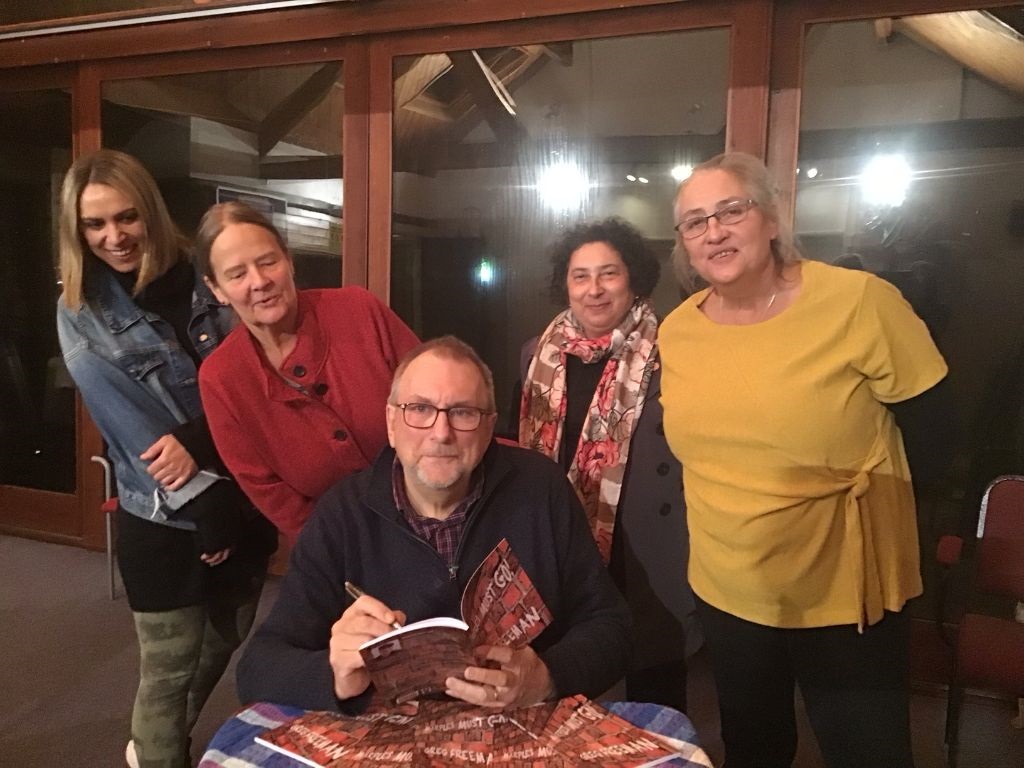
    Greg’s poetry collection Marples Must Go! has been published. It includes a sequence of five poems about the Sean Henry statues in Woking, and there has been an article about the book in the Woking News & Mail headlined “Poet creates back-stories for town centre’s famous statues” – a very favourable piece. A fellow poet has also made a short film starring Greg and four of the statues that can be seen on YouTube.  Fellow WWC member Carla has reviewed Greg’s book for the online literary quarterly London Grip.  

    Carla’s article titled ‘Intertextuality in The Handmaid’s Tale’ has gone through a rigorous peer-review process and has been accepted for publication in The American Review of Canadian Studies. Carla will let us know when it has been published.

    Can everyone have a think about a Christmas Gathering. We could hire the hall as usual, but please come to November’s meeting with some ideas.

    Readings:

    Tricia read another instalment of her pandemic saga. This focused on a coma patient awakening and having no experience or understanding of the Covid virus that made her sick. The consensus was that this would work well as a starting point for the whole story and that her awakening should be more gradual.

    Carla read a poem, ‘Variable conditions’, inspired by a walk near a lovely, ruined castle in a windswept area of the Northumbrian coast. The poem was highly regarded, and Carla’s use of language was positively commented upon. The first verse conjured up images of a beautiful memory shared. There was much discussion about the breeze waving through the clothes and how maybe another word would suit better. “The landscape” slashed was very evocative.

    Greg read his poem ‘Just Desserts’. This was a hilarious tale of revenge “best served cold” from Greg’s youthful days where an old neighbour who complained about Greg and his flatmates entertaining their girlfriends overnight got his  ‘Just Desserts’ through the letterbox – puds galore. It was funny and very well crafted, the use of both French and Italian desserts and the rat-tat-splat. Very much enjoyed by all. Liz suggested that the word ‘that’ could be replaced with ‘We’d’.

    Emily read another part of her romantic novel. The piece focused on the boredom experienced by the main character with family life and her hankering after “Jack”. The feeling was that this needed to be more fleshed out with added details, and more showing rather than telling. Suggestions were made as to how this might be achieved, such as confidences with a friend at toddler group, and dialogue between her and the partner.

    Liz gave treated us to another chapter in her diary of a somebody. This is based on Liz’s own journal writings. It was generally felt that elements that included dreams and a recent retirement and the changes that had brought about, were very insightful and of much interest and that it would be good to have one or two themes that ran through the whole diary rather than every little element. This would provide a more cohesive narrative.  The piece was generally enjoyed.

    Hilary read another chapter in her novel about Linnet. This centred on her childhood friendship with a girl called Rosa, which came unstuck because of Linnet’s conflicting emotions in coming to terms with her parents’ separation and her father’s alcoholism. Somewhat innocently Rosa comments on the father begging outside Lidl and the pair argue. By the time Linnet realises the importance of the friendship, her friend has left town. This was powerfully written, and the tension was palpable. It was a good introduction to why Linnet has such difficulties with her relationships. The emotions described felt very authentic and drew you in to the character.

    Next meeting: Thursday November 18 at St Mary’s church hall, Horsell

    Jobs:

    Wine: Carla

    Minutes: Greg

    Chair: Tricia

    Can someone bring milk and biscuits, please.

  • What happened at our September meeting – news and readings

    MINUTES OF WOKING WRITERS CIRCLE MEETING AT ST MARY’S CHURCH HALL, HORSELL ON 16 SEPTEMBER 2021

    Following our summer social at the church hall in August, this was our first in-person official meeting since the Covid lockdown in March 2020

    Present: Amanda, Liz (chair), Carla, Emily, Heather

    Apologies: Tricia, Alan, Dan, Hilary, Greg, Simon, Alex, Peter.

    News

    Amanda has reviewed ‘Looking Good Dead’ by Peter Jones. This appears on the WWC website. Amanda explained that the turnaround time for completing reviews and sending them to the theatre was very short; Greg then posts reviews on the WWC website. Amanda advised that upcoming shows at the New Victoria include ‘Bedknobs and Broomsticks’, ‘School of Rock’ and ‘The Play that Goes Wrong’.

    Carla does reviews for Write Out Loud and London Grip. She has recently enjoyed going to London and seeing exhibitions again and also saw Andrew Lloyd Webber’s ‘Cinderella’, which she described as ‘edgy’. Carla has been writing articles and one relating to ‘The Handmaid’s Tale’ has been submitted to the American Review of Canadian Studies; it is likely to be published soon, having gone through an extensive review process.

    Liz reported that the Book Club had enjoyed both ‘Hamnet’ (awarded around 9 out of 10) and ‘Shuggie Bain’ (9+). 

    Introduction:

    This was Emily’s first meeting and she was warmly welcomed. Emily has completed a Writers Bureau course and has been writing fiction.

    Readings:

    Carla read two poems. The first, ‘Ghirigori’ (Doodling) drew a contrast between her father’s jagged, sharp complex doodles and her own, “wistfully releasing/my aimless tensions,/but in a lighter way”. There was discussion about possibly shortening and simplifying the first two lines of the second stanza, but all agreed that the poem worked extremely well, effectively making the contrast between the two ‘doodlers’.

    Carla’s second poem was a reworking of ‘Wedding’ (Nozze), which she had read at an earlier meeting. Again, the marked contrast between the nervous bride and the calm composure of the groom was beautifully conveyed. The penultimate line of the poem was the subject of debate, it not being clear to the group that this was the line from an Italian song. It was felt that some explanation was needed and that possibly, ‘Resta qui con noi – stay with us’ would clarify the sentiment and enhance the listener’s appreciation of the poem.

    Heather also read two poems. The first one, ‘Forbidden Treat’ was a light piece about choosing to have her oven professionally cleaned as a birthday treat. She had enjoyed cooking a messy roast the evening before ‘Mr Sparkle’ was due to come, revelling in the “spatterings”. However, when he arrives her enjoyment is marred by imagining how appalled her mother would have been.

    Heather’s second poem, Forgetting’, was a very short poem (six lines) which sought to capture the value of words as a means of remembering a person as other memories fade. The first line says, “I squirrel away the things you say” and stresses that the writer wants unpolished, ordinary words: “I want your words uncensored,/funny and clumsy, the words of everyday”. Liz enjoyed the resonance of the words ending in ‘ay’ and felt this helped to create and close a circle.

    Emily read an extract from halfway through her romance novel. The audience appreciated Emily’s writing style, which managed to convey an underlying note of menace in an extremely subtle way. On the face of things, the relationship between Louise and Jack shows her as the vulnerable one, obsessing over social media and impossibly dazzled by Jack, but she is not as innocent as she seems. The group picked this up, suspecting that Louise could be a stalker and also feeling she is rather enjoying the drama of the situation. Everyone wanted to hear more.

    Liz read from her journal, ‘Diary of a Somebody’, alluding to ‘Diary of a Nobody’ featuring Mr Pooter. Liz makes daily entries in her journal, providing a detailed account of all aspects of everyday life. Liz’s life writing has a direct and vivid quality and all enjoyed her natural writing style. There was discussion about possible publication and the need for editing and organisation of the material into different themes. Emily suggested that this journal would be a wonderful legacy for Liz’s grandchildren to enjoy, painting as it does such a convincing and detailed picture of her daily life.

    Next meeting: Thursday, 21 October 2021 at 7.30pm

    Chair: Amanda

    Minutes: A volunteer on the night

    Wine: Carla

    Milk and biscuits: Liz

    Homework: No subject set

  • What happened at our July meeting on Zoom – news and readings

    WOKING WRITERS CIRCLE MEETING Thursday 15 July 2021

    Present:  Greg (Host), Carla, Hilary (Chair), Heather, Sarah Bell, Liz, Dan, Alex, Alan (Minutes)

    Apologies: Tricia, Amanda

    News:

    Heather had given a poetry reading to Carers UK, on Zoom. She found this a profoundly moving experience, feeling “humbled” by the carers’ unfailing concern for and commitment to severely ill children. Many carers were effectively trapped in their homes, with their loved ones or other dependents, as a result of the latter’s needs and the current restrictions.

    Hilary advised that Amanda has offered to host the next meeting in her garden, with the possibility of this being a social rather than a reading event. Heather will check with Amanda whether this could be on the usual third Thursday (i.e. August 19). Hilary also agreed to contact St Mary’s Horsell again, to find out if a September meeting there would be possible.

    Readings: The homework theme was ‘The Beautiful Game’.       

    Carla read a poem entitled ‘Watering My Pot Garden’. The repetitions of key phrases made for very powerful, emphatic verse, giving a physical impression of the sheer effort required to maintain a garden. Listing various flowers and vegetables in the opening verse formed an original and effective introduction. The phrase “pot garden” gave rise to amusing speculation about possible drug-related connotations. The dual imagery of snapdragon blooms, firstly in terms of their colours and then their skull-like shapes, was a subtly unsettling, brief  ‘modulation into a minor key’, felt to be worthy of masters of the horror or Gothic fiction genres.

    Greg, having regard to the homework theme, read a poem called ‘Touchline Dads’, recalling brawling fathers at a kids’ football game. Vivid imagery allowed us to visualise the two parents setting about each other like ferrets in a sack, following one child’s goal being disallowed. Everyone admired the nostalgic atmosphere and powerfully invoked passion of being a dad on the touchline. Greg also recalled his own warning from a referee, for being an over-involved parent.

    Dan read ‘The Nebula’, a short story about a spaceship travelling through a highly radioactive and dangerous asteroid or similarly threatening belt of galactic horrors. The narrative examined the psychological effects (as recorded in the ship’s log), of the dangers on the various crew members. Great escalation of tension and effective use of detail combined to produce a gripping tale with a strong sense of imminent doom. Dan explained that he was considering adjusting the length of this piece, to comply with competition or other submission requirements. The creeping, growing horror of the plot, including the loss of individual crew members, apparently callously recorded by the narrator, impressed all listeners as a subtle technique.

    Heather read two wonderfully atmospheric poems. The first, with the splendidly deceptive, apparently utilitarian title of ‘Loading The Dishwasher’, was a lovely fusion of domestic irony and faux noire. This included a marvellous satirical reference to Munch’s ‘The Scream’, combining that image with a reference to a knife in the poet’s hand. Alex shared an interesting reference to the link between different people’s methods of dishwasher stacking and their personalities, that she’d discovered through various past conversations. Heather’s second poem, ‘Pegging Out’, was another master class in atmospheric period detail, garnered from childhood memories of her mother’s domestic circumstances, including references to finger drawings on window panes that “wept into black, rotting frames”, as the scrawls were destroyed by running condensation. A reference to the copper vessel commonly used in those days effectively recreated the wearying tedium of washing day.  Allusions to the fatigue and effort associated with all-day washing routines, devoid of domestic appliances, conjured images of war. These made the contrast with her mother’s joyful experience of the wild, untamed sensation of the wind, up on their tiny balcony, with billowing sheets, all the more effective.

    Liz read more from her life writing journal, entitled ‘The Diary of A Somebody’. All enjoyed the various references to wildlife – green woodpeckers “feeding exactly like pneumatic drills” and a dehydrated, wrinkled frog that she had to pick up and remove. These were interspersed effectively with memories of patchwork sewing and asides about the origins of her early experiences of wildlife – a dislike of birds being ascribed to her father deliberately showing her a scrawny, naked baby cuckoo. One particularly charming reference involved a russet-breasted robin darting into the cover of a nearby hedge. Another section dealt with scenes from Liz’s childhood at a farmhouse on the Hog’s Back. We learned of the chicken house – warmer and hence more welcoming, due to its location on the south face of the Hog’s back, than the farm house on its north-facing counterpart. An atmospheric description of her fear of a broody hen’s probable reaction to attempts at egg collection, together with scenes from a party, with a chandelier fashioned from an old bicycle wheel, candles and jam jars, completed a memorable album of imagery.

    Hilary finished off the currently untitled short story that she had commenced reading at the previous meeting, involving Julie and Margery, Julie’s adult neighbour from childhood. This had begun with a doorstep conversation, in which Julie introduces herself to the vicariously predatory Margery, as Mrs Terry’s daughter. The whole excerpt was a masterclass in gripping atmospheric tension, powerfully realised by means of tellingly authentic references to Julie’s father’s past domestic tyranny and controlling behaviour. Images such as the rigidly regimented mealtimes and ritualistic covering of the “never-to-be-seen polished wooden table surface” created a menacing atmosphere of bristling resentment.

    Sarah read some observations of an author being introduced to an audience by a librarian, prior to reading from her “dark, Gothic novel”. This was a very effective piece of descriptive writing, with a particularly effectively rendered contrast between the sinister narrative and the writer’s warm friendly personality.

    Alan read a story called ‘Cut To The Chase’, about a murder investigation that initially appeared to highlight Tim and Melissa’s young gardener as the prime suspect. Tim, however, affronts the DCI on the case by proving to him, by means of a discourse on the technicalities of lawn mowing using rotary or cylinder mowers, that he’s got the wrong man. The twist to the tale, plus the balance of technical detail and characterisation were enjoyed, with gratifying comparisons being made to Inspector Morse.

    Next Meeting: Thursday 19 August, 7.30 pm by Zoom – Note: This day and time subject to confirmation, as the reading meeting may be replaced with a social gathering – see News .

    Chair: Dan

    Minutes: Heather

    Homework Theme: ‘A Summer Party’

  • What happened at our June meeting on Zoom – news and readings

    WOKING WRITERS CIRCLE ZOOM MEETING ON 17 JUNE 2021

    Present: Amanda, Hilary, Alan, Liz, Greg, Carla, Alix, Heather 

    Apologies: Simon, Tricia, Dan, Melanie

    News:

    Liz reported that the book group had read Shuggie Bain and would be discussing it at the meeting on Monday 21 June.

    Alan’s book, Theta Double Dot, had been picked for consideration for a TV mini-series. Alan had received a most encouraging letter. He would let Greg have this to be shared on the WWC website. Members were encouraged to post reviews of Alan’s book on his Amazon website page.

    Greg has posted Carla’s review of Michael Ayrton’s exhibition at the Lightbox on the WWC website.

    The launch of Greg’s poetry collection Marples Must Go! is planned for September 2021, accompanied by “an avalanche” of publicity.

    Hilary reminded members about the Guildford Fringe Festival and in particular the appearance of John Harper at 5pm on 10 July at The Star, Guildford. 

    Greg raised the question of return to the church hall for face-to-face meetings and it was agreed that September was probably the soonest that this would happen. Hilary would investigate the position regarding bookings without committing to any firm arrangement. 

    Amanda asked about a social get-together in August, possibly in Woking Park. It was agreed that early August would probably be good timing for such an event.

    Readings:

    Alix read ‘Alice in Wonderland’, reflecting the ‘Wonderland’ homework topic.  This was a profoundly moving story about a young girl with special needs, who ‘felt like a queen’ at home and encountered unkindness on her way home from school one day when older boys snatched her satchel. Although dealing with important issues, these are conveyed all the more effectively by the author’s lightness of touch. We are not told exactly what Alice’s problem is and this works well. Everyone agreed that Alix should write more fiction of this nature for the young adult market.

    Heather read a poem about her own wonderland, ‘Pavarotti in the Kitchen’. This featured the ‘ridiculous’ activities associated with cooking a meal and the ‘sublime’ pleasure derived from Pavarotti’s rendition of La Boheme. Liz challenged someone to sing, Che gelida manina (in Italian) and, in a heartbeat, Carla magnificently obliged. A truly magical moment!

    Hilary’s piece – as yet untitled – featured two characters who spoke in turn with no written device to identify the change of speaker. The first speaker is Julie, who we meet approaching the door of the house where her mother has recently died. The second speaker is the neighbour Marjorie, who doesn’t recognise Julie at first and is desperate to engage her in conversation, having an ‘eager to chat’ look on her face. Julie senses that Marjorie wants her to feel grateful. She remembers the cupcake that Marjorie gave her which her mother had thrown in the bin. All agreed that the changes of speaker were clear without any written indications. Hilary said she was about halfway through the story. It was suggested that the BBC might be an appropriate market, but Hilary said that they no longer accept pitches. Greg asked for information about short story competitions to be sent to him for the WWC website.

    Liz read two pieces which flowed from her journals. The first piece, ‘Recalling’, featured a girl escaping from the confines of education to travel the world as a member of cabin crew for Emirates. The descriptions of fashions were vivid, as in ‘floaty dresses’ and ‘bikinis worn under huge sun hats’. The girl is, of course, Liz’s daughter and there was a subtle reference to her meeting ‘The Quiet American’ and their subsequent wedding. The second piece, ‘Naming’, related to the birth of Liz’s granddaughter, Luna, on 27 May 2021. Everyone enjoyed the way that Liz had captured the vividness of these events and congratulated her on Luna’s arrival!

    Greg’s contribution was a wonderfully evocative poem, ‘See Britain by Train’ (featured with a splendid poster of the Yorkshire Coast near Whitby on the Poetry in Surrey Libraries website). The poem met with unanimous approval, with the ‘implied gentle sarcasm about the veracity of posters’ (thank you, Alan!) greatly enjoyed.

    Alan also used the homework topic in his story, ‘Blown Away’. This told the sorry tale of Pam and Simon, who are in the throes of a relationship breakdown. While they are away, they  contemplate ‘the carcass of the holiday’. The return home is dreadful and once back, Pam looks out to see a cloud formation that identically replicates the mountain range of their holiday location. When she looks again, the cloud formation has ‘blown away’ – as has their relationship. Everyone enjoyed Alan’s story with its unsettling sense of impending doom.

    Carla had written a prose poem in the course of a workshop, ‘How do You See Yourself in Five Years?’ This was a very real assessment and consideration of future goals and the writer’s capacity for fulfilling her ambitions as the years pass. All agreed that this was a sensitive and well-written piece, which could be reworked as a conventional poem.  

    Date of next Zoom Meeting: 15 July 2021, 7.30pm

    Homework: A Beautiful Game

    Host: Greg

    Minutes: Alan

  • What happened at our May meeting on Zoom – news and readings

    MINUTES OF WOKING WRITERS CIRCLE ZOOM MEETING ON 20 MAY 2021

    Present: Tricia, Hilary, Alan, Liz, Greg, Carla, Heather 

    Apologies: Alix, Danny, Sarah DD, Amanda

    News

    Carla has attained her PhD – many congratulations, Carla! She is reading submissions and commenting on them for Litro magazine and the editors then decide whether to publish. Carla has also revised an article about her grandmother that she wrote before Christmas and this will be published by Memoir Magazine.

    Alan’s ghost story, ‘The False Note’ was originally published on the NAWG website and a recording of Alan reading this and other stories is accessible from Woking Writers website via the link to Alan’s website.

    Liz reported that the Book Group had read Wise Children by Angela Carter and admired it greatly. The next meeting will be on 7 June and the book to be discussed will be Shuggie Bain, winner of the Booker Prize.

    Hilary is doing a six-week course, ‘Finishing Your Novel’, run by Curtis Brown and is finding it useful.

    Heather had reached the final six in the ‘experienced amateur’ category of the King Lear Poetry Competition.

    Readings

    Tricia read part seven of ‘The Deadly Crown’ which plunged her listeners into a world dominated by the Covid virus. Tricia painted a vivid picture of rich countries keeping the virus at bay, while poorer countries were unsupported in their struggle. Corruption was rife. The descriptions of the changes in London, with the emptiness of Trafalgar Square and absence of cafes were vividly drawn. Hilary commented that each part of the work was very powerful and that Tricia might look at connecting the different parts in a more seamless way. 

    Greg read a poem, ‘The Paper Round’ (after Simon Armitage) which impressed with its vivid images and the satisfying way it came full circle. A reference to ‘garden paths’ cleverly linked Greg’s future career in journalism with his boyish enthusiasm for reading the front pages of the papers and making his ‘fingers grubby with newsprint’. 

    Carla presented two poems, both of which were greatly enjoyed. The first, ‘Doodling’ drew on memories of her father doodling geometric shapes with sharp edges. Carla also doodles, but in ‘a lighter way’. Her second poem ‘Wedding’ examined etymology and described in vivid terms the difference in mood between the bride and groom. She is anxious, ‘stomach churning’ while he seems very relaxed. The final lines were very dramatic. Carla is thinking of doing more work on this poem and was asked to bring it back to WWC in due course.

    Heather read a poem, ‘May Masquerade’, which was a description of a morning in May when the garden was full of ‘tricks’, with snail slime appearing as a necklace on a fence and nails shining like rubies. In this magical, shining world, even the laurel, ‘dusty and Victorian in July’, looks as if she might lift up her skirts and dance across the lawn.

    Alan’s story, ‘Light Camouflage’, responded to the theme of the homework, ‘Maybe’. As always, tension was maintained throughout with the listeners not being sure what was going on – which was, of course, the author’s intention. The dialogue successfully carried things forward without the need for descriptive passages which could have slowed things down.

    Liz read from her journal which she had started in a new spiral notebook. She had started dating her entries and including a note of actions to be taken at the end of each entry. The journal had immediacy and a range of emotions, most notably in the references to the milkman no longer calling and memories of past associations with milking cows. All agreed that the associations with milk and the changes in the milk industry would be very marketable, particularly as they were recorded by ‘the daughter of a dairy farmer’. It was suggested that ‘Best of British’ magazine might be a marketing opportunity.

    Hilary contributed a piece written for a course exercise which required the writer to put somebody in a position of jeopardy. Hilary had chosen a woman walking home at night down ‘Solomon’s Cut’. Hilary’s listeners were on the edge of their seats as the woman  walked over the uneven stones and heard a whistle half-way along the path. She heard the call, ‘Specko’, and looked at the ground as instructed, only to see her shadow who threatened to leave her.  Fortunately, none of us had to follow that!

    Date of next Zoom meeting: 17 June 2021, 7.30pm

    Homework: Wonderland