Category: Members

  • Woking Writers Circle holds its first meeting online

    Woking Writers Circle holds its first meeting online

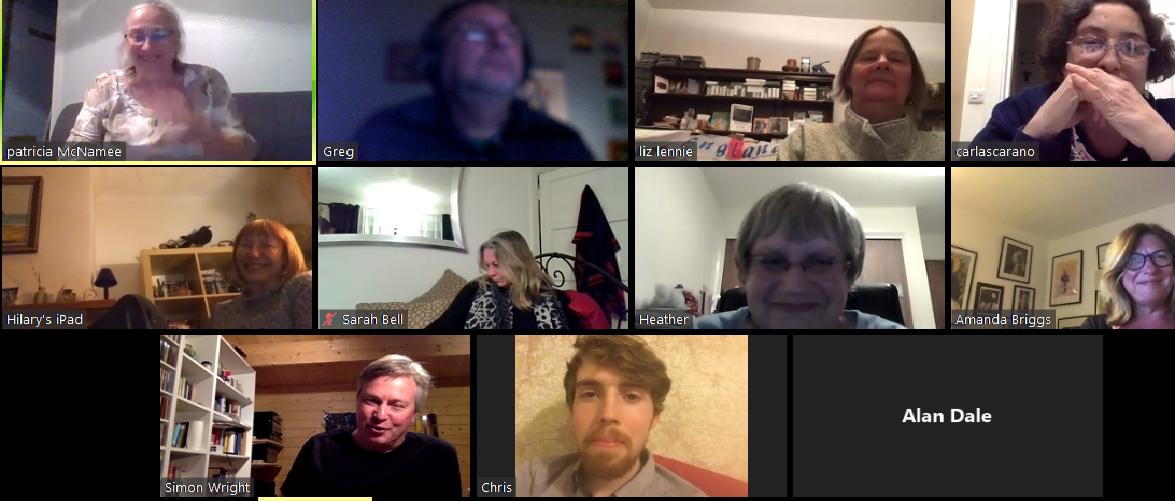
    Woking Writers Circle held its first online meeting on Thursday 16 April – and it was a great success. It was organised and set up by our secretary Amanda Briggs, who has expertise and experience in video conferencing, and attended by Tricia, Greg, Liz, Carla, Simon, Hilary, Sarah DD, Heather, Alan and Chris. An excellent turnout!

    Apologies for missing LIz’s opening contribution, owing to my late arrival at the meeting. Tricia followed with a very thoughtful essay on what had happened so far in the coronavirus crisis, and what might take place in the future. She rocked us back on our heels by talking about 20 years from now.

    Carla gave us a series of five delicate and elegant coronavirus haiku, and picked out one in particular which she said she had submitted elsewhere:


    Long days of stillness,

    no hurry to reach

    the end of the rainbow.


    Alan read a piece of flash fiction, About Face, which was unconnected with the crisis, but with a decidedly medical theme – and an in-your-face twist, as it were.

    Simon’s finely wrought sonnet matched the fleeting world of the may-fly with a relationship which, it emerged, was long gone. He said it was inspired by a quote from Pablo Neruda: “Love is so short, forgetting is so long.”

    Sarah read us a moving poem that she had “scribbled down” earlier that day called ‘Broken Shards’, using the metaphor of shattered glass while describing the plight of an older person waiting for death.

    Liz let us know about the book group’s next project, which is Anne Bronte’s The Tenant of Wildfell Hall, before we broke for an interval so that we could all take part in the 8pm clapping in support of the NHS front-line workers who are risking their lives to save ours.

    When we resumed, Heather read her sonnet, ‘Song of the virus’, which describes this “thing of beauty magnified” as “hitching lifts on kisses”. It ends: “And as you isolate you might agree – / it’s odd that such a loving God made me.”

    Hilary has been thinking about the theme of transformation, while reading a huge treatise about fairy tales, called From the Beast to The Blonde. She has been thinking about such ideas for her next novel, which will involve hairdressing.

    Greg has been writing a series of poems during the crisis, a kind of poetry journal, and he read two of them: ‘Love in the Time of Coronavirus’,  about life in West Byfleet, and ‘Dancing in Marbella’, about lockdown in Spain.

    Chris said his lockdown hobby has been writing a web serial under the title ‘ An ordinary novel but every 10,000 words the audience kills the least interesting character’. He warned us: “It’s more performance art/first draft than serious literature, so don’t expect anything too amazing.” Here’s the link

    Amanda read another of her satirical pieces about a fictional school and the chaos that ensues as it approaches lockdown. She began: “The school was disintegrating. It was a sinking ship, and we were at the helm as it went down. Students and teachers had started to abandon ship way before we were ready to launch the lifeboats.” The Titanic analogies didn’t stop there. And it ends thus: “A few days after we officially closed, I went into work one last time to collect essential items from my office … Panic buying was its peak at this point, and worries about acquiring basic necessities had overtaken those of continuity of education. I started sorting through my files, deciding which might be most useful, but went instead to the supply cupboard, and filled my bag with boxes of tissues. Loo roll substitutes. The impact of the virus had finally begun to sink in.”

    It was a very jolly evening. We listened to each others’ work, and commented, as we always do, but in an entirely different setting. We agreed to hold another meeting in just a fortnight’s time, instead of the usual month. That will be Thursday 30 April. The homework subject – “Transformation.”

    Greg Freeman
  • CORONAVIRUS: A MESSAGE FROM OUR CHAIRMAN

    Dear Friends

    Thank you to those who were able to respond to my email of 14 March.  Only a couple of you said you would like to attend, and those responses were before today’s government advice for all to avoid non-essential contact.

    We will cancel this month’s meeting on Thursday 19 March and wait to see how things develop month by month. I will try to sort out a system to enable us to share work and receive feedback – a virtual WWC. I will be in touch but keep writing, stay well.

    Peter

  • What happened at our February meeting?

    Owing to a technical problem we can’t bring you any details of news or readings from February’s meeting. What we can tell you is that the date of the next meeting is Thursday 19 March, when the homework topic is ‘The Flood’.

    Jobs:

    The role of chair is vacant.

    Minutes: Peter

    Wine: Simon

    Milk and biscuits: Amanda


  • What happened at our November meeting – agm, news, and readings

    WOKING WRITERS CIRCLE 30TH AGM and NOVEMBER READINGS at ST MARY’S CHURCH, HORSEL, 21 November 2019

    Present: Greg, Peter, Heather, Dan, Alan, Amanda, Liz, Hilary, Kate, Chris, Sarah DD

    Apologies: Simon, Tricia, Cathy

    2019 AGM

    1. Minutes of 2018 agm were accepted.
    2. No matters arising.
    3. Venue: the move to Horsell and St Mary’s has been well received, and we’re happy with the move, and wish to continue.
    4. Chairman’s report (Peter Morley): Numbers are stable, however new members are always welcome. The standard of writing has improved, and members have reported various successes and publications, often reported on our website. The theatre and art reviews from the New Victoria theatre and the Lightbox add interesting  contributions to the website. More similar or locally related articles are encouraged.
    5. Treasurer’s report: It has been decided not to continue our membership of the National Associations of Writers Groups. Greg or Hilary will close the account. Current membership: There are 11 paid-up members, although we need 16 paying members to break even. Current funds will allow us to continue without increasing membership for another year. Current subs are £24. We may need to raise it by £2 next September.
    1. Website report (Greg Freeman). Greg felt the website had featured more items in the past year, and was a lively mix of arts reviews and reports of members’ successes and activities. He repeated Peter’s call for more articles on local matters, and said The Ambassadors and the Lightbox both value the coverage they get form us.
    2. Election of officers: current officers approved. Chairman: Peter Morley,                        Treasurer: Hillary, Secretary: Amanda, Steering committee member: Liz, Website Manager: Greg.


    NOVEMBER MEETING

    News

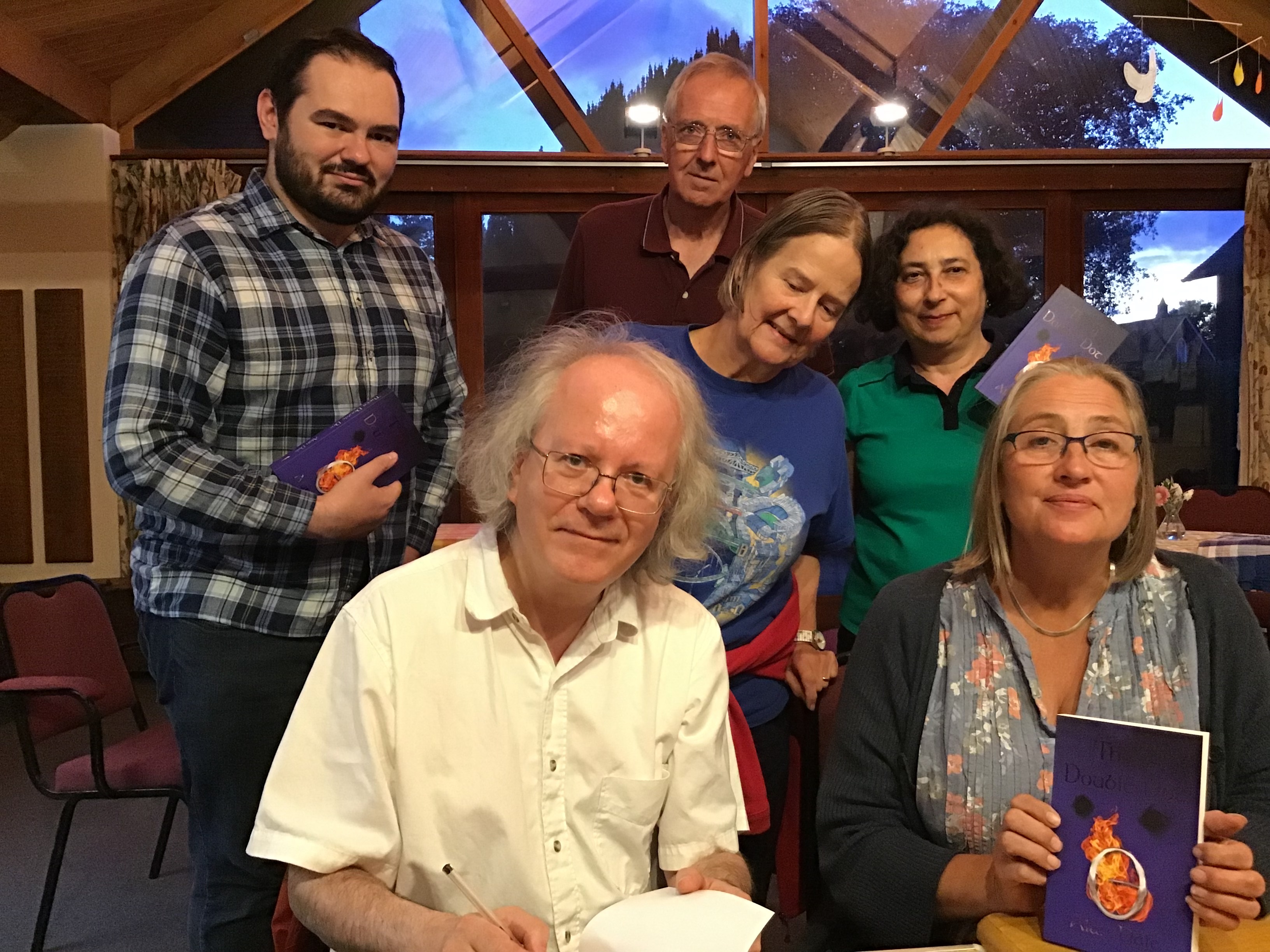
    1. Alan is continuing to push forward with publicity of his novel, Theta Double Dot, which is going well, with particular thanks to his hairdresser. There’s a rumour a book club has picked it up.
    2. Greg, aka Pirate no.3, promoted the forthcoming Send Amateur Dramatic Society  pantomime, ‘Treasure Island’ written by Ben Crocker, one of the best writers in the field, and “one of the best we’ve done”. It has since played to often packed houses and much acclaim.
    3. The WWC Book Club recently read the Secret Life of Bees: rated as 8/10, very positive and life enhancing. Next meeting Jan 13, to review The Ginger Tree by Oswald Wynd.
    4. December (19) meeting will be a social at the hall. Peter and Rosie to bring a meat and veggie chilli. Open to all members and partners. Please communicate numbers, and what you will be bringing to Peter, in order to avoid an overabundance of mince pies and sausage rolls.
    5. One of Carla’s academic articles has been accepted by a Warwick University magazine, to be published in January. It has a Margaret Atwood connection with regards to the consumerism society.


    Readings:

    Greg’s ‘A Puritan’s View of Bonfire Night in Lewes’ was a vivid,  colourful, vibrant poem, capturing the truculent, rebellious nature of the town, which has a tradition of civil disobedience. The excitement and thrill of the parade and celebration was well conveyed, and the change in imagery and tone at the end provoked a lively discussion, reinforcing the effectiveness and power of the poem.

    Heather read two poems. In the first, ‘Lunch’, a sharp old aunt listens for the ping of the microwave, whilst fantasising about her love of deliciously cooked food. A surprising ending that made everyone laugh out loud. ‘The Outing’ was a poignant, sparse poem about a day trip with a disabled loved one, which ended in humiliation and rage. The emotions conveyed were powerful and evoked a strong response from members. Although very different, both poems were hugely admired for the powerful imagery, and treatment of the subject matter, and skill and versatility in style.

    Carla read three poems, ‘Fallen Leaves, November’; ‘Negotiating Caponata’; and ‘Country House’. All three were beautifully rich and deep; described as requiring time to consume at length to fully appreciate, perhaps ideally to be read and savoured with a glass of whisky in front of a warm fire. The third poem, ‘Country House’, received the most comments;  images of catching lizards were evocative, as were the destruction of the snake eggs. The interesting juxtaposition of cruelty and innocence was well-regarded.

    Hilary continued with her psychological thriller novel. Sam is living in a large house with her new husband and extended family, including her two nieces (aged two and five) who are a constant cause of annoyance. We learn that Sam is secretly taking contraceptive pills. Her only pleasure is swimming in her pool. After the swim, ‘almost immediately things start to go wrong….’ The dark undertones and sense of menace is constant – very taut. The listing device was very effective in understanding Sam’s state of mind. The voice of the 5 year old Maisie was discussed, with reference to the adult tones. As we get deeper into the story, we see this is becoming a real page turner!

    Kate read chapter three of her novel ‘The Heron Pool’. Previously: After an unexpected break up, Lucien the narrator, has fled to his family home … Lucien is disturbed in the middle of the night,  which leads him to the garden to search for an intruder. He is drawn to the pool where he sees a young woman swimming in the lake before mysteriously disappearing. The piece was admired for the descriptive style; the garden was particularly well described, painting a dreamlike picture in the moonlight.

    Daniel’s short story, Ellie’s Game, was fast-paced, fast-read, and universally admired. An avid video gamer finds solace in the gaming world whilst hiding his university rejection letters from his parents. He is at the point of contemplating suicide when he becomes enamoured by a fellow gamer, ‘Ellie’. A connection soon develops, with unexpected consequences. A highly entertaining piece with unexpected twists and turns;  the combination of prose, character, style and plot were considered masterfully done by the delighted group.

    Alan’s short story, Please Do Not Walk on the Illusions, was a tale of two halves – recollections of a learning experience in a vividly described classroom leads to another one of ‘life’s vignettes’ at a later stage of life, involving a desert plant as the focal point for a busy office’s beleaguered workers. Cemented by Alan’s inimitable style and lexicon, the piece gave the audience much to enjoy, and was universally accepted as very entertaining.

    Chris read an extract from his fantasy fiction novel, Pipe Down. Kelvin is distraught when he finds his boss about to fry up a gigabird egg after 10 months of tender care in the hatchery. This leads to an animated discussion between Kelvin, Maddie and Ros on the distinctions between caring for and the exploitation of both humans and animals. Group response: loved it – very enjoyable. Notably for the distinctive narrative voice, strong sense of identity, good use of dialogue and action.

    Liz: Life Writing – Portraits (various, 1921-51?). A photo of a family gravestone, a photo album of various members of the family on the Brock family farm and surroundings, is the inspiration for this piece of writing. Liz warmly describes the family members, ponders on the circumstances of the photos, whilst building a strong, nostalgic sense of character, time and place. There was a sense of authenticity and even catharsis to the piece. The group agreed it would be interesting to use the photo album as a device to create a structure for a story, prompted by a lovely last line; ‘The album – it’s full’.

    Sarah DD’s inspired ‘eleventh hour’ poem, written whilst relaxing on the sofa contemplating a piece of art, was highly evocative and identifiable, noting that the value that one holds in a piece of art should be measured in how it makes you feel, and not its monetary value. The group asked for a second reading, enjoying and much discussing a couple of lines in particular – “All that is human …”and “The ignited mind”.

    This last piece was surely the prompt to ignite the minds of the group to do the next homework, ‘Ekphrasis’: a literary description or commentary on a visual piece of art


    Upcoming reminders:

    Christmas party: Thursday 19 December. 7.30 pm. Pot luck – please bring a dish or something to drink. A literary game or two?


    Next reading meeting: Thursday 16 January

    Homework: Ekphrasis

    Hilary: milk and biscuits

    Kate: Wine

    Heather: Minutes

    Carla: Chair


  • What happened at our October meeting: news and readings

    WOKING WRITERS CIRCLE MEETING AT ST MARY’S CHURCH, HORSELL

    THURSDAY 17 OCTOBER 2019

    Present: Greg, Amanda, Alan, Hilary, Chris, Heather, Liz, Sarah, Daniel, Kate, Peter, Simon

    Apologies: Carla, Tricia

    News

    The AGM will take place at the start of the next WWC meeting on 21 November, at the earlier time of 7pm. Among the items on the agenda, it will be discussed whether the annual subs need updating and whether the NAWG subscription should be renewed, in order to ensure that cashflow keeps pace with outgoings.

    We welcomed Chris, a “new” attendee who had previously visited WWC last year.

    Liz reported that the Poetry Society is organising a competition for “ekphrastic” poems – poems inspired by works of visual art – of up to 40 lines for members.

    Several reviews have gone up on WWC’s website, including Greg’s of a production of The Entertainer, Amanda’s of Avenue Q, and Carla’s of an exhibition of the Scottish Colourists.

    The book group were due to meet at the Crown in Horsell on 4 November. The topic will be Sue Monk Kidd’s The Secret Life of Bees.

    Alan reported that his book, Theta Double Dot, is being displayed at Frankfurt Book Fair.


    Readings

    Heather kicked the meeting off with her poem, The Dispossessed. Exploring themes of the struggle between nature and human civilisation, the group praised the brutalist imagery of the piece and the haunting sign-off, “for death is not the same as rest”. Heather explained that she had been inspired to portray different forms of dispossession as a result of her experiences in prison… before hastily clarifying that she had not been on the wrong side of the bars!

    Daniel read his short story, The Cost of Good Manners, which satirised the fetishisation of manners and proper etiquette. He had attempted to emulate the atmosphere of Margaret Atwood’s dystopias, and the group agreed this came across well. Some suggestions were made to improve pacing, and an alternative title of Manners Maketh Man was proposed.

    Chris also read a short story, You Want to Wait for Another Hitler?, about the ill-conceived theft of a fantastic new gun. The witty cut-and-thrust dialogue was singled out for particular praise, which managed to amuse the reader without getting in the way of the pulp sci-fi-style action and breakneck pace.

    Greg read St Winwaloe’s, Gunwalloe and St Mary the Virgin, Burgh St Peter, two very evocative poems relating to old churches. He captured beautifully the characters of the two buildings and the decay suffered by them, and introduced wonderful new terms like “wherry men” to the group’s collective vocabulary. In response to a question posed in the latter poem, it was agreed that Larkin probably would have been kinder to the latter church than Pevsner.

    Kate also brought a poem, The Thief, which used the metaphor of an owl swooping on a fieldmouse to explore themes of fear and loneliness. She used some brilliant striking imagery to paint the hollowness of the narrator, and the absence of a guiding light moving forwards. Some small suggestions were made as to word choice, in order to maximise the impact of the powerful last lines.

    Peter brought the beginnings of an as-yet-untitled story about a boy, Tommy, and his sister learning to ice-skate in inter-war London. Peter asked for comments in particular on the depiction of English anti-semitism, which sparked a lively discussion. It was agreed that the bigoted comments of Tommy’s father were very effectively contrasted with his support for the war effort, but those themes should be developed more or, if they are not to be a main focus of the piece, pruned back slightly to make room for the ice-skating plot.

    Liz read two poems, What am I Like? and The Pocket Watch. The first piece was light-hearted in nature while the latter was more sombre, and inspired by a century-old pocket watch which Liz passed around the table. Both poems were admired by the group, and opinion was fairly evenly divided over which was the better of the two.

    Alan read a short story, As Witness, This App, which zipped along in his trademark style with a twist – the story was made up entirely of dialogue. This enabled Alan to pack a lot of action into fewer than 500 words. Particular appreciation was reserved for his excoriation of telephone cold-callers.

    Amanda read a piece paying tribute to her friend, RWR (or Red Wine Richard), who despite his illness recently threw a party in celebration of his life. Amanda wrote a very respectful account of the proceedings while capturing the essence of a larger-than-life personality. Sadly, shortly after the meeting, Amanda received news that RWR had passed away. He sounds like somebody we would all have liked to know.

    Hilary read from her work-in-progress novel, a psychological thriller. The extract was gripping, ratcheting up tension by exploring the shifting power dynamic between the main character and a psychiatric nurse. Hilary reported that she has finished the first draft and is now on rewrites.

    Sarah read a variety of notes she had taken in her 365 Days of Happiness book. The subject matter ranged from Alan Rickman’s diction to a “Sarah-ism” about compasses to how sad Philip Pullman looks! Truly, a note or thought for every occasion.

    Next meeting: AGM on Thursday 21 November 2019 at 7pm, followed by regular session at 7:30pm.

    Homework theme: “The Border”.

    Jobs Chair: Simon. Minutes: Amanda. Wine: Greg. Milk and biscuits: Liz.

  • What happened at our September meeting – news and readings

    MINUTES OF WOKING WRITERS CIRCLE MEETING AT ST MARY’S CHURCH HALL, HORSELL ON 19 SEPTEMBER 2019

    Present: Peter, Dan, Kate, Amanda, Alan, Liz, Simon, Greg, Carla, Heather

    Apologies: Tricia

    News

    Greg reminded everyone that the regular monthly poetry open-mic meeting of Write Out Loud Woking would take place on Thursday 26 September at 8pm in the cafe at the Lightbox.

    Tricia had reviewed the Northern Ballet’s production of Cinderella at the New Victoria theatre in Woking, and you could also read Carla’s review of the Royal Institute of Painters in Water Colours exhibition at the Lightbox on the Woking Writers Circle website, too.

    Heather’s poem, ‘The Birthday’ had received a commendation in the Ware poetry competition, and had been published in the competition anthology.

    Liz reported that the Book Club had read ‘The Underground Railroad’ by Colson Whitehead and awarded it their highest ever mark of 9 out of 10. The book for the October meeting will be ‘The Secret Life of Bees’.

    Liz also advised that the Guildford Book Festival would take place from 6-15 October. There is a packed programme, including various creative writing events.

    Introduction

    This was Kate’s first meeting and she said she had decided to come along because she felt her writing had ‘ground to a halt’. Kate had written a novel and was looking for feedback and help.

    Readings

    Peter provided photos rather than words as evidence of feverish construction activity which he said had prevented him from writing. All agreed that the resulting edifice is a thing of beauty and evidence of much hard graft (and not just by Peter!).

    Heather read a poem, ‘Tarquin’ which she described as extremely silly.. The poem included the phrase, ‘mad wriggle’ in an effort to fulfil the homework brief. She also read her commended poem, ‘The Birthday’, which was felt to capture the sadness and inevitability of the distancing and loss of a much-loved friend.

    Kate read the first chapter of her novel, ‘The Heron Pool’ which concerned the acrimonious break-up of a relationship. All agreed there was a satisfying build-up of tension, but that this could possibly be further enhanced by shortening the first part featuring Lucien’s journey home. There could also be more showing than telling; although when action occurred it was powerfully conveyed and heightened the tension. All agreed it was a powerful piece of writing and there were some extremely vivid details, such as the fragments of the broken vase.

    Carla read her poem, ‘Cooking Betrayal’, which has been published in the latest edition of South magazine, and which was greatly admired. Telling use was made of herbs and food items as ingredients to reflect the ambiguity in a relationship in terms of culinary images. There was not a word wasted and the overall effect was lyrical, powerful and memorable.

    Dan read the prologue to his novel, ‘Child Night’, which he had written some six months previously. The cult mentality was conveyed most effectively and there were many memorable phrases, such as the air being churned by helicopter blades. All agreed that this was absolutely right for a prologue; it conveyed suspense and mystery and captured attention.

    Greg read four poems as a sequence inspired by Sean Henry’s sculptures in Woking: ‘Woman (Being Looked At)’, ‘Standing Man’, ‘The Wanderer’ and ‘Seated Man’. These worked extremely well as examples of poetry derived from, and inspired by, another form of art. There was discussion about contacting the Lightbox and the arts representative at Woking Council, and also putting something on the WWC website.

    Liz had attended a Positivity Summit in London and had written about two speakers that she had particularly enjoyed. ‘Boyd the Boxer’ and ‘Murphy the Skater’ had both overcome significant problems in their lives and radiated warmth and positive emotions. It was, however, Liz’s sharp observations about the ‘New Age Guru’ running the event that really evoked interest and it was suggested that she should write about this. Liz felt that this honesty would make the work unsuitable for publication. Further thoughts were that she could feature the characters in a poem or a short story.

    Amanda’s poem, ‘After Blackberrying’, was full of powerful and satisfying images conveying how nothing stands still in Nature or in family life. The poem contained some beautiful and memorable lines, including ‘Silent and songbird still,’ ‘A red kite beckoned me back’ and ‘Silence no longer echoed emptiness’. The picture of the common being turned into moonscape before Nature regenerated and provided a habitat for ground nesting birds has stayed with the minute writer, who possibly over-empathised with the homeless foxes and rodents!

    Alan sang ‘The Weekend Belongs to Cats’ which was greatly enjoyed by everyone. This wonderful piece was inspired by ‘Tomorrow Belongs to Me’ from the film Cabaret. The words fitted – apparently effortlessly – with the tune and it was the purrfect conclusion to a most enjoyable meeting.


    Next meeting: Thursday, 17 October 2019 at 7.30pm

    Chair: Greg

    Minutes: Dan

    Wine: Heather

    Milk and biscuits: Amanda

    Homework: Under the Mask

  • What happened at our August meeting – news and readings

    What happened at our August meeting – news and readings

    MINUTES OF MEETING ON THURSDAY 15 AUGUST 2019

    Present: Tricia (chair), Simon, Amanda, Hilary, Peter, Carla, Dan, Liz, Alan (minutes),

    Apologies: Greg, Heather, Sarah DD

    NEWS

    Carla returned from Canada. Her tutor had dissuaded her from seeking an interview with Margaret Atwood, deeming it inappropriate, due to the subject’s current onerous workload. Carla expanded on her Facebook impressions of the two principal Calgary libraries, detailing various aspects of her current research on Margaret Atwood. She submitted a piece on comparisons between Beckett and Atwood, and had a review on her speciality published. Part of the introduction and four chapters of her doctoral thesis are now complete. Various visa difficulties, social events and meetings with Canadian poets and authors completed an eclectic summary of her travels.

    Liz confirmed Alan’s recent discussions with Woking library. regarding a possible launch event involving Woking Writers and his publisher, Austin Macauley. This, as with Walton library, whom Alan has also approached, now depends on the respective libraries’ decision on whether to stock the book. Liz then announced that the Book Group read The Keeper of Lost Things by Ruth Hogan. They will now read Colson Whitehead’s Pulitzer Prize-winning The Underground Railroad.

    On the table:

    Details of competitions, events or other literary items: Carla brought a copy of Free fall, a poetry anthology, and a copy of Margaret Atwood’s The Handmaid’s Tale.


    READINGS

    The homework theme was either “Backwards”, or “Backwards and in high heels”, from the 1982 Frank and Ernest cartoon by Bob Thaves: “Sure he was great, but don’t forget that Ginger Rogers did everything he did, …backwards and in high heels.”

    Tricia read  a poem entitled ‘Etosha’, explaining that she had tried to reverse an African poem, to comply with the homework theme, but found that this didn’t work, due to the narrative, and consequentially sequential nature of the original. All admired the subtle inclusion of local flora and fauna  names. Etosha is the name of a Namibian nature reserve and the shimmering, parched conditions and appearance of the location were very skilfully evoked. A reference to large genitals originated from the German colonisers’ propensity for palpitating patients’ genitals to detect hernias.

    Simon read a sonnet called ‘For Somerset Maugham’. Universally admired, it contained several memorably lyrical and refreshingly original lines, such as “caught forever in his measured voice” and “marooned on some far flung verandah”. This evocative work originated from Simon’s impressions of the mournful, disappointed expats that he encountered in South America. The wryly reflective observation of expat life and its relation to Maugham’s work gave great enjoyment.

    Hilary read another extract from her forthcoming novel. This dealt with the Monday after the psychologically terrible dinner with Mark’s family, together with the start of their new domestic routine. Once again, listeners delighted in some original, perceptive writing. Sam’s exuberant relishing of swimming’s physical release and mental escapism were particularly sharply captured. The passage also conjured the children’s horrible and rapidly worsening characters, together with the obsessional nature of swimming, with chilling authenticity.

    Liz read a poem entitled ‘From The Cottonwood Tree’, compiled from material found on revisiting her 1960s American Travel Notes, which she recently rediscovered in her garden hut. Several listeners felt that the poem had potential as the introduction to a much larger work. Liz told us that she is considering the production of a poetry anthology. The poem powerfully evoked the mores and physical impressions of the Deep South, stimulating comparisons with Steinbeck. An authentic period American voice resounded through the verses, to universal admiration. Concern was, however, expressed regarding the expression and hence possible misinterpretation of certain racially sensitive sections. This engendered a debate about the moral and literary merits of literal adherence to the factual, and “sanitisation”, aimed at achieving a more widely acceptable rendering, at the cost of what some might label pusillanimous obfuscation. Further discussion centred on whether the work functioned best as poetry or prose. The consensus was that while it was an admirably successful poem, it could very well become a prose introduction to a story. The references to the economic and geological causes of crop changes drew admiring comments.

    Alan read ‘Manufactured Evidence’, a story about a detective using his railway enthusiast son’s fascination with steam locos’ valve gear to help him trap a murderer. The pace and twist ending were admired, with gratifying confirmation, for the author, that he hadn’t given the game away.

    Amanda read ‘Journey’s End’, a poem which she asked readers to help her edit, with the aim of drastic curtailment. Various suggestions were forthcoming, with Carla feeling that the piece tended more in the direction of prose. Alan advised replacing pistons with cranks, the latter being capable of turning, to comply with the verse. He also wondered whether cutting each verse as an individual entity might achieve the desired abbreviation. Dan suggested integrating the two, currently distinct, sections and beginning with “They came down from the north”.

    Dan read ‘Going Away’, a story about the bitter ironies and indignities of old age. A neat twist ending completed a deft, wry treatment of the issues surrounding coping with aged parents. The uplifting conclusion highlighted Patrick’s determination to triumph over his dependence, while emphasising the generational conflict between parents and children. The narrative and treatment evoked comparisons with HG Wells’ the History of Mr Polly (breaking down the paper walls). The theme of escape permeated the narrative, to universal appreciation.

    Next meeting: Reading meeting at St. Mary’s church hall, Horsell, 7.30 pm  on Thursday 19 September.

    Chair: Dan

    Minutes: Tricia

    Wine:  Carla

    Milk & Biscuits: Amanda (tbc)

    Homework: Either : Write a madrigal, or: A story containing the word “madrigal”.


  • What happened at our July meeting – news and readings

    MINUTES OF MEETING OF WOKING WRITERS CIRCLE ON JULY 18 2019

    Attending: Hilary, Tricia, Dan, Alan, Greg, Liz, Peter Morley

    Apologies: Heather, Carla, Amanda, Cathy


    NEWS

    Alan had physical copies of his newly published novel, Theta Double Dot , to show us. Anyone who would like to buy one should email Alan, and he will bring copies along to the next meeting in August.

    Carta’s review of the Parallel Lines exhibition at the Lightbox had recently been published on the Woking Writers Circle website

    Liz had visited the National Poetry Library at London’s Southbank Centre, and distributed info on poetry competitions, groups and publishers that she had garnered during her visit.


    READINGS

    Peter’s philosophical piece about the concept of perfection, ‘Perfect Rhythm’, considered discoveries of the past before concluding that, for him, it meant “the sweep of synchronised oars on a racing shell”. This moment came to him “in a garden on the banks of the Thames, with hills rolling green, framing a reedy, restful, riparian scene, the river running steely grey past town, towpath, and temple”. Champagne for breakfast, Pimms, strawberries and cream, “dresses below the knee, blazers and schools caps”.  Henley Veterans Regatta.

    Hilary read another extract from her novel. She is nearing the end of it, with two and a half chapters still to write.  The couple arrive late at their house, and Mark carries Sam over the threshhold, putting her down gently, “like a precious parcel.” She suffers a clinic flashback. A wicker hamper, jam, cream and scones, have been provided, “but suddenly it was all too much”.  The euphoric discovery of a swimming pool rescues her. The mood is edgy, the listener is tense throughout.

    Tricia read an absorbing piece of Africa travel writing that she had first shared with this group a number of years ago, in a nod to the homework subject, Born to be Wild. On a game drive in Namibia, they come upon a lion feeding, “pulling and gnawing”, as well as a family of elephants. The piece was packed with exotic references: the forest of weird ghost trees, Bushmen, the Lake of the Mother Tears, and the Aawambo men, apparently known for their large genitals, according to the minute-taker’s notes; although this remains unconfirmed by Wikipedia. Greg suggested some of this fascinating material could be condensed into a poem.

    Greg’s poem ‘The Dignity of Pizza’ paid tribute to the work ethic of Zizzi pizza chefs, in a restaurant on the site of a redundant brewery in Dorchester, now a regeneration redevelopment.   A rare foray for Greg – an attempt to look forward, not back.

    We welcomed Dan back after a few months’ absence. His brilliant short story An Accident was about the death of an annoying neighbour. Was her end – a tumble down the stairs – really an accident? Her annoyed neighbour is an expert in criminal law. Despite its brevity, there was an echo of Dostoevsky’s Crime and Punishment about this. Totally publishable.

    Liz came up with a travelogue relating to her recent trip to Canada. She didn’t take to Toronto, but met up with old friends from her Singapore days, which released a lot of South-East Asia memories. Her touring also took in a care home in Calgary, the mountains, and Banff.

    Alan’s short story Dubai Desert Showdown included German tourists marching in military formation, and a sinister display of falconry, full of foreboding, culminating in the appearance of an eagle. As Alan notes early on, this could have all the elements of a war film starring Richard Burton. In the event, the story ends on a reassuring note, with the surprise survival of a gerbil.

    Homework: ‘Backwards and in Heels’ or ‘Backwards’, a reference to the necessary dancing style of Ginger Rogers partnering Fred Astaire.

    Next meeting date: Thursday August 15.

    Jobs: Tricia (chair); Alan (minutes); Dan (wine); Liz (milk and biscuits).

  • What happened at our June meeting

    MINUTES OF WOKING WRITERS CIRCLE MEETING

     20 June 2019 at St Mary’s church Hall, Horsell

    Present: Tricia, Amanda, Greg, Simon, Sarah DD, Alan, Carla, Hilary, Peter G.

    Apologies: Catherine, Liz, Peter DPM, Heather.

    We are back to meeting on the third Thursday and do not plan to change this in the foreseeable future.

    This was a super meeting; we seem to be consistently sharing interesting writing of a high standard and good variety.  We heard essay, play, poetry and prose philosophical, nostalgic, humorous, dramatic, some hard-edged and tense, some light and whimsical, one lightly polemic.

    Readings

    The theme set last month by Simon was ‘Song Lyrics’.

    Tricia offered two pieces. One, a playlet based on Bob Dylan’s Duquesne Whistle.  The song has many thoughtful layers and Tricia may have added some of her own.  We were there on that train enjoying the rhythm – and blues. Tricia’s second was a collage of misheard lyrics, some familiar to some members, all entertaining. Is music more effective than words?  The jury is still out.

    Simon is a straight-looking chap with a bluesy soul.  His misspent youth life invested in valuable experience has equipped him to be able to see life with some of its flaws and many of its riches.  His essay showed us folks in their third age, content to be entertained on a budget in Formica and Dralon clubs.  The musicians strive to stir and reach parts no longer accessible; the audience just hoping for fellowship and remembering a past warmer and more complete than it ever was.  We all enjoyed this essay masterclass. And we thought it should be published.  It would enrich a magazine like The Oldie.

    Peter brought a gentle report about an old bloke transported to another age by a vintage motorcycle.  The group thought it was atmospheric with sufficient humour.  The motorcyclist gets out a bit but probably spends time in one of Simon’s clubs?

    Hilary read another scene from her progressing novel.  This, again, was beautifully crafted, and drew us inexorably into the manor house and the emotions of the characters.  Perhaps only the audience can see the underlying conflicts in Samantha’s troubled mind.  It’s bound to end badly?

    Carla treated us to a new poem that she wrote at a workshop, based on an old family photo.  A poem can convey a lot in ten lines.  Carla’s form was the specular – or mirror- poem in which the lines in the first half are used in reverse in the second part.  Carla’s grandparents and their baby are the subject but the story hints at history and informs us in Italy, as in England, about the divide in language and culture between north and south.  Carla asked for critical feedback and there was discussion about her ‘cheating’ the form slightly with a last line not exactly the same as its obverse.

    Sarah reverted to a theme of a couple of meetings ago and brought a ‘found’ poem.  It was thoughtful and subtle, the sort of poem you could re-read a few times and keep discovering meaning.  We were impressed with Tricia who correctly identified the inspiration as Virginia Woolf.

    Greg’s verse showed his twin pedigrees of journalist and poet with a ‘report’ of an Art Garfunkel performance at Hampton Court.  It was a sad portrait of a pop star past his best and still unable to accept that even his apogee had been in the shadow of a greater lyricist.

    Alan reminded us how many song lyrics draw on rain as a metaphor.  An enchanting piece, honouring Joan Baez, Johnny Cash and the Beatles, with a neat finish that drew a gasp from the audience.

    Amanda treated us to the light polemic of the corporatised world of education in independent schools, usurped by post-its, programmes, strategy and interchangeable acronyms.  Immensely enjoyable – but worrying.

    Next month: 

    Theme: Born to be Wild

    Chair: Hilary

    Minutes: Greg

    Milk and biscuits: Alan

    Wine: Tricia

  • What happened at our May meeting – news and readings

    MINUTES OF WOKING WRITERS CIRCLE MEETING AT ST MARY’S CHURCH HALL, HORSELL ON 23 MAY 2019

    Present: Peter Morley, Amanda, Alan, Liz, Simon, Greg, Carla, Tricia, Hilary, Heather

    Apologies: Sarah DD, Cathy, Dan

    News

    Greg reported that the Woking literary festival open-mic poetry event at The Lightbox on Saturday 27 April had been well supported with lots of participants, including Amanda and Heather. The regular monthly open-mic meeting will now take place on the last Thursday of the month at 8pm in the cafe at the Lightbox.

    Greg also circulated a flyer advertising the next SADS production, Neighbourhood Watch, by Alan Ayckbourn. Performances will run from 6-8 June, starting at 7.30pm. Box office number: 07542 107815, sendamateurdramatics@hotmail.co.uk.

    Alan has had another article published in ‘Yesterday Remembered’ and a promise of publication for another. He has received confirmation that his novel will be published on 28 June by Austin Macauley Publishers.  Everybody congratulated Alan on this considerable achievement.

    Carla had reviewed poetry books and also an exhibition at the Lightbox. She will be a visiting student at the University of Calgary in June and July, when she will be undertaking research.

    Liz reported that the book group had enjoyed the last book, Bel Canto, although some members felt that the ending was rather weak. Nevertheless, the book achieved a mark of eight and a half out of ten and the group had advised the library accordingly. The next meeting will be at The Crown, on 16 July 2019.

    Readings

    Carla’s evocative and memorable exposition about the significance of cherry blossom and haiku in Japanese culture at the April meeting was responsible for a veritable orchard of offerings on the homework subject, ‘Cherry Blossom’.

    Tricia had written two versions of a poem, ‘Cherry Blossom/Broken Hearts’. Both versions comprised four haiku plus a final couplet. These were both greatly enjoyed and it was felt that the links between the ephemeral blossom and the falling warriors were poignantly drawn. The phrase ‘mono no aware’ – a sensitivity to ephemera – featured appropriately in both versions.

    Simon paid homage to Philip Larkin with his poem ‘Cathedral Going’, with its pronounced echoes of Larkin’s ‘Church Going’. Simon had also employed nine-line stanzas to great effect. While his poem reflected Larkin’s thoughts, such as ‘a hunger in himself to be more serious’ in the context of questioning why we visit churches when we have no religious beliefs, the poem had its own power and freshness.

    Greg’s poem, ‘Cherry Blossom’, had some cross-overs with Tricia’s poems, evoking the same tragic comparisons between the blossoms and the fate of the soldiers. There were slanting references to Cherry Blossom shoe polish in the shining boots of the Japanese soldiers and the rough leather of the GIs’ boots, to which the Americans attributed their lack of success at impressing Japanese girls. The reference to the deadly bomb in the form of the bright cloud in the final verse was effective and deeply memorable.

    Carla read her ‘found poems’, which related to exhibits in the Manchester Museum and the V&A Museum. Each short verse related to one exhibit. Everyone enjoyed the variety of the exhibits described and the humour at the end of the Buddha verse, ‘relax your cheeks’. It was felt that it would have been helpful to include the word ‘museum’ in the title – possibly ‘Museum Collage’. This would help the reader to get into the poem more quickly.

    Heather had written two poems relating to the cherry blossom theme. The first, ‘Cherry Blossom’, sought to capture a fleeting memory of Heather’s mother sitting under cherry trees. The second poem, ‘The Virgin of El Panecillo’, told the sorry tale of tourists visiting the huge aluminium statue above Quito and being disenchanted. The statue was upstaged by a man polishing shoes – you’ve guessed – with Cherry Blossom polish!

    Hilary read an extract from her novel about Samantha. She promised that this would be much lighter than the other excerpts, but listeners found plenty of tension and mystery about Sam’s new husband and about their relationship. Her husband’s secretiveness could have had foundation in his romantic nature or in something very much darker.

    Liz had embraced the homework topic and used an intriguing approach, writing individual lines of a poem, ‘Sakura for Carla’, on separate strips of paper. These were handed out and put together in different configurations by those present. Each line contained a complete thought, so each poem ‘worked’. Liz had put together her own version which was greatly enjoyed.

    Alan’s short story, ‘Signed Off’, also featured cherry trees and a couple under threat from bailiffs. The couple’s beloved cherry trees would be sacrificed to Fructigro and the advance of ‘progress’ in the form of GM cherries. As always, Alan’s story held every listener’s attention and nobody foresaw the ending. There was humour, of course, but also sadness in this story.

    Amanda had resisted the attraction of the blossom and presented a stunning poem, ‘Peacocks’, which painted a vivid and utterly convincing portrait of the appearance and behaviour of this lofty bird. Just one line, ‘Buckingham Palace dour in comparison’ didn’t feel quite right and there was discussion about other possibilities including the Taj Mahal.

    Peter read two pieces, neither of which succumbed to the lure of the pink stuff. The first, ‘The Road to Yesterday’, was full of atmosphere about a journey on the A30 heading towards Storm Hannah. With its lyrical use of place names and references to the energy of the storm, this was an immensely enjoyable piece, but Peter lost half a point for being unable to resist a reference to the height of Salisbury Cathedral’s spire. ‘Brief Encounter’ was also much appreciated with its vivid but tranquil images of rowers and mature skinny dippers. The incorporation of technical terms in an unforced and easily understood manner was much admired.

    Next meeting: Thursday, 20 June 2019 at 7.30pm

    Chair: Greg

    Minutes: Peter Morley

    Wine: Simon

    Milk and biscuits: Amanda

    Homework: Song lyrics/song titles

    Note 1: Greg will put the Cherry Blossom contributions on the WWC website, subject to each author’s agreement.

    Note 2: Please note that parking spaces are available in adjacent side streets. The school car park opposite the Church will only be opened by arrangement.