

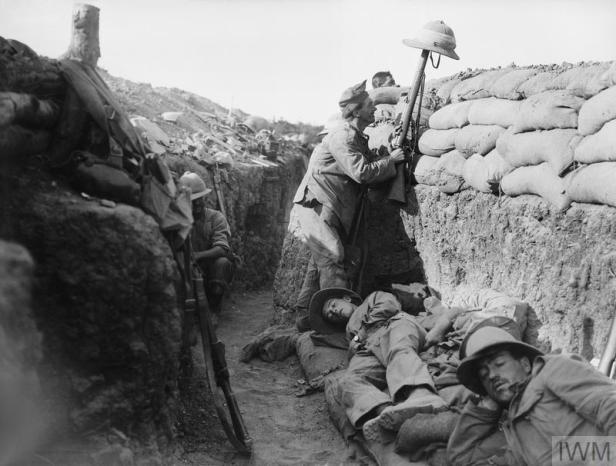
PHOTOGRAPH: IMPERIAL WAR MUSEUM
Heather Cook talks about the inspiration for her first world war poem ‘My Pal Leonard’:
“The inspiration for it came from my grandfather’s handwritten record of his life, which he was encouraged to write when well into his 90s. He remained active and a force to be reckoned with until his death at 98. His name was Robert Alec Swan.
He wrote about his experiences in the Great War in a characteristically matter-of-fact manner which if anything emphasises the horror. He and his pal Len rushed to join up as soon as war broke out and just before Christmas 1914 they were on board a troopship bound for Malta. After a spell there and later at Khartoum they were sent to Gallipoli at the end of August 1915, landing at Suvla Bay, narrowly missing the terrible hand-to-hand fighting which had occurred there. The armies settled down to trench warfare and my grandfather and Len were in the machine gun section armed with the latest Vickers gun which could fire 450 rounds a minute. The trenches were thinly manned and dysentery was rife.
A few weeks before the evacuation from Gallipoli, the long drought broke and there was a terrible storm. The trenches began to collapse and the sandbags fell in. A lot of men couldn’t get a foothold to climb out of the trenches and it was total chaos. That was the last that my grandfather saw of his pal Len, who was eventually posted as ‘Missing’. My grandfather went to see Leonard’s parents when he eventually returned to London and always said it was one of the most difficult things he had ever had to do.”
MY PAL LEONARD
by Heather Cook
I face his parents as they sit in silence,
side by side on the worn settee.
They crave some soothing words
to soften ‘MISSING’ into something
they can almost contemplate,
free from nightmare visions
of bodies trapped in mud.
They are desperate to sleep
without his searing screams
filling every grey and empty space.
They hope I bring some tiny chance of peace,
so that they might say his name one day and smile.
I couldn’t lie, but couldn’t tell the truth.
Where to start and where to end,
watched by the grinning schoolboy on the wall?
Harder than heaving the muddied gun,
worse than frostbite is my pain today.
I see the rain in shining sheets,
trenches collapse as rivers race,
sandbags slide with guns and men;
we climb, fall back, are swept away.
Then sleet and snow. Our clothes freeze on us.
No bully beef and such a thirst!
I have to lie.
I cannot say he was last seen
writhing in mud at Gallipoli.
I say it was quick; that he died laughing
and see hands meet on the worn settee.
 Woking Writers Circle