Category: News

  • MINUTES OF WOKING WRITERS’ CIRCLE MEETING, ST MARY’S CHURCH HALL, HORSELL ON 17th OF APRIL 2025

    PRESENT: Simona, Liz, Alan, Nathan, Cathy, Harry, Heather

    APOLOGIES: Tricia, Sarah, Hilary

    NEWS:

    1. Simona will email about an opportunity presented by the Bylines Network publication.
    2. Liz reported that WWC Book Group was reading 2 books: Orbital and Night Train to Lisbon.
    3. Liz has entered the Write Out Loud competition. She has also taken part in 3 workshops.

    WRITING COMPETITIONS:

    It was agreed that for a period of 3 months, the Minutes would include a section on current writing competitions, to see whether WWC members found this useful. No attempt would be made to provide a comprehensive list, or to give full details of each competition as these are available on the relevant websites. WWC members might find it helpful to obtain the monthly magazine, Writers’ News, which runs its own competitions and provides information about many other opportunities.

    1. Frome Festival Short Story Competition: For unpublished short fiction between 1000 and 2,200 words. Closing Date 31st May.
    2. Yeovil Literary Prize: Various categories, including Poetry and Short Stories. C/D 31st May
    3. Personal Memoir Competition: For unpublished, original memoirs up to 1,500 words. C/D 31st August.
    4. Ware Poets Open Poetry Competition: For poems up to 50 lines, any subject. There is a special Sonnet Prize. C/D 30 April
    5. Winchester Poetry Festival: For poems up to 40 lines, any subject. C/D 31st July

    READINGS:

    Simona read a short story, featuring Alys, who is a woman with a mission. The piece could stand alone, but the intention is that it will be part of Simona’s book. It was rich in technical detail, but this was conveyed in such a way as to make sense to the non-techies in the group. There was great admiration for the writing style, which maintained tension and pace throughout. All agreed that it was a remarkable piece of work.

    Heather once again lowered the tone with her poem, Support for the Partners of Poets, written after being driven to several recent poetry events by her long-suffering partner. She also contributed 2 clerihews (inspired by Nathan’s ground-breaking venture at the March meeting), one of which featured Hieronymous Bosch; the second, Picasso.

    Nathan’s wonderfully romantic, dreamlike poem, Wanderer, was in stark contrast to the previous offerings and was greatly appreciated. Suggestions were made regarding the ‘clutch at straws’ usage in verse 2 and the puzzle simile at the end of verse 2, but everyone relished the beauty of the language and images created in this remarkable poem. Nathan also presented a trademark Haiku, Echoes, which was admired by all. The last line, ‘The past carries on’ was compelling in its truth and simplicity.

    Cathy had followed the Homework suggestion which had been to write in a different genre from the usual one favoured by the writer. This she had done to great effect in a short poem, employing spare language to convey the stark facts known about a person’s life: Baptism, Marriage, Burial. Every 10 years, the Census recorded scant facts such as status, occupation, but nothing else about a person’s life survived beyond family memories. This was a moving and beautifully constructed piece.

    Alan contributed 2 pieces, in very different styles. The first very short story, Moonshine, featured 2 prisoners peeping out and seeing the moon. The whole story took up less than half a page of A4 and was told entirely in dialogue. This was a clever piece with the usual punchline delivered with a satisfying thud. The second story, Petrified Witness, was very different from Alan’s usual style, conveyed in an exchange of letters which faithfully reflected the style of Victorian polite society. This was a longer story which allowed for development of character and some telling references to the prevailing customs of the day, as in Miss Bingham’s allusion to reading mathematics at Cambridge not being ‘an avenue…open to our sex’. This story also had the power to shock, possibly more so because of the mannered style of the letters. Both pieces were greatly admired.

    Liz began by inviting views about whether she should write a wellbeing piece, possibly focussing on the pleasure to be had while shopping in Woking. She had departed from her usual genre by writing a children’s poem inspired by a walk round Winkworth Arboretum with her family. The young boy was fascinated by dinosaurs and all agreed that Liz’s rhyming poem captured the child’s excitement and wild imagination. Some suggestions were made about the imaginary dinosaurs that were hiding conflicting with the idea of digging, a possible solution being to dig for dinosaur bones in a sandpit. This was a very enjoyable piece.

    Harry’s poem, My Friend and the Racist, signalled a complete change of mood. The language was real and the inclusion of swear words gave credibility to the uncomfortable scene described. The emotions felt were powerfully conveyed and the regrets of the writer, as in the racist inviting the writer to punch him, followed by, ‘I didn’t – I wanted to./ I wish I did.’ The inclusion of reference to the racist putting down his ‘black dog’ worked well and the final lines about the writer feeling ‘sorry for his dog’ provided a neat and thoughtful end to a powerful and disturbing (in a good way!) poem.

    Next Meeting: Thursday, 15th May at 7.30pm

    Chair: Cathy

    Minutes: Simona

    Wine: Nathan

    Milk and biscuits: Simona

    Homework: Letters
  • MINUTES OF WOKING WRITERS’ CIRCLE MEETING, ST MARY’S CHURCH HALL, HORSELL ON 15th of AUGUST 2024

    Present: Keith, Tricia, Alan, Heather, Simona, Hillary, Liz, Nathan, Harry, Sarah

    Apologies: Peter

    INTRODUCTIONS:

    We welcomed our guest, Harry, with warm introductions and hope that he will continue to join us. Harry likes to write horror poetry, poems that make you feel uncomfortable, sometimes cosmic but in general quite modern.

    NEWS

    Alan’s short story ‘Temporary Accommodation’ was published in Gosnell’s Writers Circle – Circle of Friends June Publications. Congratulations Alan.

    Liz continues her marketing efforts of her recently published Haiku book, called ‘Images’. She was interviewed by Woking News and Mail and was very happy to relate her story.

    Heather requested collating a list of telephone numbers and email addresses and asked for group’s permission to circulate a list of emails to all active members. The telephone numbers will remain known only to officers with assurance that all GDPR precautions will be take.

    READINGS:

    HEATHER’s poem, ‘A longing for sky’ uses natural elements she felt connected to evoke emotional states. Hillary noted that although the poem appears simple it gets more and more complex as you read it and suggested that it would be suitable for publication. Hilary also suggested that the removal of some words might make the flow slightly better or in one breath. Liz thought that the poem was increasingly good wondering what ‘grasping unseen coils’ might mean to which Heather provided a brief explanation. Tricia noted that Heather’s long relationship with her environment coming to an end is well expressed.

    HILLARY wrote the continuation of a story she had brought in the past to the Circle. The story focused on how a black cat, ‘Sable’ came to live with a witch. Tricia noted that Hillary captured a really genuine voice for Sable. Heather appreciated the imagery of the muted ghastliness of the children and the cat’s discomfort and the emphasis of the cat walking alone. Simona liked the sensorial imagery, and the strength of the connection expressed. Alan noted that hinting of a pentagram which gave the environment a different mood.

    ALAN wrote a very short story on the homework topic titled ‘The Carrion Crow’ which focused on a dialogue between 2 characters having lost their opportunistic scavenging to an unknown third party. Tricia said that the story was very tight with Alan’s trademark twist at the end. And Heather was taken by surprise at the abrupt ending but noted the story was very good.

    KEITH’s poem, ‘Dunkirk’ centred around his father’s experience with war and the triggers which had brought the horrors back into his mind. Heather noted the poem being very powerful, particularly in describing the detachment of ‘war being televised’. Harry liked the juxtaposition between different generations and how desensitisation and vivid horrors were well executed. Tricia brought into discussion PTSD triggers and how this was well expressed in the poem. Sarah noted that the poem had a unique way of expressing the horror of historical events.

    NATHAN’s poem ‘Sunset eyes’ raised a few questions about the general topic of the poem which Nathan clarified to be about saving someone from attempted suicide. Hillary noted that the poem has very gothic vibes and that Nathan uses his words very creatively. Tricia liked some of

    the imagery, in particular the ‘salt eats at her thick coarse skin’. Nathan then read his new haiku which engaged the group in a lengthy discussion about the correct use of certain words, contradictions and how these may be resolved.

    HARRY’s poem ‘A bird flew’ was well received by the group. Hillary noted the sinister elements work very well and that the audience is engaged to unpack the poem. Simona commented that the protagonist appears almost unhinged in their need/ want of the bird and Tricia commented that the unattainable beauty concept is expressed really well. Heather said the poem was very clever and Sarah found it very interesting to visualise.

    LIZ wrote 3 poems inspired by her journey to Newcastle and titled the collection The Death of Great Ships. She read all three together and titled them: Part 1: The fighting Temeraire, accompanied by various visual aids including a £20 note (the note portrays J.M.W. Turner), Part 2: The Tyne Pride and Part 3:The Keyside near Newcastle upon Tyne. Hillary commented that Part 3 was a very 3-dimensional piece. Simona liked the historical elements of Part 2 while Tricia suggested that it could be possible to knit the 3 poems together into a grander piece. Other suggestions were made to enhance the first 2 poems through prose and lighter language. Sarah liked Liz’s performance and particularly the accent used.

    TRICIA’s piece was Part 2 of her recollection of her Tanzania trip, titled ‘Materoni Falls’. The group consensus was that the travel log is amazingly vivid and will be added to the website as a part 2.

    SIMONA read part of a chapter from her book, but she expressed dissatisfaction at the pacing and character engagement. Alan suggested removing some of the narrator commentary as it slows down the reader’s attention, Hillary encouraged rewriting the piece by identifying which elements achieve nothing in the chapter and comparing to the original piece. Other suggestions were mentioned to either not overburden the dialogues with reveals or conduct the reveals in a more natural way. Simona was grateful for the feedback.

    SARAH took the group through an artistic journey inspired by her walking tour of the Chertsey Abbey Museum. She outlined to the group the historical facts that make the Abbey special and then she read to the group a poem made entirely of haikus relating to the Abbey’s history. She then delighted the group by turning the poem into a song which she sang and recorded herself. Heather commented that the poem/song works beautifully and does not feel forced and enjoyed hearing the unravelling of the journey before enjoying the poem and song and that it really set the tone. Tricia noted that the poem works really well as a song and is almost pastural.

    Next meeting: Thursday 19th of September at 7.30 pm

    Chair: Tricia

    Minutes: Heather

    Wine: Simona

    Milk & Biscuits: Sarah

    Homework: Ups and Downs

  • The Vanity of Small Differences – At The Lightbox, Woking until 7th July 2024

    The Vanity of Small Differences – At The Lightbox, Woking until 7th July 2024

    Grayson Perry’s Tapestries

    Grayson Perry’s large and vibrant tapestries are currently on display in Surrey at The Lightbox, Woking, flooding the main gallery with colour.

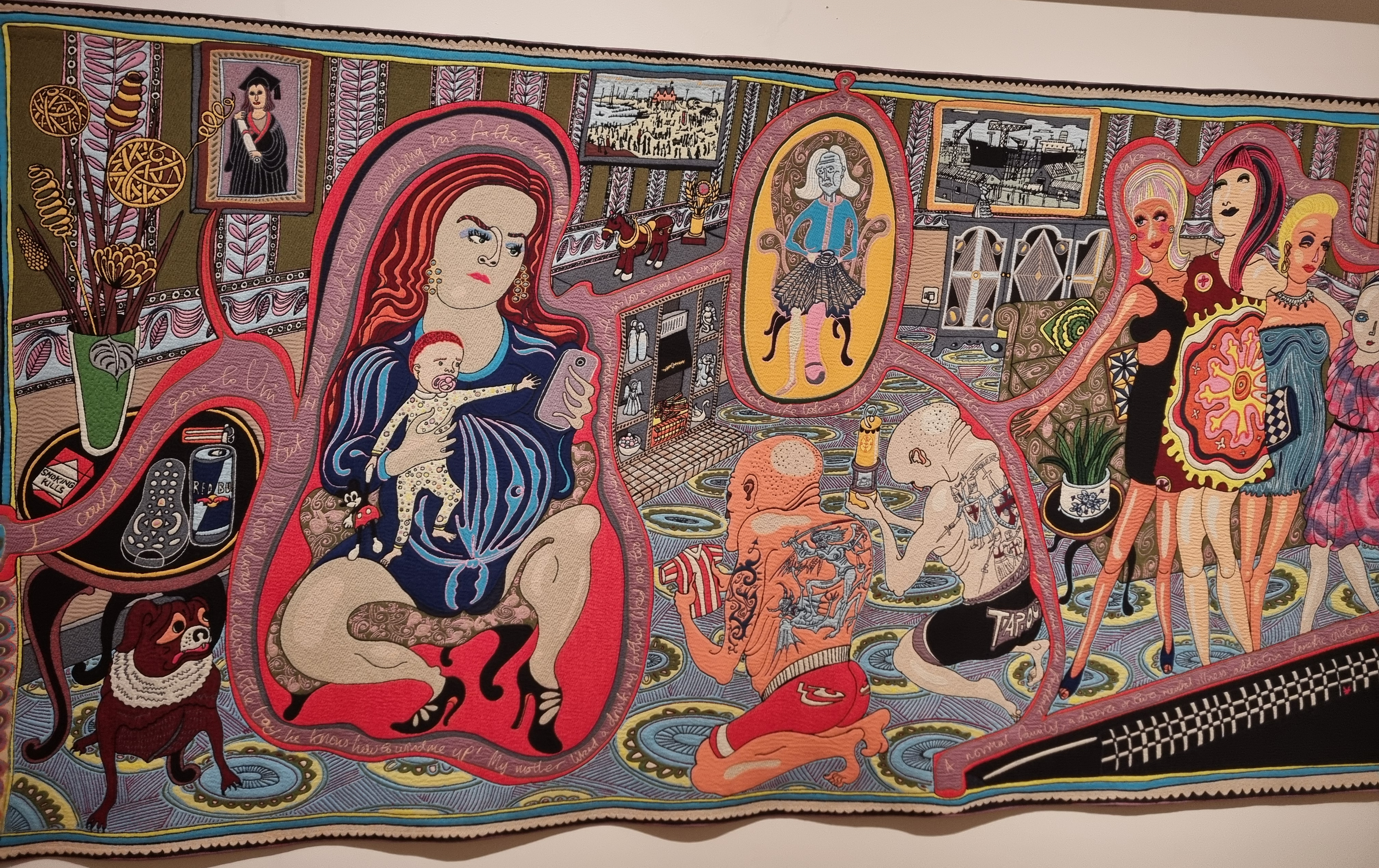
    The six tapestries, each measuring 2m by 4m, tell the story of Tim Rakewell as he embarks on a journey of twenty-first century social mobility. A familiar story? Indeed. Tim Rakewell’s journey is inspired by William Hogarth’s A Rake’s Progress, (c1735).

    Grayson spent time in Sunderland, Tunbridge Wells and the Cotswolds for the Channel 4 series, All in the Best Possible Taste. He incorporated many of the characters, scenarios and objects he encountered in these contemporary scenes, exploring the British preoccupation with social class and what is perceived to be good taste.

    The Agony in the Car Park

    Also inspiring the various scenes depicted are a wide range of works from artists as diverse as Bellini and Gainsborough. 

    Most visitors have found it helpful to watch the short video before viewing the tapestries as the references to the other works of art undoubtedly add interest to the experience.

    Having spent a considerable amount of time in the company of the tapestries as a Lightbox volunteer, I can honestly say I have felt fascinated and uplifted – not only by the tapestries themselves, but also by the reactions of visitors. People of all ages have spoken of their delight in these remarkable works and many have returned for a further visit, bringing friends or simply coming for another look in order to absorb the allusions and complexity of each scene.

    There is a refreshing inclusivity and vigour about Grayson’s art and the enthusiastic response to the exhibition confirms that this message has been fully appreciated.

    Heather Cook

    Upper Class at Bay

  • Heather Cook is joint winner of poetry pamphlet publication competition

    Heather Cook is joint winner of poetry pamphlet publication competition

    Woking Writers Circle member Heather Cook, who is also a regular reader with Write Out Loud Woking at the Lightbox, and Write Out Loud Woking on Zoom, has been named joint winner with Clare Starling of a pamphlet publication competition. Her pamphlet will be published later this year after she won a Frosted Fire First Pamphlet award.

    You can read and hear three poems by Heather that will appear in the prize anthology here.

    Heather has been shortlisted and commended in several competitions, including Buxton, Ware, Wildfire Words and Shepton Mallet Snowdrop Festival. She also won the Hysteria poetry competition in 2022.

  • Greg Freeman’s new poetry collection ‘The Fall of Singapore’

    Greg Freeman’s new poetry collection ‘The Fall of Singapore’

    Publishers Dempsey & Windle will be launching WWC member Greg Freeman’s new poetry collection ‘The Fall of Singapore’ online on Wednesday 30 March. It has been published to mark last month’s 80th anniversary of the biggest surrender in British military history.

    Greg said: “My father was one of many thousands of Allied soldiers taken prisoner by the Japanese at Singapore, and as a POW forced to work on the notorious Burma-Siam ‘Death Railway’, which cost many, many lives. The collection contains a sequence of poems about that time, but there are also other war-related poems in the book which have acquired a grim new relevance in recent weeks.

    ‘The Carriage in the Forest’, for instance, is about the resentment and revenge of Hitler who believed Germany had been cheated of land and prestige at the end of the first world war. ‘Tallinn’ refers to the suffering of the people of Estonia at the hands of the Russians over the last century and beyond. ‘Cherry Blossom’ is partly a poem about Japan, and ends with the cataclysm of Hiroshima.”

    The collection also contains a poem, ‘A Foreign Wood’, about the former burial ground for Muslim soldiers from both world wars outside Woking. It has now become an Islamic peace garden.

    Greg with his father in the 1970s

    You can join the launch event for ‘The Fall of Singapore’ via Eventbrite. Copies of the book can be obtained from Dempsey & Windle, by emailing Greg at gregfreem62@gmail.com, or from the Lionsheart bookshop in Woking. And you can read WWC member Carla Scarano D’Antonio’s review of The Fall of Singapore in the online arts magazine London Grip here

  • Woking church collecting donations to aid Ukraine’s war refugees

    Woking church collecting donations to aid Ukraine’s war refugees

    There are many relief organisations that you can give money to aid Ukrainian refugees fleeing the invasion by Vladimir Putin. But Woking Writers Circle would like to publicise the fact that the church where we meet each month – St Mary’s the Virgin, Horsell – is open from Monday-Friday 10am-5pm to drop off donations for the people of Ukraine (please don’t leave donations outside when the church isn’t open).

    St Mary’s said on its Facebook page: “We have had an amazing amount of donations for Ukrainians which we thank everyone for. The first van load has left the church this morning to start its journey to Poland.”

    The church is asking for medical supplies such as bandages; plasters; painkillers (for both adults and children); soup powders; tinned food (with a ring pull); energy bars; coffee; tea and toiletries. Please note that we have been told they do NOT want any more donations of clothes. Please leave donations in the church porch.

  • ‘Marples Must Go!’ is WWC member Greg Freeman’s first full poetry collection

    ‘Marples Must Go!’ is WWC member Greg Freeman’s first full poetry collection

    Woking Writers Circle member Greg Freeman has brought out his first full poetry collection. Marples Must Go! is already available from Guildford publisher Dempsey & Windle, under their Vole Books imprint, although the official publication date is 1 September. Greg said: “I always hoped to have published a full poetry collection by the time I turned 70. I am very pleased and relieved to have managed it with just over a year to spare!” But what is the collection about – and what on earth does the title mean?

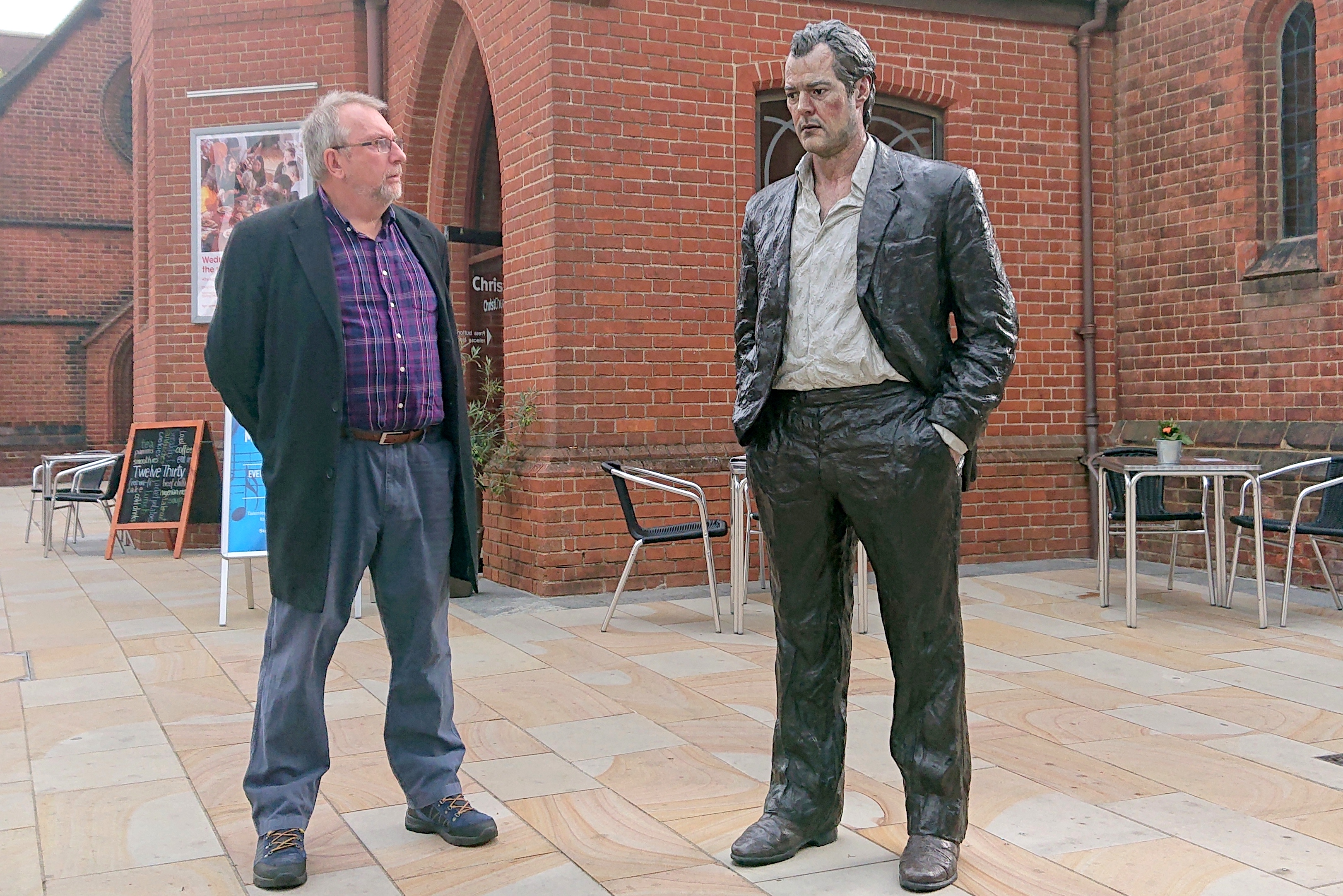
    A mysterious slogan on a bridge across the M1 that remained there for decades denounced a 1960s transport minister who had a finger in the pie of motorway building, and also oversaw Beeching’s vandalism of Britain’s railways. His name was Ernest Marples. Greg’s wry and bemused poems meander around this and other subjects such as free school milk, Juke Box Jury, Space Patrol, and the curious appeal of Andy Williams, as well as the first proper sentence of a two-year-old child: ‘Jack see Mrs Thatcher.’ As the years go by, he finds himself remembering the cartoon comic heroes of Beano and Dandy, picturing what might have happened to them in later life, and wondering plaintively: ‘Why can’t life still be hilarious?’ The collection also includes a sequence of poems about the Sean Henry sculptures in Woking titled ‘All The Lonely People’.

    Greg’s poems have attracted praise from poets such as Brian Bilston, the hugely popular ‘poet laureate’ of Twitter, who said: “In Marples Must Go! Greg Freeman pulls off the difficult trick of writing poetry that is both funny and thoughtful, poignant and personal. With topics stretching from the Beatles to Brexit, from childhood comics to Covid jabs, this collection constitutes a wonderful poetic romp through the history of modern Britain.”

    Greg will be launching his collection at Write Out Loud Woking on Zoom next month, and at a special online publisher’s launch with Dempsey & Windle in October.

    ​

  • Carla Scarano D’Antonio launches ‘Negotiating Caponata’ poetry collection

    Carla Scarano D’Antonio launches ‘Negotiating Caponata’ poetry collection

    Carla Scarano cover

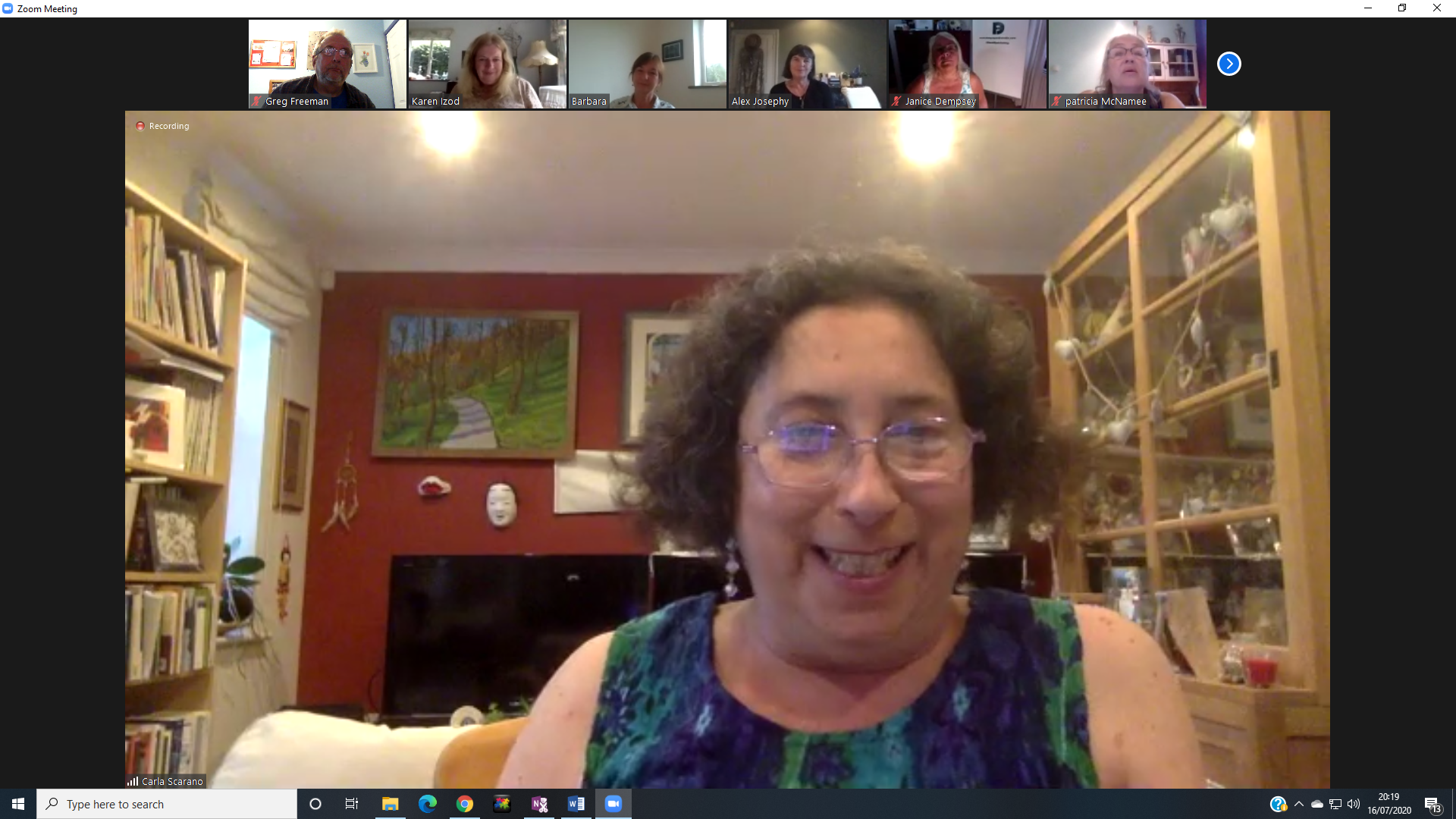
    “Food is so important in Italy for our identity. It shapes our relationships. And it is also a way to renew them.” With these words Woking Writers Circle member Carla Scarano D’Antonio introduced the launch of her short poetry collection, Negotiating Caponata, on Zoom – an occasion attended by dozens of friends, family and poets, from Italy, Canada, and even Australia.

    The event was warmly and ably hosted by Janice Dempsey, of Carla’s Guildford-based publishers Dempsey & Windle.  Carla’s collection is indeed about food, and abounds with lip-smacking recipes; but it is also about family history, a father’s final days, a mother and her cyclamens, and an acute assessment of the seasons. She had generously invited 19 poets to take part in an open-mic accompanying her reading. They included fellow WWC members Heather Cook, Liz Lennie and Greg Freeman, and a number of regulars who read at Write Out Loud Woking poetry nights. But there were also poets from the north-west of England, where Carla used to live and read her poetry before moving to the Woking area, and from Canada, which Carla has visited while pursuing her PHD research into the work of novelist and poet Margaret Atwood.

    Those Canadian poets included Josephine LoRe, whose parents are from Italy; and Pam Medland, who met Carla when she visited Calgary, and read a poem titled ‘Buffalo Jump at Calgary Olympic park’.

    North-west of England poet Keith Lander, who with Carla jointly won a poetry translation prize a few years ago, read a poem about a beach in northern Italy. Another poet Alex Josephy, who usually spends a lot of her time in Italy, has been stranded in England during lockdown. Her poem was ‘Leaving Italy’. Fellow WWC members Heather Cook and Greg Freeman contributed poems about Verona and  Bagni di Lucca respectively, while Liz Lennie gave us a series of haiku, including one sequence that she titled ‘Five-course Italian meal’, a response to Carla’s collection.

    But what of Carla’s own poems?  She gave two readings, at the beginning and end of the evening, commencing with the title poem ‘Negotiating Caponata’, a poem that appears to be about a recipe, but contains more enigmatic lines such as “The aloofness at times” and “The body has no protection / when the light dims”. Suppressed feelings are bubbling under the lid in ‘Cooking betrayal’, while ‘Farina Manitoba’ – “the land of flour” – anticipates Carla’s first trip to Canada.

    ‘Only a cake’ takes its title from a Margaret Atwood quotation, ‘Special carbonara’ has liquor as the “secret ingredient”, and ‘When I was leaving’ is a sequence of poems about the seasons. Carla said her favourite season was autumn: “I was born in November.” During Carla’s second reading we glimpsed old family pictures to assist us with poems such ‘Grandad Ciccio and Grandma Orsola’ and Mum during the war’, and heard poignant poems about her father’s final days in hospital.

    She grew up in Rome, gained two degrees at La Sapienza, the University of Rome, and moved to England about 14 years ago – first to the north-west, where she obtained an MA in creative writing at Lancaster University, and read poetry at venues such as the Spotlight in Lancaster. She moved to Surrey around six years ago, and quickly became a regular at local poetry venues. She has published her creative work and reviews in number of print and online magazines.

    She is also an artist, and you can find motifs by Carla within her collection. The attractive cover illustration, Cappuccino in Positano, is by her publisher, Janice Dempsey.

    You can order a copy of Negotiating Caponata here  

    or from Carla herself here

    You can watch Carla reading poems from Negotiating Caponata at Write Out Loud Woking’s open mic poetry night when she was the guest poet in July


  • Greg Freeman’s poem published in The New European newspaper

    Greg Freeman’s poem published in The New European newspaper

    Greg's New European poem

    Woking Writers Circle member Greg Freeman has had a poem published in the April 23 edition of The New European newspaper. Titled ‘The Morning After’, Greg began writing it the day after the 2019 general election, which found him and his wife Gillian visiting their family in Marbella. Greg said: “We had listened to the election results the night before on the radio in Spain – but not for long. I wrote the poem over the few days that we were out there.

    “I sent it to The New European almost as soon as I got home, heard nothing until mid-February, and now it has been published, when events have moved on somewhat, and Brexit doesn’t seem quite so important any more. The good news is that Kate, Alba and Fran will be allowed out of doors from Sunday, after a six-week lockdown in their flat. The swings and slides may still be out of bounds, but it’s a start.”

    Greg added that one or two poetry friends had complimented him on a particular phrase in the poem – “the big dark”  – which he said he “stole” from his granddaughter. “I may be in line for a £25 publication fee from The New European – which is rare in itself in poetry  –  so maybe Alba can expect a little something as a result of that in the future!”

    The New European runs a weekly poetry column edited by Briony Bax, who also edits Ambit, a quarterly literary and art magazine. Greg said: “It’s a wonderful newspaper, written in a very even-handed way, if you support their point of view, or even if you don’t. It’s been a great discovery for me while waiting for my poem to be published. I’m now a regular subscriber.”

    New European 2


  • Memories of Dermot … WWC members pay fond tributes to long-serving former secretary

    Memories of Dermot … WWC members pay fond tributes to long-serving former secretary

    Members of Woking Writers Circle were saddened to hear the news just before Christmas that their  long-serving and very popular former secretary, Dermot Hoare, had died at the age of 88. Dermot had been in a nursing home in Sunninghill for 18 months.

    Dermot joined Woking Writers Circle around 15 years ago, and his firm, courteous and humourous presence quickly set a new tone for the group which increased its membership during this time.  He concentrated on the short story, always aiming for a satisfying twist at the end, although he wrote an occasional amusing poem as well.  He was also keen on members displaying their work as a group, and an anthology, Podium, was published in 2008. He published two books of short stories under the pen-name of Douglas O’Shea on Kindle as well.

    The social side of the group also boomed during his tenure as secretary. Dermot often hosted Christmas socials at his home, pioneered additional breakfast meetings on Sunday mornings in local cafes, and introduced the custom of making wine available, rather than just tea and coffee, during half-time breaks at the circle’s regular meetings.

    There was always something happening when Dermot was around. The Writers Circle had got into the habit of repairing to a nearby pub, the Fox and Flowerpot, after their meetings at Strollers in Goldsworth Park. It was a rather disreputable pub, but neverthelesss  Dermot managed to get the writers banned from it, after leading a deputation to complain about the loudness of the music.

    In later years he began writing local theatre reviews which then appeared on the Woking Writers Circle website, or on the Essential Surrey website, and organised other members to take part in a reviews rota. Dermot’s reviews always had a sure touch, and you can read one of his most recent ones, of the musical Funny Girl, here.

    He also had a magnificent reading voice, which he projected to great effect when occasionally reading his stories on local radio. This was undoubtedly due in part to his days as a thespian and former member of the famous Cambridge University Footlights student comedy society in the early 1950s.

    His daughter Sandra said:  “He got a huge amount out of the group, and loved being part of it.  He particularly liked the challenge of creating short stories and I have read many of them over the years.  The theatre trips and reviews brought him great pleasure … – as a former member of the Cambridge University Footlights, theatre was a huge part of his life and he adored it.  I accompanied him to some of the productions as the taxi driver (!) and our evenings together, as well as being asked to read and check the subsequent review, are great memories for me.”

    She added: “I know the circle spurred him to write his memoirs … he published the book (Ich Habe Keine Gelt Aber Viel Humor: The Autobiography of a Contented Man) and it is a wonderful reminder for us, and we are eternally grateful he finished it.”

    Two members of Woking Writers Circle, current secretary Amanda Briggs, and longest-serving members Liz Lennie, visited Dermot at his nursing home a few weeks before he died, and found him lively and in good spirits. Amanda said he left “many fond memories. It was good to see him recently; he keenly recalled and asked after everyone, and sent his best wishes to us all. He was such a gentleman and positive influence, albeit getting the WWC banned from the Fox and Flowerpot!”

    Woking Writers Circle’s chairman, Peter Morley, said: “We will remember Dermot fondly for his engaging writing and warm presence in our group.” Another member, Heather Cook, said: “He was very helpful and welcoming to me when I rejoined WWC and I loved his writing – packed with humour and true life adventure!” Shaun Attwood addressed his remarks directly to Dermot: “I’ll never forget all of the times I sat next to you in WWC, and listened to your hilarious short stories delivered with your unique voice. Those moments live on in all of our hearts and souls. Thank you for being such an inspiration! Appreciatively yours, Shaun.”

    Long-standing WWC member Alan Dale recalled: “My first memory of Dermot was at the conclusion of the very first reading meeting that I attended, as a guest. ‘Well, was that more or less what you’d expected?’ A knowing smile and raised eyebrows hinted at amused anticipation. I was happy to confirm that it had been. He’d managed to make me feel included and accepted, with one gentle inquiry.

    “My subsequent impressions were comparative.  I greatly value and enjoy the opportunity to hear the rich variety of styles and narrative voices offered at each meeting. Dermot’s writing, a subtle concoction of patrician elegance, leavened with puckish, Feydeauesque humour, fascinated a raw beginner like me. Hearing and contrasting this with others’ narrative, descriptive and characterisation techniques taught me much, for which I remain indebted to him. His robustly detached view of the publishing industry was another, much appreciated source of encouragement. I am thankful for the privilege of having known Dermot, as I mourn his passing.”

    A number of former, long-standing members also paid tribute to Dermot. Keith Jahans recalled:  “We spent many a happy hour together, mostly at Woking Writers meetings but also at his home and in a pub.  He will be missed by all those who knew him.”

    Former chairman Kevin Smith – he and his wife Diana were both long-serving members of Woking Writers Circle – said: “It was saddening to hear of Dermot’s passing. He was such a strong presence in WWC and I always enjoyed his stories. Just occasionally I could spot the twist coming, but not often. I recall the Fox and Flowerpot banning, Amanda, one of the few occasions in the history of the public house when the ban was for being too quiet …”

    Another former member, Ian Hearnden, said: “I first met Dermot Hoare when he was in his mid-70s. Recently moved to Woking, I joined the town’s Writers Circle with three hopes: to write more often, to write more satisfyingly, and to meet interesting, friendly folk. That I very soon realised I had met and exceeded the third aim owed much to pre-existing circle members. Dermot was in that number.

    “Dermot wrote purely for pleasure. When reading his own material, he was entertaining and effusive, yet self-deprecating. When commenting on others’ work, he was unfailingly warm and constructive. Dermot possessed a wry wit which revealed his lived experience, and a youthful playfulness which belied it. For me, his generosity, wisdom and awareness helped make the writers’ circle a happy place.

    “Outside of writers’ group meetings, Dermot was no less engaging and accommodating. Keen to organise and host get-togethers at Christmas and other times, Dermot opened the doors of his house in Chobham to group members on more than one occasion. No one left feeling anything less than valued and well looked after – testament to Dermot’s big-heartedness and geniality. I am very sorry to have learned of Dermot’s passing, but feel privileged to have spent time with him. He would probably balk at the suggestion, but local writing in north-west Surrey will be a lot poorer. RIP Mr H.”

    Dermot’s funeral will be held on Friday 17 January 2020 at Guildford Crematorium at 2.15, and afterwards, tea at the Tithe Barn, Loseley Park.


    Greg Freeman adds: You often find out so much more about a person at their funeral. Dermot did not tell us too much of his back-story – he saw no need to. But the service at Guildford crematorium, attended by the WWC’s Liz, Greg, Amanda, Simon, and Peter and his wife Rosie, we heard for the first time that Dermot’s father was a TV chef in the 1960s – no doubt the origin of his love for good food.

    We also did not really appreciate the significance of – or rather, had no details about – his university years with the Cambridge University Footlights Revue. But his daughter Julia read a song ‘Turkish Delight’ that Dermot performed on the West End stage and co-wrote, and that was mentioned by Frederic Raphael in the writer’s memoirs:  “Dermot Hoare … landed the delectable part of the odalisque in the Ottoman number, and performed it with rouged and mascaraed aplomb.” The song included a refrain about “a man on my Ottoman”.

    This solo number by Dermot featured in the revue Out of the Blue, a Footlights show that ran for three weeks at London’s Phoenix theatre in 1954. This performance also features in a history of the Footlights, with a preface by Eric Idle, which includes a drawing – pictured below – by the famous cartoonist Ronald Searle of Dermot in sultry Turkish costume alongside Jonathan Miller. It appeared in Punch magazine. There was also a photo on display at the wake at the Tithe Barn on the Loseley House estate of Dermot dressed up as one of the Bronte sisters, from the same early 1950s era.

    However, as a result of his West End experiences Dermot dismissed thoughts of a career on the stage. In the fascinating memoir he wrote for his family and that his daughter Sandra has kindly allowed us to borrow, he said that “the theatrical people I met that fortnight were far too egotistical for my liking”.

    Dermot Hoare cartoon 2