Category: News

  • Heather Cook wins poetry prize commendation

    Heather Cook wins poetry prize commendation

    OLYMPUS DIGITAL CAMERA

    Congratulations to WWC member Heather Cook, who recently won a commendation in the Ware poetry competition for her poem ‘The Birthday’. Heather is also a Poetry Society member and her success was also mentioned on the Poetry Society website. Well done, Heather! Her poem has been published in the competition anthology.


    THE BIRTHDAY

    by Heather Cook


    You sit, as if alone, by candlelight,

    thin fingers worrying at twinkling rings,

    the chatter all around a senseless noise,

    the cutlery and glass forgotten things.

    You smile enquiringly at all your guests,

    soft shadows dancing on your puzzled face,

    then tentatively raise a shining glass,

    your every gesture one of perfect grace.

    We sing the silly ‘Happy Birthday’ song

    and clasp your sparrow bones as if to prove

    the story’s end could be rewritten still

    if we could just persuade you of our love.


    The cake sits untouched on your party plate:

    the one we loved has left. It’s all too late.


  • Thrilling moment for Alan Dale as he publishes his first novel

    Thrilling moment for Alan Dale as he publishes his first novel

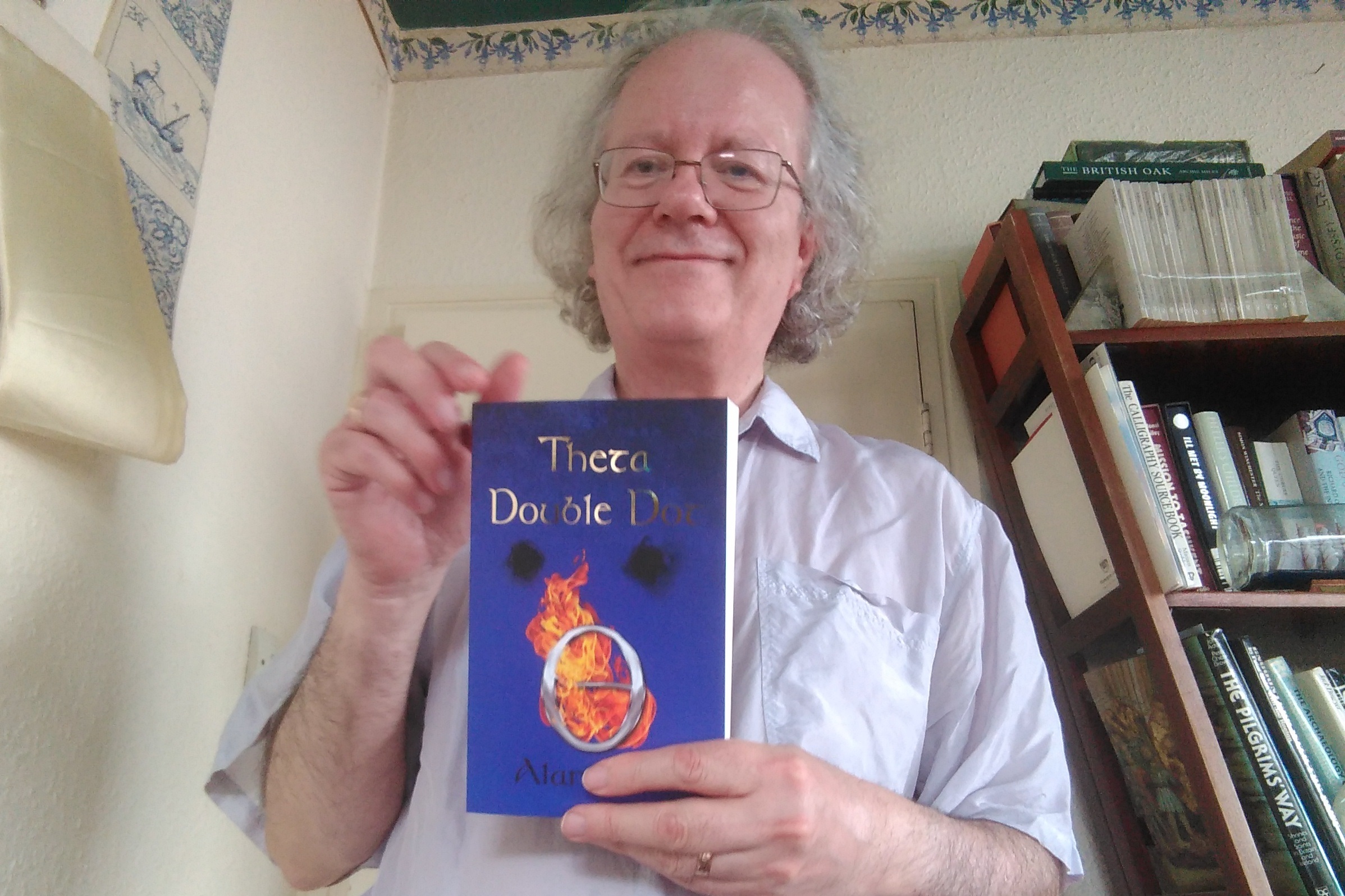
    Many congratulations to Woking Writers Circle member Alan Dale, who has just published his first novel. The title of his thriller is Theta Double Dot, and publishers Austin Macauley describe it thus:

    “Saddled with the project everyone dreaded, Mark Hammond finds himself ensnared in a nightmare that threatens his marriage, career, sanity and, finally, his life. Who are the increasingly violent activists, wreaking havoc, with attacks on petrochemical plants across the UK? Ministerial frustration increases with mounting evidence of police bewilderment. Mark’s problems expand to include an Alaskan community facing annihilation as the Arctic Sea threatens to overwhelm their homeland. Desperate for time and managerial support, he finds himself enmeshed in the ultimate horror; a race against time, to a potentially suicidal showdown. Not even he envisages the terrible endgame.”

    We know Alan fairly well, of course, but it’s always useful to read the publisher’s biog: “Alan Dale is a graduate mechanical engineer, with project management experience in the petrochemical industry. He began writing a few years ago, in his fifties, by enrolling on the Writers Bureau Comprehensive Writing Course. Alan has since had short stories, articles and features published in magazines and online. He lives in Surrey and is a member of the Woking Writers’ Circle.”

    Alan explained further: “When I first received the Writers Bureau prospectus, I looked at all the modules on the Comprehensive Writing Course and noticed the one headed Novel Writing. I thought – dream on! Then I saw something about not having to tackle every subject. Right, I thought, that gets me out of ever having even to try to write a novel. A warm glow of relief suffused me at this point, as it always does when I think I’ve got out of a corner. Loads of assignments down the line, I actually chose …’or write the first chapter of a novel …’ I can’t remember what the alternative was … must have been something about which I knew even less, if that’s possible, like lads’ mags. Anyway, I completed the course, obtained my certificate, then started submitting articles etc. I finally got going on the plot and development a few years later, having plucked up the courage to revisit it. About seven-eight years, one tantalising expression of interest in the first three chapters from an agent and five drafts later, I received an email acceptance from Austin Macauley, offering me my contract. As I subsequently wrote to Peter [WWC chairman], ‘I did what anyone would do in the circumstances – I went out to buy some ant powder!’ (True – I had ants in the kitchen and my mad sense of humour couldn’t resist that one.)

    “The title came about when I was sitting in a dynamics lecture, years before any of this, at uni. The lecturer wrote a differential equation of motion on the board, including theta double dot. As he did so, I had the vision of those two dots above the Greek letter being bullet holes, with the bullets coming out towards me. This lay dormant for about 35 years …” Asked how he felt about being a published novelist, Alan added: “If anyone had told me, as I began the course, or before, that I would one day have a novel published, I’d have asked them what they were on!”

    You can get hold of a copy of Alan’s novel here


  • A glimpse of Woking’s musical past – at a gig to support its grassroots music future

    A glimpse of Woking’s musical past – at a gig to support its grassroots music future

    IMG_6870

    by Greg Freeman

    There was a fascinating glimpse into Woking’s musical past on Saturday night when Steve Brookes – the man who formed The Jam with Paul Weller at Sheerwater school in 1971, and then quit it four years later, just as the band was about to hit the big time – appeared at the Fiery Bird live music venue in Woking to talk about those olden days.

    Steve had suggested the gig as a fundraiser for the Fiery Bird, which is currently in temporary premises in the former Quake night club in the centre of Woking. The building is due to be demolished in a year or so, as part of the redevelopment of a larger area in the centre of Woking. Which will leave the Fiery Bird without a home, unless the council can help find them a new, permanent one.

    He talked about meeting Paul Weller at school in Sheerwater, and quickly beginning to learn and write songs together – after being impressed that when they performed in the music room at the school one lunchtime by the fact that nearly all those that came to watch them were girls. Encouraged by Paul’s dad John, they performed their first gigs on weekday nights at Woking Working Men’s Club, just as a duo.

    Why did he leave The Jam? They had been playing together for four years, almost inseparable from the ages of 13 to 17: “Paul and I just started to drift apart … it was time to go.” They were “great mates” again now, though, and Steve has played on a couple of Paul Weller albums. He also told how he persuaded Paul to join him at a charity gig a few years ago at Woking’s HG Wells Centre in aid of Woking Hospice. Steve wanted to maintain the element of surprise, so hatched plans to smuggle Paul in via the adjoining hotel. It helped that the young hotel receptionist – told that someone famous would be coming in – had no idea who Weller was when he arrived.

    I could see some of Paul Weller’s mannerisms in Steve Brookes as soon as he appeared on stage –  or maybe Weller has some of his. After all, they were close companions for four years in their teens. Formative years. Brookes has a fine voice and guitar style, and entertained us with a number of tunes, covers and originals, that he and Paul played together in those early Jam years, as well as a couple of more recent ones of his own. As his website says , after a long break from performing, Steve is back playing music again.  It was an inspirational and informative evening for those who take pride in Woking’s music heritage.

    Also on the bill were singer-songwriter Rebecca Jane, pictured below, with a nice line in country-influenced tunes, and the band Phoenix Chroi, headed by Elaine McGinty, pictured above, the moving spirit behind the Fiery Bird and the Phoenix Cultural Centre, along with her partner Joe Buckley, who plays bass in the band. Woking Writers Circle has strong ties with the Phoenix. I’ve read my poems at the open mic on a number of occasions over the years, and fellow WWC member Cathy Rogan has played there with her band The Ukeaholics, and more recently as part of a new ukulele duo Mother of Order.

    What the Phoenix has always been about, is trying to provide a grassroots space for music and community arts in the town. The people that run Woking, the council and its officers, sometimes give the impression that they are not interested in allowing things to grow from the bottom up, but only in directing everything from the top down. As the first of Woking’s series of towers start to rise, The Jam is an example of something that grew from below, even if their Town Called Malice has seen fit to commemorate them with three giant lumps of wood. But don’t get me started …

    The Fiery Bird centre remains something worth supporting, encouraging and preserving. Keep the flame alive!


    IMG_6846

  • All right on the night! Confessions of a local am-dram performer

    All right on the night! Confessions of a local am-dram performer

    Sads 2

    by Greg Freeman

    Woking Writers Circle gives proper prominence and support to our splendid New Victoria theatre by regularly reviewing their productions – and it’s right that we do. But spare a thought, too, please  – and your support – for the local amateur dramatic scene as well.

    The Woking area has a number of thriving am-dram groups. I belong to Send Amateur Dramatic Society – but we are not in the least sad, despite our acronym. I joined the group only two years ago, after nursing an ambition to tread the boards for most of my life. Unfortunately my work in the evenings made that impossible until I retired a few years ago.

    So, rather late in the day – but better late than never – I turned up for an audition for Goodnight, Mr Tom in January 2017. To general surprise – not least my own – and encouraged by my wife Gillian (a far more experienced am-dram performer) I landed the part of Mr Tom, a grumpy old chap, alongside rising star Evan Huntley-Robertson, who played young William.

    For those that don’t know the story, it’s a heart-warming tale of wartime community spirit, although it certainly has a dark side as well. It was a great joy to perform it at Woking’s Rhoda McGaw theatre in June of that year with a number of our junior members, who acted with cheery confidence and brio and played a big part in the show’s success.

    Since then I have been cast as Friar Tuck in Send’s annual village panto, plus a cameo King Richard; a dying husband with dementia in a one-act play with Gillian that we took to Woking drama festival; and I now have a part in an upcoming one-act, comedy whodunnit that we will be performing at our usual home of Lancaster Hall in Send on 14-16 March at 7.30pm.

    Our play is called Over My Dead Body! I play a rather insubordinate butler (that’s me, second from left, next to his lordship). But I’m not telling you whether I did it. There’s another comic one-act play on the bill as well, Bride Before a Fall. And if that isn’t enough, there’s a Joyce Grenfell monologue, Nursery School Flowers, which in my book should be worth the £8 admission price alone.

    Maybe you too have nursed similar ambitions to become involved in local am-dram? They are a lovely, friendly crowd at Send – no divas or egos – with a thriving junior section as well. But we are always on the lookout for new members. You don’t have to perform if you don’t want to – there are plenty of backstage jobs as well, including set-building for the DIY-handy. One of the pleasures of am-dram for me is feeling part of a group working towards a common purpose – a group buttressed by a number of dedicated, long-standing, unsung heroes. That collectivism that we tried to convey in Mr Tom, perhaps? It’s relaxing, despite the line-learning – and it’s almost always fun.

    So why not come along and see for yourself, on one of those 14-16 March dates? The box office is 07542 107815 or email Sendamateurdramatics@hotmail.co.uk – or you can just turn up on the night as well. Hope to see you there!

  • Try Some Different Cards this Christmas

    Try Some Different Cards this Christmas

    Woking Writers’ Circle member Catherine Rogan has written a non-fiction book about Hanafuda, the Japanese playing cards. She tells us what inspired the book and a bit about the games.

    “I first came across Hanafuda (flower) cards in a Nintendo DS game. This had a version of Koi Koi, one of the capture games which can be played with the cards. At first I was bewildered, but after a few rounds of randomly poking at the screen, I began to get into the rhythm of the game and so spot the matching cards.

    cover with title small

    “In the main, games played with a Hanafuda deck involve matching cards by month (identified by a plant) and collecting combinations of cards that give you a scoring bonus. Rather like learning the Japanese alphabet, a large part of the learning curve is the visual difference between the cards and European cards. However once you have learnt to recognise the different flowers and animals on the strikingly attractive cards, the games are a lot easier to play that they first appear.

    “Having bought myself a pack of Hanafuda cards (they are available from Amazon) I set about trying to teach my partner to play. I quickly realised that the game is a lot easier when the computer is highlighting your choice of matches, and keeping track of your sets. Once we had played a few rounds, though, he was beginning to get the hang of it. I found the rules for other games on the internet. I brought the cards on a caravanning holiday but with no mobile signal in rural Wales I had to print off various webpages and lists of hands. I did find a book on the internet, but it concentrated on a game called Hachi-Hachi (88) which is extremely complex and tactical. What I wanted was a guide that could be used to teach the family how to play some simple games.

    hanafuda

    “While Koi Koi and is one of the most popular Hanafuda games, there are many other games you can play with the deck. I have stuck to the more straightforward games, the ones that beginners can pick up and enjoy. The games are from Japan, Korea and Hawaii and there are several different styles of play. Capture games are about picking up cards and making combinations, Poka games are about getting rid of your hand. There are some Kabufuda games – these can be played with a special deck but equally you could use a Hanafuda deck or a European deck with the face cards removed. Kabufuda cards are numbered 1-10 and are used for blackjack style games. Kabufuda cards are harder to find than Hanafuda, but I got some from eBay.

    IMG_0027 (2)

    “As well as some of the more simple traditional games, this book has some Solitaire games for one and I’ve also included a couple of traditional European children’s games at the end. These are good for younger children, and for getting used to the cards.

    “The book would be a great Christmas gift for an older child, or anyone who enjoys card or board games and wants to try something new. It is available from Amazon.”


  • Triumph for Peter Morley as he finds the bike his dad left at Dunkirk – or one very similar

    Triumph for Peter Morley as he finds the bike his dad left at Dunkirk – or one very similar

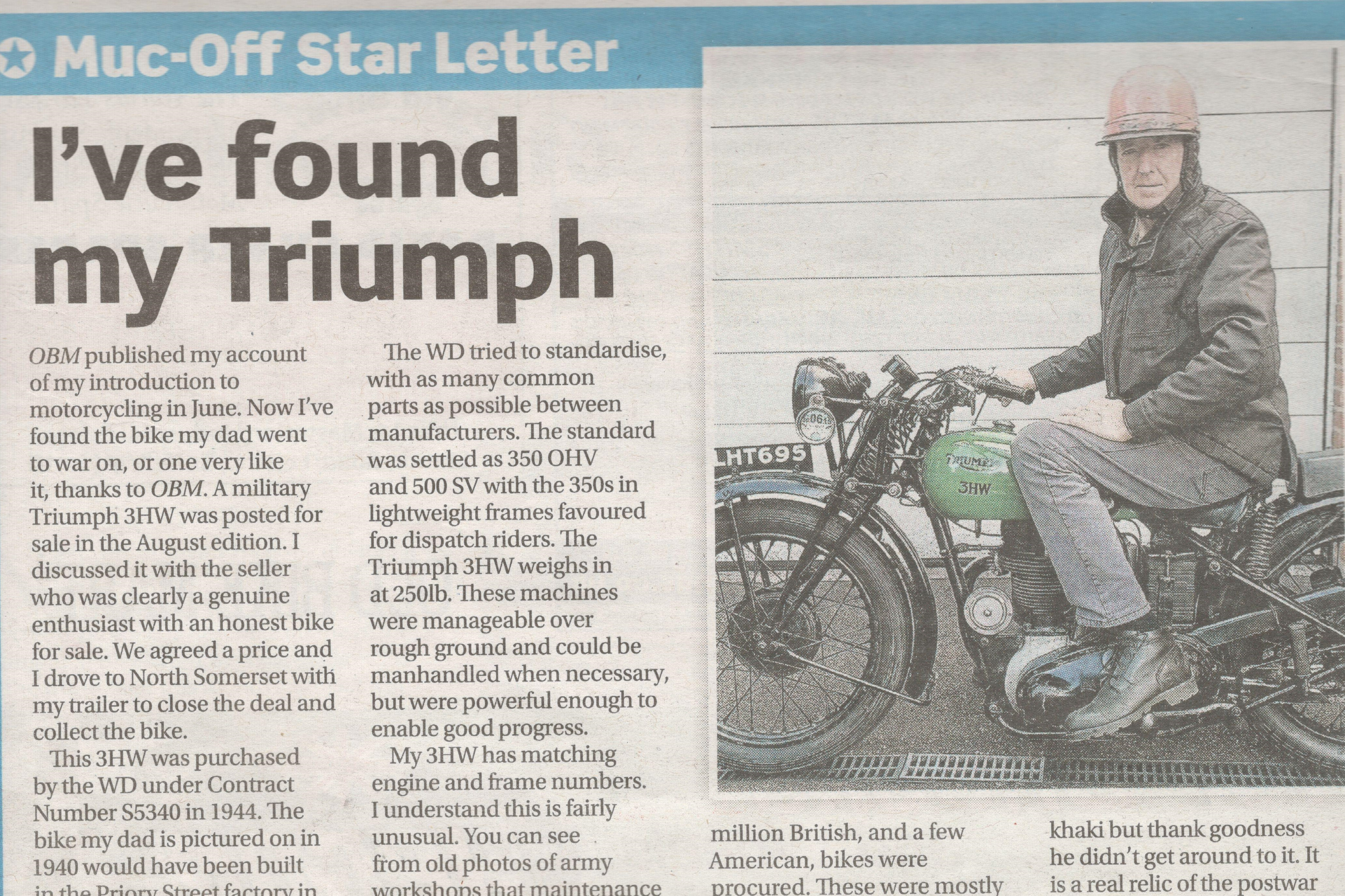
    WWC member Peter Morley is back in print to celebrate the fact that he has found the motorbike his dad went to war on … or one very much like it. Peter’s original quest was featured earlier in the year in Old Bike Mart – and now his letter reporting success in his quest has been published there, too.

    In his letter Peter says:  “The OBM published my account of my introduction to motorcycling in June.  Now I’ve found the bike my dad went to war on, or one very like it, thanks to OBM.  A military Triumph 3HW was posted for sale in the August edition.  I discussed it with the seller who was clearly a genuine enthusiast with an honest bike for sale.  We agreed a price and I drove to North Somerset with my trailer to close the deal and collect the bike.

    “The machine I have is 3HW (350 cc OHV).  Some sources suggest the 3HW was first made in 1940 and most agree it replaced the 3SW for military use in 1942, with production continuing until 1945.  My Dad’s bike could have been a 3SW (350 cc SV) or a 3HW it’s difficult to tell from the photos.  My Triumph looks pretty much the same.

    “The WD [War Department] tried to standardise, with as many common parts as possible between manufacturers.  The standard was settled as 350 OHV and 500 SV with the 350’s in lightweight frames favoured for dispatch riders [DRs].  The Triumph 3HW weighs in at 250 lbs.  These machines were manageable over rough ground and could be manhandled when necessary but were powerful enough to enable good progress.”

    Peter’s letter goes on to say: “The DR was the primary means of passing orders and dispatches during engagements.  Radio was considered unreliable but with the DR the safety of the message was the most important thing and they were inspired by their motto, ‘Swift and Sure’.  During Operation Dynamo, the evacuation of Dunkirk, orders were passed to the units holding the ‘Strong Points’ that guarded the perimeter.  These orders were usually, ‘Hold your position.’  If you visit the Commonwealth War Graves in the area you will see the headstones of men of the rear-guard regiments and one or two of the Royal Signals – the dispatch riders.  Dad made it home but left his Triumph near Dunkirk.

    “I love the history of my bike.  It is a genuine WD machine, similar to Dad’s but it has its own history too.  It was ‘civilianised’.  The previous owner said he bought it intending to put it back into khaki but thank goodness he didn’t get around to it.  It is a real relic of the postwar austerity years of baby boomers, prefabs and orange juice and cod liver oil.

    “This bike was sold as army surplus to a dealer in Bristol who slapped on a bit green and some black paint and sold it in 1948 as a get-to-work transport for men home from the war and re-joining the workforce to pay off the war debt and raise a family.

    “I understand these 350 Triumphs are quite rare today.  Although 30,000 were made, many were lost during the war and, when the opportunity for a bit of leisure came along in the early fifties, the engine was found to be good for grasstrack or trials competition resulting in survivors being adapted for this purpose.

    “So, my 3HW will keep its colours and help me to remember how far we have come – from the day my dad went to France with the BEF, during the austere years of my childhood and through a lasting peace – to a time when an old man, who never needed to go to war, can indulge in a bit of nostalgia and a lot of gratitude for the men and women who made it possible.”

    This week Peter gave a talk based on the above at the monthly meeting of the Vintage Motorcycle Club at Brooklands Museum. He said: “It was amazingly well received and enabled the sale of 10 copies of my book Orange Juice and Cod Liver Oil.”

  • Carla Scarano and Greg Freeman in South poetry magazine

    Carla Scarano and Greg Freeman in South poetry magazine

    South mag cover

    Congratulations to Woking Writers Circle members Carla Scarano – pictured at the mic at Write Out Loud Woking at the Lightbox – and Greg Freeman, who both have poems in the latest issue of South poetry magazine. Carla’s poem is called ‘Janet’ and is one that she read at a WWC meeting back in May. Greg’s two poems in South, which is published twice a year, are ‘The show’ and ‘Churchill in Madeira’. The latest issue, South 58, will be launched with readings by included poets at Bournemouth library on Wednesday 10 October at 7.30pm.

  • Lightbox literary festival to become the Woking literary festival in 2019

    Lightbox literary festival to become the Woking literary festival in 2019

    20180606_134338

    The Lightbox literary festival is to significantly expand in size and will be renamed the Woking literary festival from 2019, after two successful years and a recent cash injection from Woking council. The festival was launched in 2017 and will run over 10 days at the Lightbox gallery and museum in Woking.

    Two Woking Writers Circle members, Catherine Rogan and Greg Freeman, were involved in the 2017 festival, Catherine interviewing author Nicola May and Greg compering three hours of open mic poetry plus special guest poets. Greg was back at the Lightbox festival earlier this year, compering four hours of poetry on behalf of Write Out Loud Woking, an open mic poetry night which now meets each month at the Lightbox. In its press release the Lightbox said that “the festival’s hugely successful collaboration with Write Out Loud Woking continues to bring performance poetry and the spoken word to audiences across Surrey”.

    The 2019 festival will run from 23 April to 2 May. Louise Musgrove, festivald  director, said: “We have had a wonderful first two years, with great authors and big attendances, and are looking to expand on that with the ambition to become an important festival in the literary calendar. In the past we have approached authors ourselves and asked if they’d like to attend but we are hoping that publishers will want to pitch their authors, both well-known and up and coming, to us in future. After all, we sell a lot of tickets and a lot of books. All attending authors will be paid a fee and travel expenses will be covered. We’ll also give them some nice grub while they are here.”

  • From Goldsworth Park to Horsell: Woking Writers Circle moves to new venue, new date

    From Goldsworth Park to Horsell: Woking Writers Circle moves to new venue, new date


    Woking Writers Circle is moving to a new venue, and on a new date. From Thursday 23 August we will be meeting at St Mary’s church hall, Horsell, pictured above, starting at our old time of 7.30pm, and finishing at 10pm.

    Meetings for the rest of 2018 will be on the fourth Thursday of each month: August 23; September 27; October 25; November 22. We will probably not meet in December (date would be 27 December) but may arrange a Christmas social on a suitable evening. We plan to continue with the fourth Thursday throughout 2019, at the new venue.

    Woking Writers Circle previously met for over 20 years at the Generation Centre in Goldsworth Park, pictured below, in a room which we always knew as Strollers drop-in café, but has now become the Baden Powell Room.

    WWC 2

  • Satan’s Cavalry, Dunkirk, and sunshine after the war: Peter Morley remembers his dad and motorbikes

    Satan’s Cavalry, Dunkirk, and sunshine after the war: Peter Morley remembers his dad and motorbikes

    Peter Morley bikes 2

    WWC member Peter Morley has had an article published in Old Bike Mart magazine  about his love for old motorbikes, inspired by rides around the countryside with his dad in the 1950s. Titled “ ‘Baby boomers’ and motorbikes”, it tells how his dad – pictured right – was demobbed at the end of the second world war, and got himself a job at an oil refinery – and an 175cc Excelsior to get to it. The family soon graduated to a motorbike and sidecar to travel around in, “a 1952 AJS Model 18 and an open plywood sidecar … the sun always shone during those years.”

    Peter’s article tells how his dad, who served in the army as a dispatch rider at Dunkirk, had also been “a professional ice skater before the war but there wasn’t much call for that in 1945 and he took whatever work he could get: hotel porter, labourer or handyman.  We lived in an old tin hut on a war-time airfield at Holmsley in the New Forest, and in other make-shift accommodation, including a converted bus that had been used as a mobile morgue during the war.  Eventually, the government’s social programme brought us a council flat.  Dad got a job in the oil refinery, and hence the bike.”

    SONY DSC

    In the article Peter, pictured right,  talks about his father’s war service: “He had been a dispatch rider for his six years’ war service and I could often catch him singing the song of his unit, ‘Here we are, we’re 88DR.  Rain or shine, we’re always there on time, we keep riding and riding along.’  I can’t remember more, perhaps there were verses he censored for civilians.  I have a nice picture, captioned ‘Satan’s Cavalry’, of 88DR training in 1939. Dad gradually shared a few stories with me during relaxed moments and it was clear that not many of Satan’s Cavalry kept ‘riding and riding along”.  Dad said there were twenty-two of them but only five came home.”

    At the end of the article Peter explains that he now has a quest, “to acquire a 1939 Triumph 3SW like the one Dad left behind at Dunkirk.  I was looking out for one and somehow bought a 1928 side-valve Triumph, an NSD.  This is a good project while I continue to look for the army Triumph.”