
MINUTES OF MEETING ON THURSDAY 15 AUGUST 2019
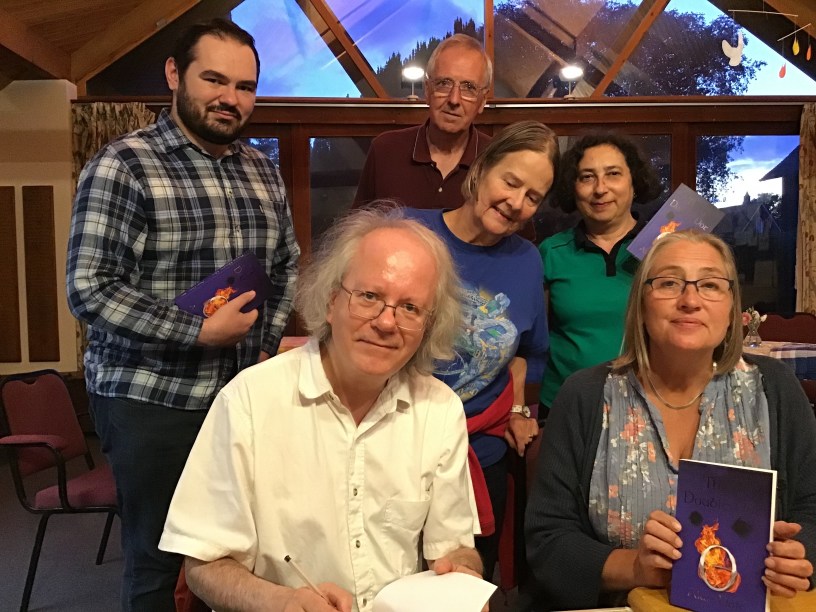
Present: Tricia (chair), Simon, Amanda, Hilary, Peter, Carla, Dan, Liz, Alan (minutes),
Apologies: Greg, Heather, Sarah DD
NEWS
Carla returned from Canada. Her tutor had dissuaded her from seeking an interview with Margaret Atwood, deeming it inappropriate, due to the subject’s current onerous workload. Carla expanded on her Facebook impressions of the two principal Calgary libraries, detailing various aspects of her current research on Margaret Atwood. She submitted a piece on comparisons between Beckett and Atwood, and had a review on her speciality published. Part of the introduction and four chapters of her doctoral thesis are now complete. Various visa difficulties, social events and meetings with Canadian poets and authors completed an eclectic summary of her travels.
Liz confirmed Alan’s recent discussions with Woking library. regarding a possible launch event involving Woking Writers and his publisher, Austin Macauley. This, as with Walton library, whom Alan has also approached, now depends on the respective libraries’ decision on whether to stock the book. Liz then announced that the Book Group read The Keeper of Lost Things by Ruth Hogan. They will now read Colson Whitehead’s Pulitzer Prize-winning The Underground Railroad.
On the table:
Details of competitions, events or other literary items: Carla brought a copy of Free fall, a poetry anthology, and a copy of Margaret Atwood’s The Handmaid’s Tale.
READINGS
The homework theme was either “Backwards”, or “Backwards and in high heels”, from the 1982 Frank and Ernest cartoon by Bob Thaves: “Sure he was great, but don’t forget that Ginger Rogers did everything he did, …backwards and in high heels.”
Tricia read a poem entitled ‘Etosha’, explaining that she had tried to reverse an African poem, to comply with the homework theme, but found that this didn’t work, due to the narrative, and consequentially sequential nature of the original. All admired the subtle inclusion of local flora and fauna names. Etosha is the name of a Namibian nature reserve and the shimmering, parched conditions and appearance of the location were very skilfully evoked. A reference to large genitals originated from the German colonisers’ propensity for palpitating patients’ genitals to detect hernias.
Simon read a sonnet called ‘For Somerset Maugham’. Universally admired, it contained several memorably lyrical and refreshingly original lines, such as “caught forever in his measured voice” and “marooned on some far flung verandah”. This evocative work originated from Simon’s impressions of the mournful, disappointed expats that he encountered in South America. The wryly reflective observation of expat life and its relation to Maugham’s work gave great enjoyment.
Hilary read another extract from her forthcoming novel. This dealt with the Monday after the psychologically terrible dinner with Mark’s family, together with the start of their new domestic routine. Once again, listeners delighted in some original, perceptive writing. Sam’s exuberant relishing of swimming’s physical release and mental escapism were particularly sharply captured. The passage also conjured the children’s horrible and rapidly worsening characters, together with the obsessional nature of swimming, with chilling authenticity.
Liz read a poem entitled ‘From The Cottonwood Tree’, compiled from material found on revisiting her 1960s American Travel Notes, which she recently rediscovered in her garden hut. Several listeners felt that the poem had potential as the introduction to a much larger work. Liz told us that she is considering the production of a poetry anthology. The poem powerfully evoked the mores and physical impressions of the Deep South, stimulating comparisons with Steinbeck. An authentic period American voice resounded through the verses, to universal admiration. Concern was, however, expressed regarding the expression and hence possible misinterpretation of certain racially sensitive sections. This engendered a debate about the moral and literary merits of literal adherence to the factual, and “sanitisation”, aimed at achieving a more widely acceptable rendering, at the cost of what some might label pusillanimous obfuscation. Further discussion centred on whether the work functioned best as poetry or prose. The consensus was that while it was an admirably successful poem, it could very well become a prose introduction to a story. The references to the economic and geological causes of crop changes drew admiring comments.
Alan read ‘Manufactured Evidence’, a story about a detective using his railway enthusiast son’s fascination with steam locos’ valve gear to help him trap a murderer. The pace and twist ending were admired, with gratifying confirmation, for the author, that he hadn’t given the game away.
Amanda read ‘Journey’s End’, a poem which she asked readers to help her edit, with the aim of drastic curtailment. Various suggestions were forthcoming, with Carla feeling that the piece tended more in the direction of prose. Alan advised replacing pistons with cranks, the latter being capable of turning, to comply with the verse. He also wondered whether cutting each verse as an individual entity might achieve the desired abbreviation. Dan suggested integrating the two, currently distinct, sections and beginning with “They came down from the north”.
Dan read ‘Going Away’, a story about the bitter ironies and indignities of old age. A neat twist ending completed a deft, wry treatment of the issues surrounding coping with aged parents. The uplifting conclusion highlighted Patrick’s determination to triumph over his dependence, while emphasising the generational conflict between parents and children. The narrative and treatment evoked comparisons with HG Wells’ the History of Mr Polly (breaking down the paper walls). The theme of escape permeated the narrative, to universal appreciation.
Next meeting: Reading meeting at St. Mary’s church hall, Horsell, 7.30 pm on Thursday 19 September.
Chair: Dan
Minutes: Tricia
Wine: Carla
Milk & Biscuits: Amanda (tbc)
Homework: Either : Write a madrigal, or: A story containing the word “madrigal”.
 Woking Writers Circle