
AMANDA BRIGGS finds herself in sympathy with the Martians – a little – as she seeks to escape from 21st century Woking and the master plans of the council by taking the HG Wells Heritage trail
“I’m doing the dearest little serial for Pearson’s new magazine, in which I completely wreck and sack Woking – killing my neighbours in painful and eccentric ways –,” HG Wells wrote of The War of the Worlds, whilst residing here in 1895.
What was it about Woking, I wonder, that sparked such monstrous imagination in Wells, that saw his neighbours murdered, mutilated, burnt alive with heat rays, scooped up by terrifying creatures with long, piercing tentacles and thrown into baskets before being eaten alive, or choked to death with black smoke and red weed? I have to admit to similar feelings against humanity when I find myself unwittingly ensnared in the infernal roadworks and road closures around Victoria Way and central Woking. As the new towers loom over the town centre – as the Martians once did – Woking is under siege yet again, this time by cones and three-way temporary traffic light systems and interminable train strikes and rail disruptions, as Woking borough council forges on with its master plans with seemingly little consideration for the current inhabitants.
“Yet across the gulf of space, minds that are to our minds as ours are to those of the beasts that perish, intellects vast and cool and unsympathetic, regarded this earth with envious eyes, and slowly and surely drew their plans against us.” — HG Wells (1898), The War of the Worlds
It’s curious to think that Wells very likely had little idea that this ‘dearest little serial’ would have global implications, and continue to excite and amuse generation after generation, in various incarnations of book, music, radio and film. Famously, Orson Welles’s radio adaptation of the story led to widespread panic in America in 1938, way before the invention of fake news. Jeff Wayne’s unforgettable prog rock musical version of 1978 ensured that everyone of a certain age is able to recite the opening line of the book, in the inimitable voice of Richard Burton:
“No one would have believed in the last years of the nineteenth century that this world was being watched keenly and closely by intelligences greater than man’s…”, before dramatically air beating the opening notes ,’Da da dah!’ with cries of ‘ Oooh la!’
The War of the Worlds has been a popular muse for filmmakers across the years; however, none seem to have captured the essence of Wells’s original, creative, forward-thinking genius. I had high hopes for the 2019 BBC miniseries adaptation which was previewed as being set in the original Edwardian time period in Woking. Hallelujah! I’d thought, putting memories of Spielberg’s 2005,Tom-Cruise-with-incessantly-screaming-child version to the back of my mind. Back to the original and an authentic retelling of Wells’s literary classic, in its original setting. No need to blow up New York and spend over $100 million in the making. But yet again I was left disappointed, to say the least. Although the Horsell Common scenes, shot somewhere in Liverpool, were passable, Maybury looked more like a Cotswold village, with not a railway line or hint of industrial revolution in sight. For some unfathomable reason, the writers, who had clearly given up reading the book at chapter two, decided to kill off the narrator, revive Ogilvy the astronomer from his fatal heat ray blasting, and tell the story from the perspective of his wife, who spent most of the time miserably wandering around a red Armageddon landscape, possibly for the sake of maintaining that the BBC has taken on board recent criticisms about gender equality.
Dissatisfied, I therefore decided the only way to discover what it really was about Woking that inspired Wells was to walk in his footsteps – tread where he walked and cycled, and walk the HG Wells Heritage Trail.
The walk starts at the train station and takes you past Wells’s home, ‘Lynton’, on Maybury Road, parallel to the train tracks, where he lived for a mere 18 months of his colourful life. It’s an unassuming house, now hidden amongst car washes, car dealerships, and slightly run down tenancy housing and new builds, only noticeable by the little blue heritage plaque on the front. Not an inspiring start if you’re trying to capture the romance of Wells’s inspiration. The trail map suggests you continue along Maybury Road and Monument Road, but if you want to avoid the congestion, noise and urban fumes, you’re better off cutting through Maybury to the Basingstoke canal for a much more pleasant and tranquil start. Immediately the bustle of central Woking is behind you, and you find yourself distracted by the natural delights of the calm and surprisingly clear water, busy only with ducks, dragonflies and songbirds – oh, and the odd Lycra-clad cyclist determinedly racing along, missing it all, crossly clicking his bell to alert you that you’re impeding him from achieving some land speed record.
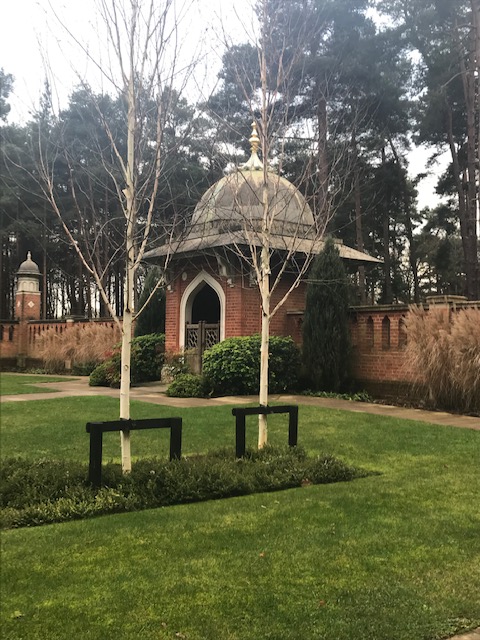
At the Monument Road Bridge, before you hit the industrial zone of Sheerwater, surface from the towpath and take a right, cross the road and you will see an oddly placed architectural curiosity – the Peace Garden, or the old Muslim Burial Ground, pictured right. Although not built until 1917, so not in Wells’s Woking, this is a must stop. Located among tall pine trees and not far from the busy arterial road, the red-bricked walled enclosure is a haven; a secret garden, with benches surrounding a gently burbling, immaculate water feature and flowering borders, more befitting of Wisley gardens, than the edge of an industrial estate. Take time to sit and enjoy, whatever time of the year. The tranquillity and peace is surprising, making it difficult to drag yourself away; blissfully forgotten are the incessant amber threat warnings that dog our daily lives, the tedium of our technological world. From there, the myriad of woodland paths make the map guide somewhat redundant, so you may have to resort to Googlemaps (and re-embrace technology) to find slightly more accurate guidance. We found ourselves ducking through some holly bushes and rampantly overgrown ivy, into a pleasant suburban street of large detached houses, accompanied by ‘oh how the other half lives’ musings, before finding ourselves back on track, crossing Woodham Lane and heading for the Sands at Bleak House restaurant and bar.
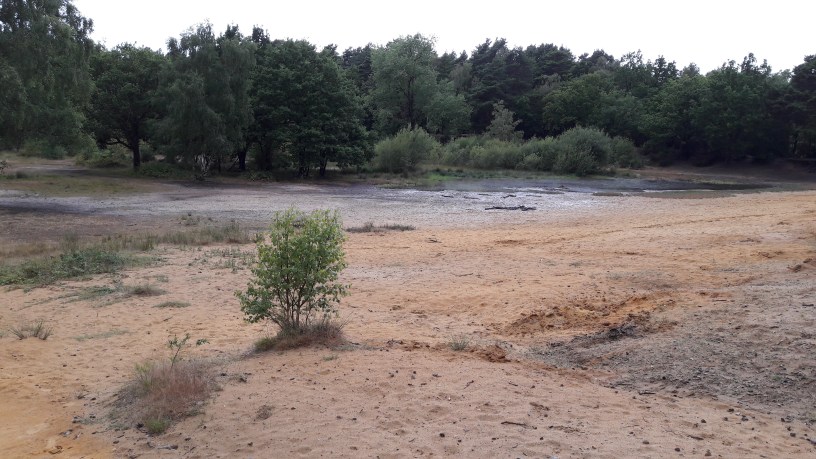
Still on the main road, but facing the common, this could be the first pitstop for some refreshment; popular with perennial ‘lunchers’ or McLaren execs, as it offers a gourmet- style dining experience, or rather, £10 sandwiches with an obligatory sprinkling of rocket, if you stop off for lunch. Cross the road, and you then find yourself on glorious Horsell common, heading for the sandpits, where the Martians in Wells’s imagination first landed.
“In addition, a large number of people must have walked from Woking and Chertsey, so that there was altogether quite a considerable crowd – one or two gaily dressed women among the others.”
Even without a Martian landing attraction, Horsell common is as popular now as it was then. The car parks are often overflowing, full of muddy dogwalkers, toddlerwalkers, joggers and flab-busting strollers. Protected now by the omnipotent Horsell Common Preservation Society, who do their best to subdue more mundane invasive species such as gorse and pine, the common is an outstanding expanse of tree and heather landscapes, with trails that reach to Chobham and Ottershaw commons and beyond.
The heritage trail doesn’t take you very far in, as the sandpits are just off the central path that traverses the main common, but they are its heart. It doesn’t take much imagination to see how Wells got the idea of an extra-terrestrial cylinder landing here, resting in an apparent impact crater. Now, it’s a popular picnic place and play area for dogs and kids, in all seasons. There are a few hand-carved benches around the edge, allowing you another opportunity to take a breather and contemplate, however this time it’s hard to do so without thoughts of, “what if aliens did …” Maybe incited by over-excited yapping dogs and screaming children, intent on destroying the peace.
The walk circles around and then takes you across the main road back towards the town via Wheatsheaf common. Mentioned in the novel, and therefore familiar to Wells, this is a small area of mostly woodland and marsh, sandwiched between the main roads and quiet suburban streets, leading to the Wheatsheaf pub where you can stop again for refreshment and only pay £5 for a sandwich, although probably without rocket, before hitting the town centre.
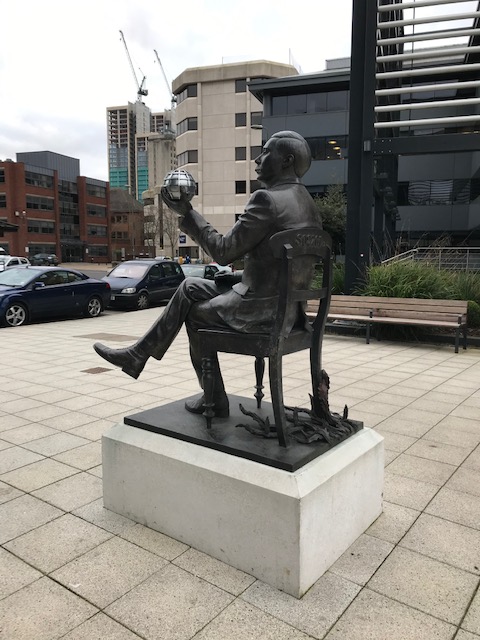
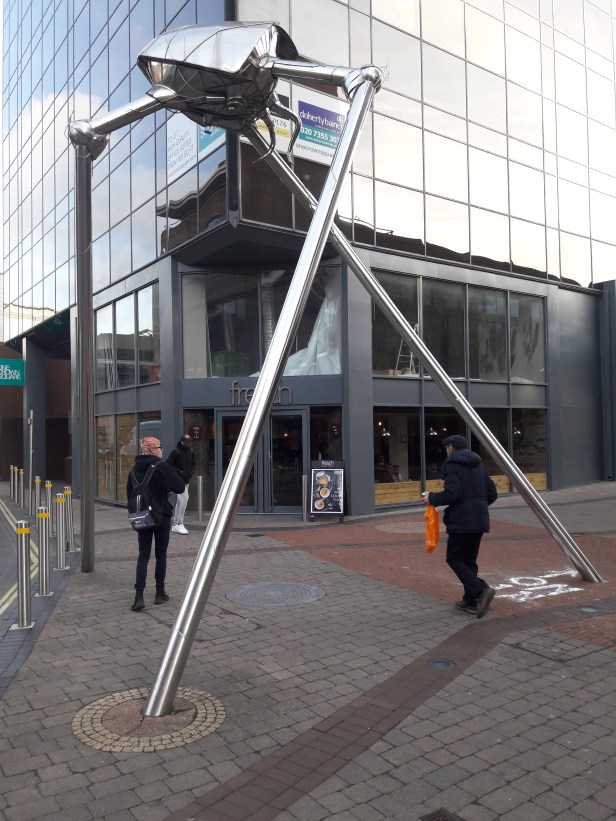
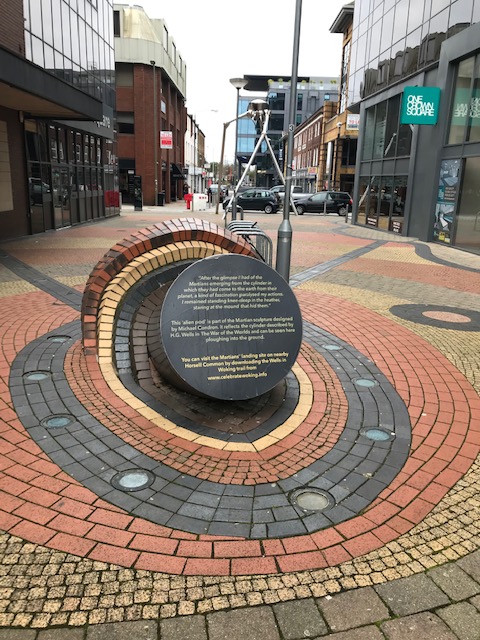 Here, from the subway under Victoria Way in, old meets new and fact meets fiction as it’s hard to avoid Wells’s impact – there’s a rather good statue of Wells, seated, contemplating a globe, now rather ironically, under the towering cranes of the new high rise buildings. There’s a seven-metre high tripod making its way towards the town centre, where you will also see the silhouette of a tripod on the town gates. The walk concludes at the Herbert George Wells Wetherspoons, surprisingly classically decorated and dedicated to Wells’s works and historic Woking, since it is more renowned for clientele who enjoy a vodka or two with their full English breakfast, getting pissed up on two for one cocktail specials and cheap lager, and musing on ‘Love Island’ rather than alien invasion shenanigans.
“I go out onto the Byfleet Road and vehicles pass me, a butcher boy in a cart, a cabful of visitors, a workman on a bicycle, children going to school, and suddenly they become vague and unreal, and I hurry again … through the hot brooding silence.”
It occurs to me that things haven’t changed at all since Wells walked these streets and common paths, and it’s not difficult, in fact, to understand where his inspiration came from. Maybe he took to wandering the common for the same reason we do; to escape the daily trials and stresses of a post-industrial revolution growth economy, where continuous construction, expansion, and travel disruptions grind and gnaw like toothache. He too may have developed a loathing of mankind’s madness, greed and vanity, yearning a cataclysmic event that would stop the world in its tracks and allow those remaining to start again. Perhaps then, we can take inspiration from Wells, knowing that his experiences were no lesser or greater than our own, and that they are only overcome by the power of the imagination.
 Woking Writers Circle