
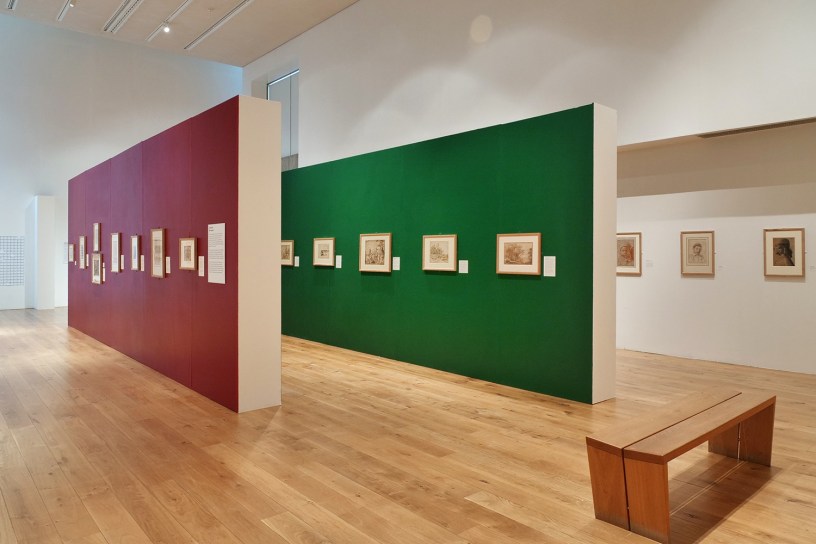
by Carla Scarano D’Antonio
The impressive new exhibition at the Lightbox in Woking features over 60 drawings by Old Masters from the Devonshire collection at Chatsworth. The outstanding collection at Chatsworth House was started by the second Duke of Devonshire and includes paintings, furniture, ancient coins, sculptures, jewellery, metalwork and textiles as well as Master drawings and prints. The history of Chatsworth House begins with Elizabeth Talbot, Countess of Shrewsbury, who married Sir William Cavendish in 1547. They built the first house, which underwent major changes in the 19th century. The house and the collection were greatly improved by the sixth Duke of Devonshire and opened to the public in the 20th century. The refurbishment of the house and some business failures forced sales of some of the collection, such as Shakespeare’s folios and quartos. In the past and right up until today, the dukes of Devonshire have confirmed their passion for collecting art and continue to expand their collection with contemporary artworks.
The master drawings on display in the main gallery of the Lightbox have been carefully chosen and range from the 15th to the 18th century, with works by Raphael, Leonardo, Parmigianino, Rembrandt, Dürer, Bruegel, Claude Lorrain, Anthony Van Dyck and others. Their works are divided in loose sections under titles such as Human Figure, Religion, Landscape and Classical Mythology and there is also an interesting video and a display about drawing materials and techniques at the end of the exhibition.
Although the artists used drawings to explore ideas, organise their final artwork and try new perspectives before completing their paintings, most of the pieces on display look like finished works that have been executed with impeccable precision in black or red chalk, metal point, a mix of pen and ink, and a wash or watercolour. The use of chiaroscuro (light and shadow) reveals the expert skills of the artists; indeed, this technique sometimes shapes the figures better than colours or paints. Some of the works are sketchier, like the ones executed in brown ink and a wash, and they are supposed to give a first or general idea of the future painting, such as Francesco Solimena’s ‘Heliodorus Driven from the Temple’. The textures of the drawings are complex and multi-layered; they convey emotions in the human figures and express subtle movement in the landscapes. Pictures such as Raphael’s ‘Venus Seated on clouds’ and Leonardo’s ‘Leda and the Swan’ not only refer to Greek mythology and pay tribute to classical traditions but also depict the ideal female beauty in a dynamic way that epitomises the renewed interpretation of ancient art by the major artists of the Italian Renaissance.
Drawings were less expensive and quicker to do than paintings, especially the sketches of landscapes in ink and a wash; they also presented an image of the future completed work to the eventual client. Nevertheless, pieces such as Moretto’s ‘A Woman’s Head with Braided Hair’ and Carracci’s ‘A Hunch Back Boy’ that are on display can be considered mature, finished works. They convey definite emotions, for example in the pensive expression and slightly reclined head of the woman and in the evident physical disability of the boy, and in the inscription ‘Non so se Dio mi aiuta’ (‘I don’t know if God helps me’). The landscapes are particularly fascinating in their unfinished impressionistic quality, which is so near to modern taste and today’s painting practices.
At the end of the exhibition there is the opportunity to contribute to a copy of ‘St Gregory Attended by Angels Praying for Souls in Purgatory’ by Annibale Carracci by sketching on a Post-it note a small square of the drawing and sticking it on a panel in a collaborative reproduction.
The extensive exhibition at The Lightbox greatly contributes to our understanding of master drawings and the skills and role of the artists in the execution of their own artworks. The preparatory sketches and drawings envisaged the major paintings that would follow and might appear today to be even more attractive than the final works.
Lines of Beauty: Master Drawings from Chatsworth, The Lightbox, Woking, 21 August–5 December 2021
 Woking Writers Circle