

by Carla Scarano D’Antonio
Chantal Powell and Dean Melbourne are two contemporary artists who work in the fields of mythology and alchemy. Their artworks in the Upper Gallery exhibition at the Lightbox in Woking are powerful and dense with symbolism, tracing a journey from a dark challenging period to recovery. Powell’s and Melbourne’s pieces are on display along with works from the Ingram Collection that inspired them or are connected to their process of self-discovery and link their work to the wider art world.
The NightShaking project is an artistic journey that encouraged the two artists to explore their personal lives. Their pieces are linked to alchemy for Powell and mythology for Melbourne. They both investigate the ‘dark night of the soul’, exploring their unconscious, and working with archives to develop their knowledge of myths and legends as well as their unconscious process related to these stories. It is a thought-provoking, mysterious process that is intended to express a poetic and personal journey from darkness to light. Archetypical images are evoked in Powell’s work that connect to a world in continuous transformation beyond the logical and realistic perception of our reality. For Melbourne traumatic experience implies the creation of an alter ego that produced his artwork. This experience is linked to the magical world of myths and folk tales. His pieces go from apparently controlled geometrical shapes to looser ink marks on paper.
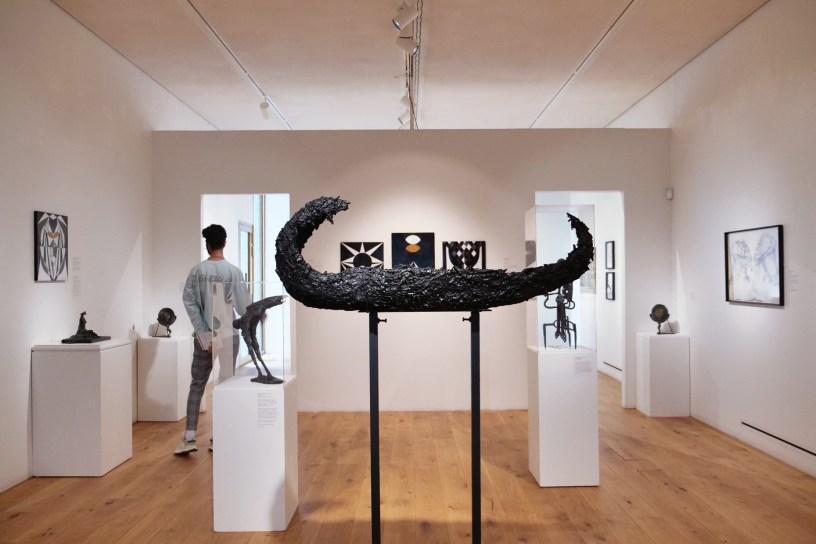
‘The Night Journey’ in hay, wire, straw and bitumen, by Chantal Powell – who has a PhD in social psychology – features a boat that suggests ancient vessels and is connected to ‘Bird’ by Elisabeth Frink. The sculpture is unsettling in its darkness and fragmented texture and links to the theme of the night sea journey, the moment of passage between dark and light. This journey implies encounters with the spirits of the underworld that speak to the living and offer them wisdom. The sculptures that represent this phase are round bronze pieces (‘Antecedent I and II’) with a serpent tail that represents the vision of the winding path that brings renewal. In the second room this recovery is displayed in the ‘Mandala Chambers’. They symbolise the ‘labyrinthine journey of the unconscious’, as Powell states in the caption. They are made of clay, then burnt in a bin, which is a process that highlights the alchemy of transformation. The results are in part unpredictable; it is a way to let go and trust the method. Some of the clay mandala may break, others are more beautiful and alchemical. They become a reflection of the self, of sorts. In the second room there are also the ‘Dogon Ladders’ in black and golden bronze. They are both symbolic and real. The ladders are used in the material world but are also symbols that represent ascending and descending movements. They also connect to the natural world; in Mali the Dogon people carve ladders out from naturally forked trees. They have a simple, almost abstract form that is both artistically appealing and meaningful.

Dean Melbourne’s process is complex in his double approach of loose work and geometrical paintings, which represent a way to control his dark side. His untitled works ‘illustrate the process of reduction’ as Melbourne, a Midlands painter based in the Black Country, worked through symbolic divinations that he meant to be a ‘porthole into the depth’. The pieces refer to a mythological journey into the underworld, the depth of a troubled unconscious. Marks trace an uncertain world full of haunting images and undefined subjects.
‘Crown’ is an outstanding piece. It describes the relationship of the artist with his own self-importance. As Melbourne remarks in the caption, it is the ‘less palatable side of my ego and vanity’. The piece is a re-assemblage of fragments from the destruction of an old painting in order to create the renewal that comes from a process of annihilation and reappropriation of a new self. There are two inverted golden triangles at the top of the painting representing an inverted crown and therefore an inverted self – that is, a change from who he was before. Thus, the re-assemblage present in the painting symbolises the reconstruction of the self in a journey that brings both to self-discovery and renewal. Reaching the end is an ongoing process that never ends. This enthralling exhibition guides the visitors in this journey where light emerges from darkness and engenders the possibility of regeneration.
NightShaking with the Ingram Collection, The Lightbox, Woking, 10 July-19 September 2021
 Woking Writers Circle