
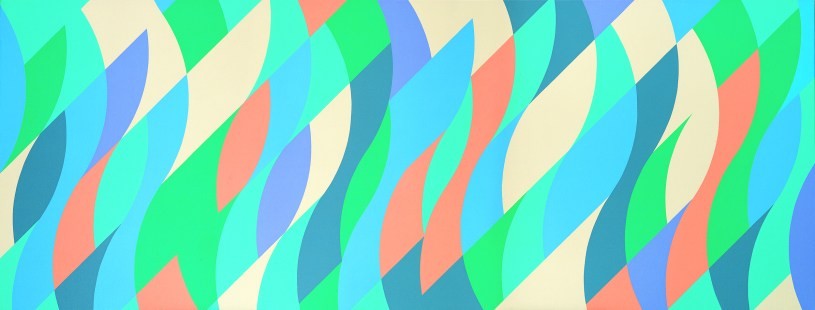
Bridget Riley’s long and remarkable 70-year career is examined at the Lightbox’s exhibition to commemorate her 90th birthday. Her abstract compositions develop in triangles, oblong shapes, circles, spirals and above all stripes that evoke natural phenomena such as the sound of the wind and the movement of the waves. The secret of her success is incessant fresh experimentation in paintings and prints. Riley wishes to involve the viewer in an emotional experience that might trigger new perspectives of seeing. During the 1960s this dynamism was conveyed in optical illusions through colours and geometric forms in black and white, and then in the 1980s and 1990s in the use of greys and in the contrast between warm and cool shades.
A keen observation and profound analysis of what surrounds her, especially of the natural world, form the basis of her art and her method. Riley spent her childhood in Cornwall then moved to London, where she studied at Goldsmiths College (1949–1952) and at the Royal College (1952–1955). Her early works are figurative in an impressionist style, as in ‘Women at Tea Table’, which is on display at the Lightbox. She then moved on to study Georges Seurat’s pictures, copying his pointilliste style, although she was not happy with the results. She felt that pointillism did not allow her to express her sensations or to understand the environment.
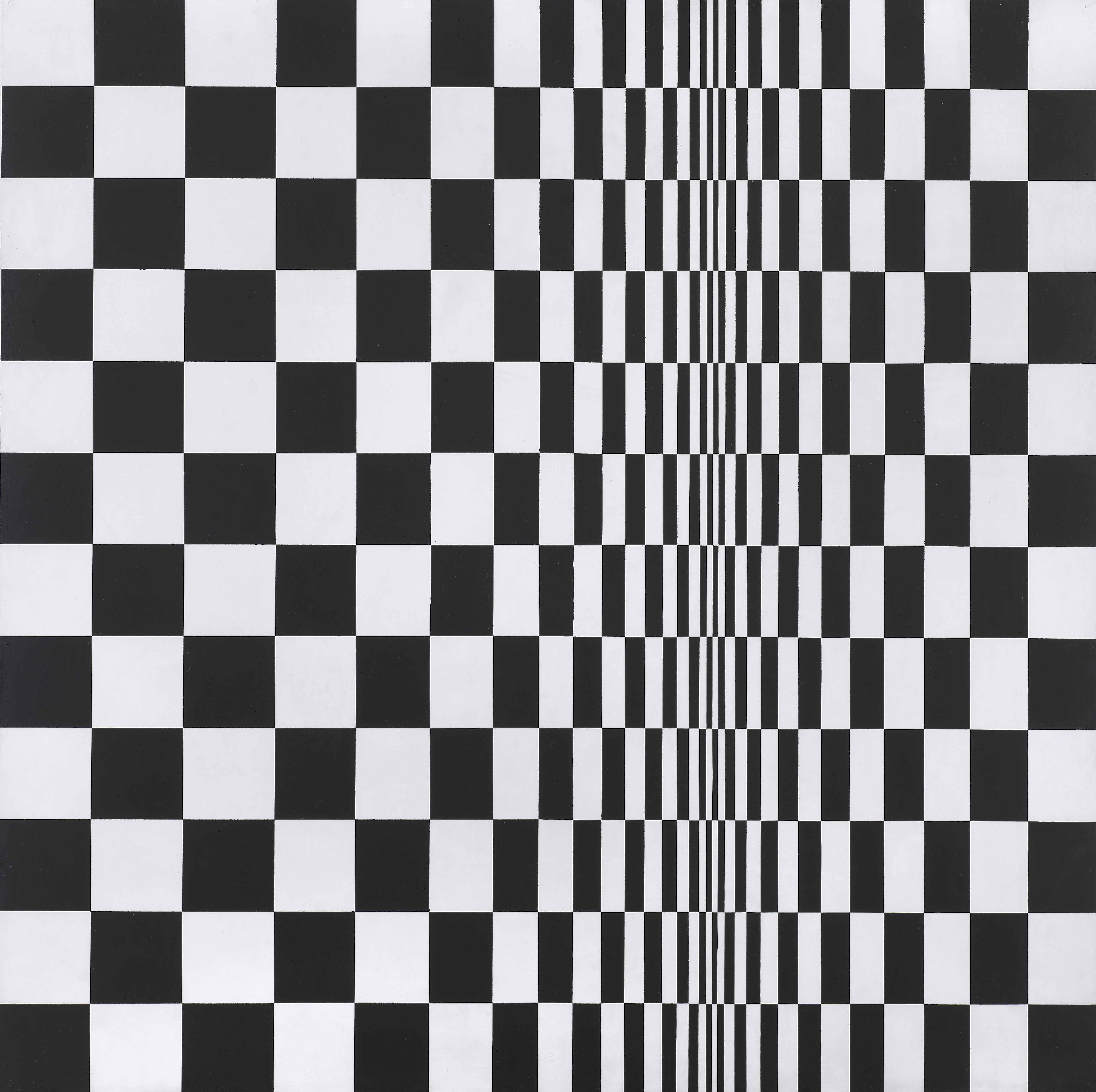
In the 1960s there was a great desire for change after the horrors of the second world war. Riley saw the works of famous painters such as Cézanne and Mondrian and abstract painters such as Rothko and Pollock. Their work led her to abstract experimentation in black and white paintings, such as ‘Movement in Square’ (1961) and ‘Untitled (Oval Image)’ (1964). She produced dynamic movement on flat surfaces, expressing the forces present in nature, rather creating a landscape or a narrative. This movement was labelled Op Art, and it emphasises the effect of optical illusion within the works. However, Riley’s art was more complex; Op Art was a way to explore and understand her sensations and to involve the viewer in a fresher experience of sight. According to Riley, the viewer completes the artwork in the act of seeing, contributing to their own perception, which is personal and different. As she often remarks, her inspiration came from the movement of water and in the rhythm of wind that create repetitive patterns and, at the same time, shape and reshape the surfaces, suggesting continuous change.
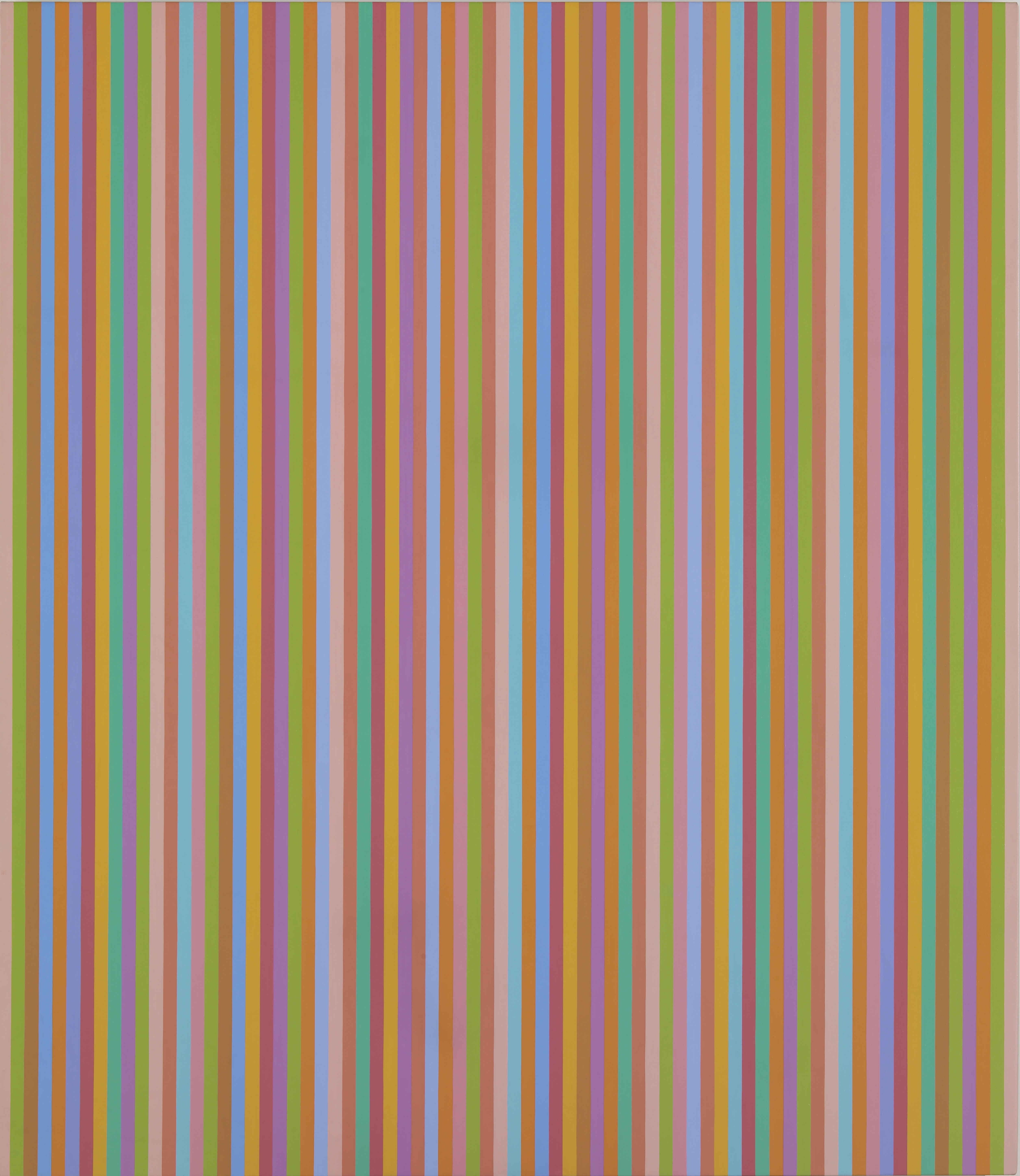
The effect of this interaction between colours and forms in movement was compared to the effects of seasickness and sky diving; they destabilise the viewer in order to induce a different experience that, according to Riley, evokes the pleasures of sight. From the 1970s she also explored relationships with colours, especially in the use of complementary colours alternated with greys. In the early 1980s she travelled to Egypt and created an Egyptian palette while studying the ancient hieroglyphs in the Valley of the Kings, in which the figures are organised in a sort of procession that the artist repeats in the stripe format, such as in ‘Green and Blues with Red (Orange Contrasts, 1985)’.
Riley has dedicated her life to her art, which she called ‘a vehicle for my life’, a mission of sorts or a vocation that follows precise steps and a methodology that is simultaneously disciplined and open to further discoveries. Her ‘pleasure of sights’, as she stated in the 1984 essay with the same title, implies physical and mental pleasures, the joy of living and being alive that are based on intuitions and sensations, and she aims to understand and convey these feelings and consequently share the experience with the public. As she remarks in the essay, light has ‘elusive, unstable, flicking’, complex qualities that contribute to changing effects. This revelation of sorts ‘takes you by surprise’. These changes are ‘sudden, swift and unexpected’ and are the result of ‘a perfect balance between […] the inner and the outer’. This experience is mystical and contingent; it resists tales and aims for ‘pure sight’, a theory that combines spiritual and bodily involvement. As Paul Moorhouse remarks in his book Bridget Riley: A Very Very Person(2019), her work is ‘rooted in personal expression and expressed a personality’.
In her recent works, Riley revisits past sketches and folios, creating new choreographic effects in her extended murals produced for the Tate, the Musée d’Art Moderne de la Ville de Paris and the National Gallery. In 2014 the Imperial College Healthcare Charity Art Collection commissioned her to make a permanent 56 metre-long mural for St. Mary’s hospital in London, and in 2017 a striped mural was installed in army barracks in Texas, Riley’s largest work that reproduces her Egyptian palette.
Her artwork has been extensively exhibited both in Europe and in the US in group, solo and retrospective exhibitions. Her long career has developed in different directions; sometimes she contrasts forms and colours and at other times she merges them. She was always enthusiastic and hungry for observation and experimentation, making continuous progress towards fresh visions, evolving into new enthralling discoveries that might be unsettling but are also striving to attain a new harmony. Her artwork seems alive, similarly to the natural phenomena she is inspired by. Her work can be considered simultaneously poetic and controlled and evoking vitality and a dream, as well as having a stable symmetrical structure; it is a form of progress that envisages the coexistence of apparently opposing views. What is definite is that she does not stop to surprise the viewer and relentlessly triggers new visions. These multifaceted and ever-changing aspects of Riley’s work are thoroughly explored at the Lightbox exhibition, immersing the viewer in the wonders of her work.
Bridget Riley: The Pleasures of Sight, The Lightbox, Woking, 18 December 2021–10 April 2022

 Woking Writers Circle