

by Carla Scarano D’Antonio
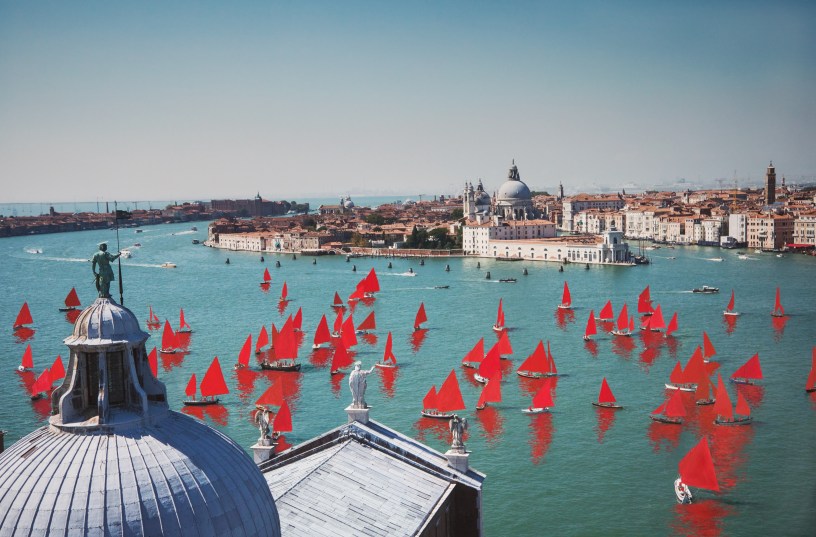
Two artists are in conversation in this Lightbox exhibition: the famous Venetian landscape painter Giovanni Antonio Canal (1697–1768), known as Canaletto, and the contemporary American New York-based artist Melissa McGill (b. 1969), who was involved in the public art project ‘Red Regatta’ in 2019 that was supported by Associazione Vela al Terzo Venezia. This collaborative project, co-organised by Magazzino Italian Art and curated by Chiara Spangaro, increased awareness of environmental issues connected with the maritime history of Venice and its present and future conditions. Venice is slowly sinking despite the measures and expensive structural works implemented in the past decades. Rising sea levels, excessive flooding and changes in the ecosystem of the lagoon, caused by global warming and climate change, have worsened the situation. Mass tourism may also be an additional problem that discourages local people from living in the city, leaving it to tourists. The project aims to document these issues and envisage a better future for Venice that is in harmony with its past and with the present urgencies at social and environmental levels.
The project started in May 2019 and included workshops and public programmes in collaboration with partners; the aim was to protect Venice and the sea through education and active programmes. In the final regatta, 52 traditional Vela al Terzo boats with hand-painted red sails sailed in the lagoon. The Vela al Terzo boat dates back to 1,000 years ago and features a flat bottom and a removable mast designed to fit Venice’s waterways. The many shades of red (rosso veneziano) of the sails refer to passion, the urgency of the issue and to Venice itself – its bricks and terracotta rooftops and its flag – and to the colour red in the paintings of Titian, Tintoretto and other Venetian masters.
McGill lived in Venice from 1991 to 1993 and often returns to the city. Her connection with Venice was also developed in her previous work ‘The Campi’ (Squares, 2017). The artworks are soundboxes, that is, music boxes of sorts, that voice the sounds and memories of the places. The box ‘Santa Maria Nova’ is on display at the Lightbox exhibition; its sounds immerse the viewers in the Venetian atmosphere, accompanying them throughout the display.
The exhibition displays 20 paintings, prints and drawings by Canaletto and 16 works by Melissa McGill that are mostly connected to the ‘Red Regatta’ project. They include a documentary film, hand-painted photography, a glass installation and watercolours. Canaletto was famous for his landscapes and Venetian scenes, minutely and precisely painted, that looked like photos but actually combined real and imagined spaces. His pictures were commissioned and purchased by aristocrats and rich merchants whose life he celebrated in elegant and rationally structured settings. He was in England from 1746 to 1756 working for aristocrats and wealthy people and applying the same style and techniques he used in the Venetian vedute (views) to the English landscape, though he adapted the colours to the new setting. He was not only famous for his oil paintings but was also an expert in etching and printmaking.
In his ‘A View of Walton bridge’ (1754) commissioned by Thomas Hollis, who is depicted in the foreground dressed in yellow, the precision of the architectural structure of the bridge and the landscape in perspective contrast in part with the impressionistic rendering of the human figures depicted in dots. The tones are cooler and the light more sombre than in the Venetian views and the rich but composed vegetation replaces the edifices. It is known that Canaletto used a camera obscura (dark chamber), an optical device in the shape of a box, tent or room with a hole on one side and a lens attached; it was the forerunner of the photographic camera. The image of the landscape was projected onto paper and therefore allowed more accurate and realistic drawings, almost photographic ones. These kinds of drawings were found in Canaletto’s quaderno (sketchbook). However, in his final oil paintings, Canaletto interpreted these views, enlarging important monuments, for example, and combining different viewpoints. In his capricci, some examples of which are on display at the exhibition, he depicts imaginary buildings that were probably inspired by some of his camera obscura drawings. He used this device more as a guide rather than to dictate his artwork.
Melissa McGill’s mesmerising artwork has a historic parallel with the work of Canaletto in the emphasis on the importance of the setting, the relation with the sea and the dynamic performative essence that engages people with the environment. The panoramic scale of the ‘Red Regatta’ has a vibrant, vigorous quality that relates this enthralling collaborative project to climate change issues and its effects on the city. In previous projects McGill expressed her focus on environmental issues and on community as well; for example, in ‘In the Waves’ (2021), a live art performance that evoked the issue of rising sea levels and climate change, and in the proposal to replace the Indian Point nuclear power plant with cherry trees that link to the ephemerality of nature and to Japan’s history with atom bombs. Her artwork is therefore an immersive and sharing experience that is done in a wide variety of media.
At the Lightbox exhibition, the photos of the reflections of the myriad of red sails in the blue-green water of the lagoon have an almost abstract rendering that emphasises this immersive dynamic experience. These photographs are the core of the work ‘Riflessi’ (reflection) that reflects the theme of the ‘Red Regatta’ and develops it in a sculptural way. Canaletto’s attentive observations are therefore reiterated from a different perspective in McGill’s work, emphasising the relation with the environment. The hand-painted photographs of the sails of the ‘Red Regatta’ and the ‘Riflessi’ series work together with the ‘Venetian Lagoon Studies’ (2020), which are in watercolour and in which the different shades of the greens of the lagoon are skilfully depicted, evoking the myriads of lights and shadows that play in the water.
In their artworks, both Canaletto and McGill engage closely with Venice at a social and historical level 250 years apart. They explore the city’s potentials and vulnerability in conversation with each other and with the environment. Their places are real and imagined at the same time, and McGill’s pieces are committed to raising awareness of a more sustainable future for Venice. The artists’ scenes immerse the viewer in the fascinating Venetian reality that has surprised and stupefied visitors for centuries – and still does to this day.
Canaletto and Melissa McGill: Performance and Panorama; The Lightbox Main Gallery, Woking, 16 July–13 November

 Woking Writers Circle